Sigiswald Kuijken - Handel: Alessandro (2011)
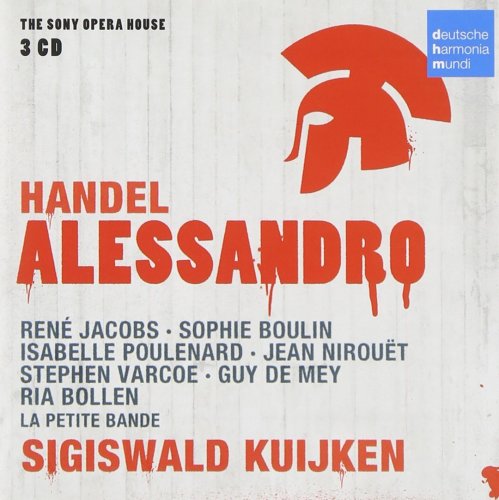
Artist: Sigiswald Kuijke & La Petite Bande
Title: Handel: Alessandro
Year Of Release: 2011
Label: Deutsche Harmonia Mundi / Sony Music Classical
Genre: Classical
Quality: FLAC (image + .cue, log, artwork)
Total Time: 03:27:02
Total Size: 934 MB
WebSite: Album Preview
Tracklist:Title: Handel: Alessandro
Year Of Release: 2011
Label: Deutsche Harmonia Mundi / Sony Music Classical
Genre: Classical
Quality: FLAC (image + .cue, log, artwork)
Total Time: 03:27:02
Total Size: 934 MB
WebSite: Album Preview
CD 1
01. Ouverture
02. Atto I. Recitativo: E tanto ancor s'indugia (Alessandro)
03. Sinfonia e Accompagnato: Ossidraca superba (Alessandro)
04. Recitativo: Grazie all'eterno Giove (Leonato, Alessandro)
05. Aria: Fra le stragi e fra le morti (Alessandro)
06. Recitativo: Che vidi! - Che mirai! (Lisaura, Rossane)
07. Recitativo: Ecco Tassile, il Re degl'Indi (Lisaura, Rossane, Tassile)
08. Aria: Quanto dolce amor saria (Lisaura)
09. Recitativo: Ne'trofei d'Alessandro (Rossane)
10. Aria: Lusinghe piu care (Rossane)
11. Recitativo: Sventurato ch'io sono! (Tassile)
12. Aria: Vibra, cortese Amor, un'altro strale (Tassile)
13. Recitativo: Fra le guerre - Chi t'agguagli (Alessandro, Tassile, Leonato, Cleone, Clito)
14. Recitativo: Apprestasi, oh Cleone (Alessandro, Cleone)
15. Recitativo: Dalla vittoria alla bellezza (Alessandro, Cleone, Rossane, Tassile, Lisaura)
16. Aria: No, piu soffrir non voglio (Lisaura)
17. Recitativo: Vilipese bellezze (Rossane)
18. Aria: Men fedele, e men costante (Alessandro)
19. Recitativo: Si, lusingando ei parla (Rossane)
20. Aria: Un lusinghiero dolce pensiero (Rossane)
21. Recitativo: Tu, che Rossane adori (Clito, Cleone, Leonato)
22. Aria: Pregi son d'un alma grande (Leonato)
23. Recitativo: Sempre del suo valor, fido seguace saro (Clito)
24. Aria: A sprone, a fren leggiero un nobile destriero (Clito)
CD 2
01. Sinfonia
02. Recitativo: Al magnanimo, al forte, al vincitore (Cleone)
03. Recitativo: Primo motor delle superne sfere (Alessandro)
04. Recitativo: Figlio del Re degl'immortali (Alessandro)
05. Duetto: Placa l'alma, quieta il petto! (Rossane, Lisaura)
06. Recitativo: Fra gli uomini e fra i Numi (Alessandro)
07. Aria: Da un breve riposo di stato amoroso (Alessandro)
08. Atto II. Recitativo: Solitudini amate (Rossane)
09. Arioso: Aure, fonti, ombre gradite (Rossane)
10. Recitativo: Eccola in preda al sonno (Alessandro, Lisaura, Rossane)
11. Aria: Vano amore, lusinga, diletto (Alessandro)
12. Recitativo: Tiranna passion, lasciami in pace (Lisaura, Tassile)
13. Aria: Sempre fido e disprezzato (Tassile)
14. Recitativo: Pur troppo veggio d'Alessandro (Lisaura)
15. Aria: Che tirannia d'Amor! (Lisaura)
16. Recitativo: Qui aspetto l'incostante (Rossane, Alessandro)
17. Aria: Alla sua gabbia d'oro suol ritornar talor (Rossane)
18. Recitativo: Vincitor generoso (Alessandro)
19. Aria: Risolvo abbandonar la belle che mi sprezza (Alessandro)
20. Recitativo: Finto sereno e Alessandro in volto (Lisaura)
21. Aria: La cervetta nei lacci avvolta (Lisaura)
CD 3
01. Recitativo: Dopo il sublime onor (Alessandro, Clito, Tassile, Cleone)
02. Recitativo: Oh Dei! che infausta nuova! (Rossane, Alessandro)
03. Aria: Il cor mio, ch'e gia per te (Alessandro)
04. Recitativo: Svanisci, oh reo timore (Rossane)
05. Aria: Dica il falso, dica il vero (Rossane)
06. Atto III. Arioso: Sfortunato e il mio valore (Clito)
07. Recitativo: L'adulador s'appressa (Clito, Cleone)
08. Recitativo: Renditi, o muori (Leonato, Cleone, Clito)
09. Aria: Saro qual vento, che nell incendio spira (Cleone)
10. Recitativo: La resa liberta dunque, oh Rossane (Rossane)
11. Aria: Si, m'e caro imitar quel bel fiore (Lisaura)
12. Recitativo: Sento un'interno inusitata gioja (Rossane)
13. Aria: Brilla nell'alma un non inteso ancor (Rossane)
14. Recitativo: Qual tormento crudel (Lisaure, Alessandro)
15. Aria: L'amor, che per te sento (Lisaura)
16. Recitativo: E qual fisso pensier (Tassile, Alessandro, Rossane)
17. Aria: Pupille amati, voi m'insegnate a trionfar (Alessandro)
18. Recitativo: Numi eterni (Rossane)
19. Aria: Tempesta e calma sento nell'alma (Rossane)
20. Coro: D'uom fiero nel soglio (Clito, Leonato, soldati)
21. Recitativo: Chi osera traditore (Alessandro)
22. Aria: Prove sono di grandezza (Alessandro)
23. Recitativo: Spegni o supremo Regnator de'Numi (Rossane, Lisaura, Tassile)
24. Recitativo: Si festeggi il bel giorno (Alessandro, Rossane)
25. Duetto: In generoso onor (Alessandro, Lisaura)
Sigiswald Kuijken has been a pioneer in performing and teaching Baroque violin technique. He and his brothers were all exposed to early instruments as youngsters. Sigiswald and Wieland intuitively taught themselves how to play the viola da gamba. Sigiswald studied violin at the conservatory in Bruges, then in Brussels with Maurice Raskin, earning his degree in 1964. After doing his own research into Baroque performance practice, Kuijken began playing Baroque works on the violin without using a chinrest or shoulder rest and, in fact, not using his chin at all to hold the instrument. He began teaching this method, and others quickly adopted it. Kuijken performed with the Alarius Ensemble between 1964 and 1972, and then at the encouragement of the Deutsche Harmonia Mundi label and Gustav Leonhardt, founded his own orchestra, la Petite Bande, to perform Baroque and Classical works. He has traveled throughout Europe, North America, Australia, China, and Japan with la Petite Bande, and together they have recorded works by Lully, Pergolesi, Mozart, Haydn, Bach, and Geminiani. He also undertook more independent projects with others, such as his brothers Wieland and Barthold, Gustav Leonhardt, Robert Kohnen, Anner Bylsma, Frans Bruggen, and Rene Jacobs. In 1986, he and his brother Wieland founded the Kuikjen String Quartet with Francois Fernandez, Marleen Thiers, and sometimes joined by violist Ryo Terakado, specifically to perform Classical period quartets and quintets. That same year, Kuijken conducted the inaugural concert in London of the Orchestra of the Age of Enlightenment. Kuijken taught Baroque violin at the Koninklijk Conservatorium in The Hague (1971-1996) and at the Koninklijk Muziekconservatorium in Brussels (since 1993). He is frequently invited to teach at the Royal College of Music in London, Salamanca University, and the Accademia Chigiana in Siena, among other schools. In the late 1990s, he began doing more conducting of modern orchestras in works of Mendelssohn, Schumann, and Brahms. Ongoing projects include the sonatas of Mozart, plus Mozart's and Debussy's chamber music with his brothers, and Bach's cantatas with La Petite Bande between 2006 and 2012. -- Patsy Morita
Related Releases:
![Brand X - Livestock (1977) [Vinyl]](https://www.dibpic.com/uploads/posts/2026-09/1789406652_0077778711650_600.jpg "Brand X - Livestock (1977) [Vinyl]")
![Twoosty Mayonez - Astrocyrk (2026) [Hi-Res]](https://www.dibpic.com/uploads/posts/2026-09/1789439189_cover.jpg "Twoosty Mayonez - Astrocyrk (2026) [Hi-Res]")
![Peter Asplund, Lars Jansson, Emmalisa Hallander - In One Breath (2026) [Hi-Res]](https://www.dibpic.com/uploads/posts/2026-09/1789485868_folder.jpg "Peter Asplund, Lars Jansson, Emmalisa Hallander - In One Breath (2026) [Hi-Res]")