Marlboro Festival Orchestra, Pablo Casals - J.S. Bach: The Brandenburg Concertos Vol.1 & 2 (1990)
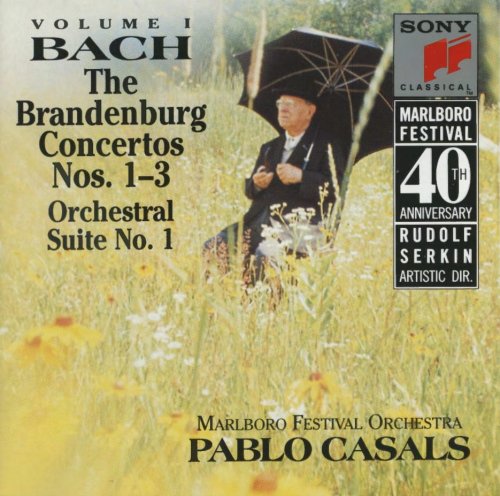
Artist: Marlboro Festival Orchestra, Pablo Casals
Title: J.S. Bach: The Brandenburg Concertos Vol.1 & 2
Year Of Release: 1990
Label: Sony Classical
Genre: Classical
Quality: FLAC (image+.cue,log,scans)
Total Time: 02:26:03
Total Size: 761 Mb
WebSite: Album Preview
Tracklist: Title: J.S. Bach: The Brandenburg Concertos Vol.1 & 2
Year Of Release: 1990
Label: Sony Classical
Genre: Classical
Quality: FLAC (image+.cue,log,scans)
Total Time: 02:26:03
Total Size: 761 Mb
WebSite: Album Preview
Vol.1:
01-03 Brandenburg Concerto No. 1 in F major, BWV 1046
04-06 Brandenburg Concerto No. 2 in F major, BWV 1047
07-09 Brandenburg Concerto No. 3 in G major, BWV 1048
10-16 Orchestral Suite No.1 in C major, BWV 1066
Vol.2:
01-03 Brandenburg Concerto No.4 in G major, BWV 1049
04-06 Brandenburg Concerto No.5 in D major, BWV 1050
07-09 Brandenburg Concerto No.6 in B flat major, BWV 1051
10-14 Orchestral Suite No.4 in D major, BWV 1069
Performers:
Marlboro Festival Orchestra
Pablo Casals (conductor)
Casals was one of the very few conductors, and certainly the first, to record the complete Brandenburgs twice – in 1950 with his Prades Festival Orchestra (Columbia LPs) and in 1964-6 with the Marlboro Festival Orchestra (Sony CDs). Incidentally, don't be fooled by their names into assuming that these were amateur ensembles – both were extraordinary groups of top-flight professionals who would come together to study and play over the summer – the cello section of the Marlboro Festival Orchestra included Mischa Schneider (of the Budapest Quartet), Hermann Busch (Busch Quartet) and David Soyer (Guarneri Quartet). As recalled by Bernard Meillat, while Casals appreciated research into Baroque playing, he viewed Bach as timeless and universal, and insisted that an interpreter's intuition was far more important than strict observance of esthetic tradition. Thus, he shunned old instruments and used a piano rather than the harpsichord heard on every other stereo Brandenburg simply because he found the resources of the piano to be far more expressive. He was also practical, substituting a soprano saxophone in the 1950 Second, not for any artistic reason but simply because the specified trumpet couldn't keep up with his breakneck pace, the fastest on record. While his tempos can be extreme, Casals' precise phrasing and subtle inflection constantly enliven his work, which emerges as warm, rich and intensely human – not surprisingly, the very qualities that distinguished his celebrated performances as the most influential of all cellists. -- Peter Gutmann
![Gong - Flying Teapot (2026) [Hi-Res]](https://img.israbox.com/img/2026-09/14/3o9r65jkluyk4135lakh71vwc.jpg "Gong - Flying Teapot (2026) [Hi-Res]")
![Enzo Favata - Ritornare (2026) [Hi-Res]](https://www.dibpic.com/uploads/posts/2026-09/1789547045_1.jpg "Enzo Favata - Ritornare (2026) [Hi-Res]")
![Rachael Calladine - Soho Elegy (2026) [Hi-Res]](https://img.israbox.com/img/2026-09/18/8zaecmxafga5xwkiq8i09nx9a.jpg "Rachael Calladine - Soho Elegy (2026) [Hi-Res]")