Raphael Wallfisch, Peter Wallfisch - Schumann: Fünf Stücke im Volkston, Adagio and Allegro, Albumblätter (1987)
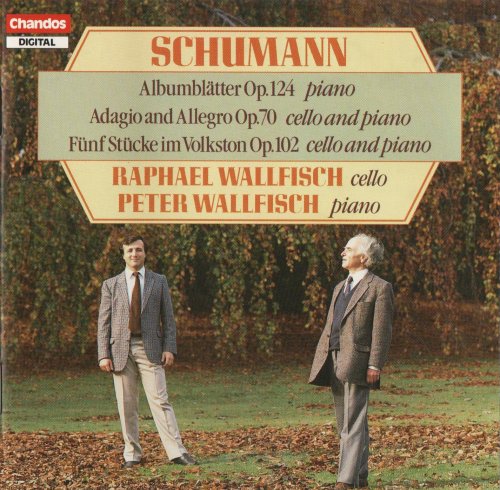
Artist: Raphael Wallfisch, Peter Wallfisch
Title: Schumann: Fünf Stücke im Volkston, Adagio and Allegro, Albumblätter
Year Of Release: 1987
Label: Chandos Records
Genre: Classical
Quality: FLAC (image+.cue,log,scans)
Total Time: 56:59
Total Size: 216 Mb
WebSite: Album Preview
Tracklist: Title: Schumann: Fünf Stücke im Volkston, Adagio and Allegro, Albumblätter
Year Of Release: 1987
Label: Chandos Records
Genre: Classical
Quality: FLAC (image+.cue,log,scans)
Total Time: 56:59
Total Size: 216 Mb
WebSite: Album Preview
Fünf Stücke Im Volkston, Op. 102
01. Mit Humor 3:15
02. Langsam 3:59
03. Nicht Schnell 4:17
04. Nicht Zu Rasch 2:15
05. Stark Und Markiert 3:03
Adagio And Allegro, Op. 70
06. Adagio 5:07
07. Allegro 4:39
Albumblätter, Op. 124
08. Impromptu 1:00
09. Leides Ahnung 1:07
10. Scherzino 1:01
11. Walzer In A Minor 1:09
12. Phantasietanz 0:59
13. Wiegendliedchen 1:51
14. Länder 1:04
15. Lied Ohne Ende 4:40
16. Impromptu 1:10
17. Walzer In E Flat 0:49
18. Romanze 1:18
19. Burla 1:05
20. Larghetto 1:08
21. Vision 0:54
22. Walzer In A Flat 1:01
23. Schlummerlied 4:25
24. Elfe 0:25
25. Botschaft 1:39
26. Phantasiestück 2:23
27. Canon 1:16
Performers:
Raphael Wallfisch - cello
Peter Wallfisch – piano
Raphael and Peter Wallfisch are simpler in their approach to the five folk-style pieces of Op. 102 than Maisky and Argerich, preferring to let the music speak for itself rather than consciously interpreting it. Certainly Argerich makes her presence felt more boldly than Peter Wallfisch. Even if occasionally over-bold, she is the winner in textural clarity, as also in the more natural-sounding reproduction of her piano by the Philips engineers. Of the two cellists, Raphael Wallfisch is grainier in tone, Maisky more assuagingly liquid. Just twice (in Nos. 3 and 5) I questioned Wallfisch's intonation. But he is scrupulously faithful to Schumann's every dynamic marking, as well as very sensitive in phrasing. In the horn-inspired Op. 70 both father and son find all the requisite Innigkeit for the quintessentially Schumannesque Adagio as well as the drive and fire for the Allegro. But in the excitement of the later texture sometimes emerges too thick and blurred.
The second side has the 20 keyboard miniatures of Op. 124 that Schumann—to our infinite gain—salvaged for publication not long before his final breakdown. Here Peter Wallfisch is considerably more introspective than the ebullient Cyprien Katsaris, who recently introduced these pieces to the CD catalogue (CD Teldec 8 43467, 4/87). I prefer Wallfisch's leisure in several of the more personally Schumannesque pieces, not least ''Lied ohne Ende'' (No. 8), the two cradle-songs (Nos. 6 and 16), ''Romanze'' (No. 11), ''Botschaft'' (No. 18) and ''Phantasiestuck'' (No. 19). But his opening ''Impromptu'' is too fast and over-pedalled for clarity of line (certainly those leaning first beats at the start lose all their point). The following ''Leides Ahnung'' is surely far more ominous when played at a consistently sustained slow tempo (and it's not the only piece in which Peter Wallfisch's unrequested rubato seems to defeat its own ends). ''Vision'' (No. 14) is too deliberate for its sehr rasch marking, though at least Wallfisch's caution here results in clearer definition of detail than we get in the sehr rasch of ''Phantasietanz'' (No. 5).
The sound quality brings a further reminder of what a very difficult instrument the piano is to record wholly naturally—even in as sympathetic a venue as The Maltings at Snape.
The second side has the 20 keyboard miniatures of Op. 124 that Schumann—to our infinite gain—salvaged for publication not long before his final breakdown. Here Peter Wallfisch is considerably more introspective than the ebullient Cyprien Katsaris, who recently introduced these pieces to the CD catalogue (CD Teldec 8 43467, 4/87). I prefer Wallfisch's leisure in several of the more personally Schumannesque pieces, not least ''Lied ohne Ende'' (No. 8), the two cradle-songs (Nos. 6 and 16), ''Romanze'' (No. 11), ''Botschaft'' (No. 18) and ''Phantasiestuck'' (No. 19). But his opening ''Impromptu'' is too fast and over-pedalled for clarity of line (certainly those leaning first beats at the start lose all their point). The following ''Leides Ahnung'' is surely far more ominous when played at a consistently sustained slow tempo (and it's not the only piece in which Peter Wallfisch's unrequested rubato seems to defeat its own ends). ''Vision'' (No. 14) is too deliberate for its sehr rasch marking, though at least Wallfisch's caution here results in clearer definition of detail than we get in the sehr rasch of ''Phantasietanz'' (No. 5).
The sound quality brings a further reminder of what a very difficult instrument the piano is to record wholly naturally—even in as sympathetic a venue as The Maltings at Snape.
![Ramsey Lewis - Routes (1980) [Vinyl]](https://www.dibpic.com/uploads/posts/2026-09/1789408304_0886446489384_600.jpg "Ramsey Lewis - Routes (1980) [Vinyl]")
![Charles Mingus - Town Hall Concert 1964 Vol. 1 (2026) [Hi-Res]](https://www.dibpic.com/uploads/posts/2026-09/1789659739_cover.jpg "Charles Mingus - Town Hall Concert 1964 Vol. 1 (2026) [Hi-Res]")
![Niia - V (Goth Jazz Edition) (2026) [Hi-Res]](https://www.dibpic.com/uploads/posts/2026-09/1789659492_cover.jpg "Niia - V (Goth Jazz Edition) (2026) [Hi-Res]")