Flemish Radio Orchestra, Michel Tabachnik - Flor Alpaerts: Orchestral Works (2008)
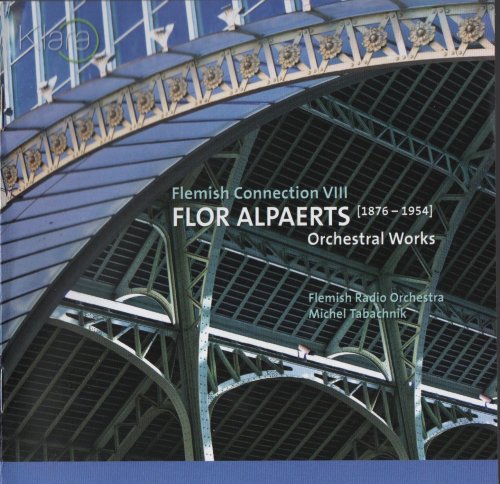
Artist: Flemish Radio Orchestra, Michel Tabachnik
Title: Flor Alpaerts: Orchestral Works
Year Of Release: 2008
Label: Etcetera Records
Genre: Classical
Quality: FLAC (image+.cue,log,scans)
Total Time: 01:03:46
Total Size: 375 Mb
WebSite: Album Preview
Tracklist: Title: Flor Alpaerts: Orchestral Works
Year Of Release: 2008
Label: Etcetera Records
Genre: Classical
Quality: FLAC (image+.cue,log,scans)
Total Time: 01:03:46
Total Size: 375 Mb
WebSite: Album Preview
01. Capriccio, for orchestra [0:04:55.74]
02. Pallieter, symphonic poem- 1. Meimorgen (Morning in May) [0:09:03.03]
03. Pallieter, symphonic poem- 2. Zomeravond (Summer evening) [0:10:36.14]
04. Pallieter, symphonic poem- 3. Bruilofstfeest (Wedding Feast) [0:09:12.47]
05. Romanza for violin & orchestra [0:05:57.01]
06. Zomer-idylle (Summer Idyll), for orchestra [0:07:39.60]
07. James Ensor, suite for orchestra- 1. Christus' intocht te Brussel (The entry of Christ in Brussels) [0:03:44.72]
08. James Ensor, suite for orchestra- 2. Gemaskerde geraamten in betwisting om een gehangene (Skeletons fighting for the body of a hanged [0:02:41.48]
09. James Ensor, suite for orchestra- 3. De tuin der liefde (The garden of love) [0:06:25.22]
10. James Ensor, suite for orchestra- 4. Helse optocht - Sabbat (Infernal cortege - Sabbath) [0:03:34.22]
Performers:
Guido de Neve - violin
Flemish Radio Orchestra
Michel Tabachnik – conductor
This release documents the work of Flemish composer Flor Alpaerts (1876–1954). He was born into a life of privation, but studied at the Flemish School of Music in Antwerp and became a noteworthy violinist and conductor, Read more Pallieter of 1924 is based on a 1916 novel of the same title by Felix Timmermans, and it serves to document the initial phase of Alpaerts’s career as a composer. The result is an almost Delius-like essay that projects moments of joy leavened by an all-encompassing melancholy.
The finest piece on this offering is the James Ensor Suite of 1928, in which Alpaerts produces moments of dark irony. It was inspired by a painting of James Ensor’s titled Christ’s Entry into Brussels. Here his language becomes more brittle and acerbic than that of his Pallieter of four years earlier, and his orchestration is noticeably spikier, though far less so than one finds in the contemporary scores of Bartók and Stravinsky.
In sum, Alpaerts is a second-tier composer, but, to invoke Richard Strauss’s self-deprecating evaluation of himself, Alpaerts is in the first class of second-class composers who undeniably composed some quite attractive music, documented with distinction on this release. -- William Zagorski
The finest piece on this offering is the James Ensor Suite of 1928, in which Alpaerts produces moments of dark irony. It was inspired by a painting of James Ensor’s titled Christ’s Entry into Brussels. Here his language becomes more brittle and acerbic than that of his Pallieter of four years earlier, and his orchestration is noticeably spikier, though far less so than one finds in the contemporary scores of Bartók and Stravinsky.
In sum, Alpaerts is a second-tier composer, but, to invoke Richard Strauss’s self-deprecating evaluation of himself, Alpaerts is in the first class of second-class composers who undeniably composed some quite attractive music, documented with distinction on this release. -- William Zagorski
![Clay Giberson - Moment's Notice (2026) [Hi-Res]](https://img.israbox.com/img/2026-10/22/td5kynij5a4n6d3lcs5dc2st5.jpg "Clay Giberson - Moment's Notice (2026) [Hi-Res]")
![Coleman Hawkins Quintet - High and Mighty Hawk (Stereo Version) (1959/2012) [Hi-Res]](https://www.dibpic.com/uploads/posts/2026-10/1792926143_3610154548241_600.jpg "Coleman Hawkins Quintet - High and Mighty Hawk (Stereo Version) (1959/2012) [Hi-Res]")
![Alex Acuna - Gifts (feat. John Peńa) (2026) [Hi-Res]](https://www.dibpic.com/uploads/posts/2026-10/1792984364_teo3v8hqyyco2_600.jpg "Alex Acuna - Gifts (feat. John Peńa) (2026) [Hi-Res]")
![Shabazz Palaces - It's a Style Sport (2026) [Hi-Res]](https://img.israbox.com/img/2026-10/23/sg46cd1c0g4grpz54hxf5ng54.jpg "Shabazz Palaces - It's a Style Sport (2026) [Hi-Res]")
![Mathias Wallerand - Color Impulse (2026) [Hi-Res]](https://www.dibpic.com/uploads/posts/2026-10/1793012036_cover.jpg "Mathias Wallerand - Color Impulse (2026) [Hi-Res]")