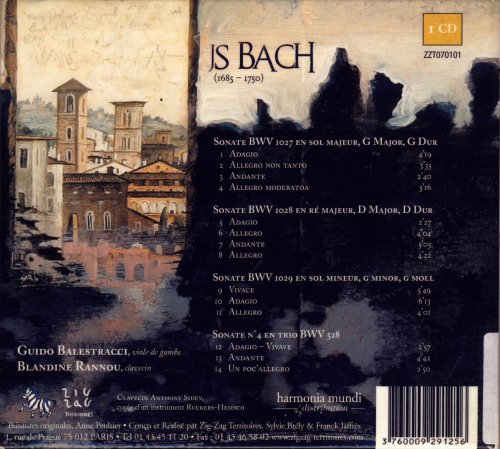
Guido Balestracci, Blandine Rannou - Bach: Sonates Pour Viole De Gambe Et Clavecin Oblige (2007)
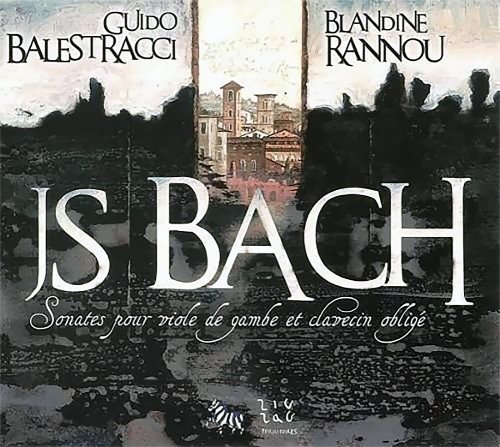
Artist: Guido Balestracci, Blandine Rannou
Title: Bach: Sonates Pour Viole De Gambe Et Clavecin Oblige
Year Of Release: 2007
Label: Zig Zag Territoires
Genre: Classical sonatas
Quality: FLAC (image+.cue,log,scans)
Total Time: 56'26
Total Size: 357 MB
WebSite: Album Preview
Title: Bach: Sonates Pour Viole De Gambe Et Clavecin Oblige
Year Of Release: 2007
Label: Zig Zag Territoires
Genre: Classical sonatas
Quality: FLAC (image+.cue,log,scans)
Total Time: 56'26
Total Size: 357 MB
WebSite: Album Preview
In this context, the three sonatas BWV 1027-29 are far from being the only instances of the use of the viola da gamba in Bach's output. As well as featuring regularly in the continuo team, it was also assigned an important role in several instrumental works (determining the tone-colour of the sixth Brandenburg Concerto, BWV 1051) and in vocal music. In the latter sphere, Lutheran tradition employed the viol more or less systematically to accompany singing, most especially in lamenti and funeral music. Faithful to this spirit, Bach used it several times in his cantatas and Passions: two violas da gamba in the cantata Gottes Zeit ist die allerbeste Zeit of 1707 (BWV 106) and the Trauer-Ode 'Lass, Furstin, lass noch einen Strahl' of 1727 (BWV 198), and a quartet consisting of gamba, flute, oboe and viola d'amore in Tritt auf die Glaubensbahn of 1714 (BWV 152). In the two extant Passions, as an obbligato instrument, its timbre is blended with low voices (alto in the St John Passion, bass in the St Matthew) to provide a grave and meditative commentary on the death of Christ and the bearing of the Cross: 'Es ist vollbracht' and 'Komm, susses Kreuz' exploit the dark, melancholy timbres of a consolatory viol.
However, Bach composed his sonatas for viola da gamba and harpsichord using new methods. He bent the heritage of the Corellian trio sonata to his own ends in order to create a new form, the sonata for a single instrument and obbligato harpsichord, in which the part for the keyboard player's right hand is written out by Bach instead of being left to be realised freely in continuo style. Thus the two instruments engage in concertato dialogue and genuine imitative polyphony. This form - chosen by Bach for his sonatas for violin and obbligato harpsichord BWV 1014-19 and for flute and obbligato harpsichord BWV 1030 - was to have a distinguished future in Germany, in the hands of such men as Johann Gottlieb Graun, Schaffrath and C. P. E. Bach, as well as in France with Mondonville and Rameau (Pieces de clavecin en concert), and later in England with Abel and Charles Avison. The highly virtuosic gamba part, especially in the allegros of BWV 1028 and 1029, attests that these pieces were intended for a seasoned musician, perhaps Christian Ferdinand Abel, then a member of the Cothen collegium musicum, or even Prince Leopold in person.
These three sonatas do not make up a unified and rationally arranged cycle, unlike other works written at the same period such as the sonatas and partitas for solo violin (BWV 1001-06) or the solo cello suites (BWV 1007-12). The first two adopt the four-movement scheme (slow-fast-slow-fast) inherited from the church sonata, while the last limits itself to the three movements of the chamber sonata or the concerto. It would even appear that these works were not composed at exactly the same date, for no manuscript or printed source contains all three of them. What is more, the Sonatas BWV 1028 and 1029 are found only in copies dating from after Bach's death, which tends to suggest that they were adaptations by the composer himself of earlier works. The Sonata for two flutes and continuo BWV 1039, an earlier version of the Sonata in G major BWV 1027, confirms this hypothesis. The widespread contemporary practice of transcription and arrangement, which extended to the works of other composers, legitimises modern transcriptions of compositions by Bach, provided that the musical language sounds idiomatic on the new instruments. Hence the case of the Trio Sonata BWV 528 which concludes this recording is interesting in more than one respect: each of the movements was the result of a reworking of earlier pieces. Whereas the second and third movements derive from organ works, the first is none other than a transcription of the introductory sinfonia to the second part of the Cantata BWV 76, Die Himmel erzahlen die Ehre Gottes, which in fact features the viola da gamba alongside a viola d'amore.
However, Bach composed his sonatas for viola da gamba and harpsichord using new methods. He bent the heritage of the Corellian trio sonata to his own ends in order to create a new form, the sonata for a single instrument and obbligato harpsichord, in which the part for the keyboard player's right hand is written out by Bach instead of being left to be realised freely in continuo style. Thus the two instruments engage in concertato dialogue and genuine imitative polyphony. This form - chosen by Bach for his sonatas for violin and obbligato harpsichord BWV 1014-19 and for flute and obbligato harpsichord BWV 1030 - was to have a distinguished future in Germany, in the hands of such men as Johann Gottlieb Graun, Schaffrath and C. P. E. Bach, as well as in France with Mondonville and Rameau (Pieces de clavecin en concert), and later in England with Abel and Charles Avison. The highly virtuosic gamba part, especially in the allegros of BWV 1028 and 1029, attests that these pieces were intended for a seasoned musician, perhaps Christian Ferdinand Abel, then a member of the Cothen collegium musicum, or even Prince Leopold in person.
These three sonatas do not make up a unified and rationally arranged cycle, unlike other works written at the same period such as the sonatas and partitas for solo violin (BWV 1001-06) or the solo cello suites (BWV 1007-12). The first two adopt the four-movement scheme (slow-fast-slow-fast) inherited from the church sonata, while the last limits itself to the three movements of the chamber sonata or the concerto. It would even appear that these works were not composed at exactly the same date, for no manuscript or printed source contains all three of them. What is more, the Sonatas BWV 1028 and 1029 are found only in copies dating from after Bach's death, which tends to suggest that they were adaptations by the composer himself of earlier works. The Sonata for two flutes and continuo BWV 1039, an earlier version of the Sonata in G major BWV 1027, confirms this hypothesis. The widespread contemporary practice of transcription and arrangement, which extended to the works of other composers, legitimises modern transcriptions of compositions by Bach, provided that the musical language sounds idiomatic on the new instruments. Hence the case of the Trio Sonata BWV 528 which concludes this recording is interesting in more than one respect: each of the movements was the result of a reworking of earlier pieces. Whereas the second and third movements derive from organ works, the first is none other than a transcription of the introductory sinfonia to the second part of the Cantata BWV 76, Die Himmel erzahlen die Ehre Gottes, which in fact features the viola da gamba alongside a viola d'amore.
Tracklist:
Sonate Bwv 1027 En Sol Majeur, G Major, G Dur:
1 Adagio 4:19
2 Allegro Non Tanto 3:35
3 Andante 2:40
4 Allegro Moderato 3:16
Sonate Bwv 1028 En Ré Majeur, D Major, D Dur:
5 Adagio 2:27
6 Allegro 4:04
7 Andante 5:05
8 Allegro 4:22
Sonate Bwv 1029 En Sol Mineur, G Minor, G Moll:
9 Vivace 5:49
10 Adagio 6:13
11 Allegro 4:01
Sonate N°4 En Trio Bwv 528:
12 Adagio - Vivace 2:57
13 Andante 4:42
14 Un Poc'allegro 2:50
![Dean Kalaitzidis - Bright Tree (2026) [Hi-Res]](https://img.israbox.com/img/2026-10/18/obltgczcjevcnwjxn6aeyfq09.jpg "Dean Kalaitzidis - Bright Tree (2026) [Hi-Res]")
![Marcel Worms - in the mixed zone (2026) [Hi-Res]](https://www.dibpic.com/uploads/posts/2026-10/1792083986_cover.jpg "Marcel Worms - in the mixed zone (2026) [Hi-Res]")

![Morten Georg Gismervik - Starfall (2026) [Hi-Res]](https://img.israbox.com/img/2026-10/18/98jkdlumshpj3dys6g7dqkl7e.jpg "Morten Georg Gismervik - Starfall (2026) [Hi-Res]")
![Nao - Autumn (2026) [Hi-Res]](https://www.dibpic.com/uploads/posts/2026-10/1791913987_1.jpg "Nao - Autumn (2026) [Hi-Res]")