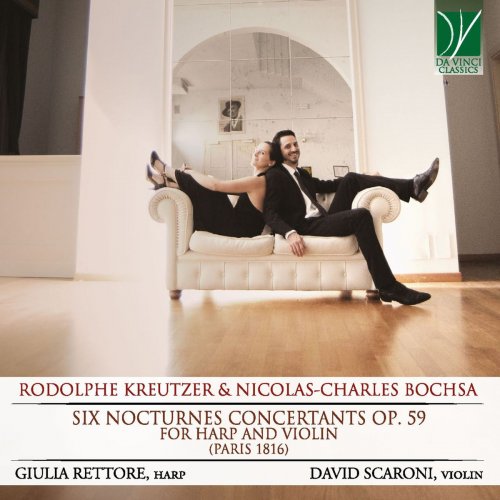
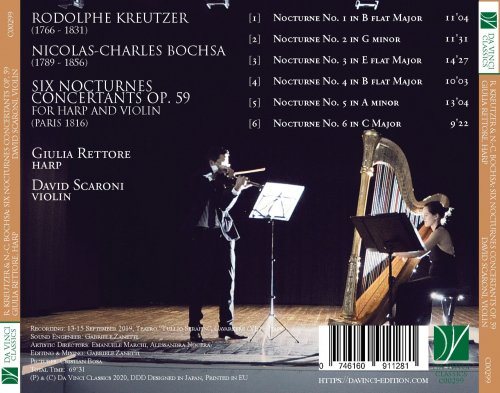
01. Six Nocturnes Concertants, Op. 59: No. 1 in B-Flat Major
02. Six Nocturnes Concertants, Op. 59: No. 2 in G Minor
03. Six Nocturnes Concertants, Op. 59: No. 3 in E-Flat Major
04. Six Nocturnes Concertants, Op. 59: No. 4 in B-Flat Major
05. Six Nocturnes Concertants, Op. 59: No. 5 in A Minor
06. Six Nocturnes Concertants, Op. 59: No. 6 in C Major
If your mental picture of a harpist who writes Nocturnes is that of an ethereal, angel-like damsel, well, forget about it. Few people are more distant from this image than Nicholas-Charles Bochsa, who co-authored the Six Nocturnes Concertans recorded in this Da Vinci Classics album. Born in France, in the fateful year 1789, he was a child prodigy whose debut as a piano soloist took place at the very young age of seven, and who wrote his first large-scale compositions (including symphonies and concertos) within the following two or three years. One of his first operas, Le retour de Trajan ou Rome triomphante was staged when its composer was just sixteen, to celebrate the arrival of Napoleon in Lyon. Shortly after, Bochsa moved to Paris, where he studied composition and fell in love with the harp, which would become his favourite instrument; he also actively intervened in the mechanical processes of harp-making, cooperating with Sébastien Érard in the development of the double movement pedal harp. Possibly remembering the celebratory opera, and certainly impressed by the young harpist’s skill, Napoleon appointed him Harpist of the Imperial Chapel; thus, the ambitious musician quickly found his way into the Parisian high society, and soon became the harp teacher of Empress Joséphine and of Empress Marie-Louise. Indeed, his fortune lasted much longer than Napoleon’s, since Bochsa successfully survived Napoleon’s fall and the Restoration (indeed, Louis XVIII “restored” him as court harpist). Bochsa had also secured his position by marrying up, with a noblewoman called Madame de Genlis. Freed from bread-earning worries, Bochsa focused on composition and wrote an impressive amount of works, both for the public stages and for the delight of amateur chamber musicians.
If Bochsa’s life, until then, was a typical example of the successful self-made man, at that point he began to deliberately destroy his fortune. Since his expenditures far exceeded his income (however large), he had the brilliant idea of forging documents and promissory notes, signing them by the names of famous musicians – and even, unashamedly, by that of Lord Wellington – and boasting about faked identities and official roles. Condemned to twelve years of forced labour in 1818, he managed to flee France and to seek asylum in England; surprisingly, however, he quickly recovered his reputation and was admitted to the circles of the high British nobility. Ironically, he became the harp teacher of the Duchess of Wellington, but also of one of the greatest English harpists, Elias Parish Alvars. His career skyrocketed, with the support of the British crown and with the establishment of the Royal Academy of Music, where he became the first harp teacher ever.
Evidently, however, a leopard can’t change its spots; and the less-than-angelic Bochsa seriously broke the law once more, becoming a bigamist with an opera singer who abandoned her husband for him. The couple concertized throughout Europe, and eventually crossed both the Atlantic and the Pacific Ocean: Bochsa in fact died in Sidney in 1856.
Having thus established that Bochsa was no harp-playing winged cherub, we must admit that the Nocturnes recorded here do not betray the adventurous life of one of their composers. The other, Rodolphe Kreutzer, was indeed much less unscrupulous: he was one of the greatest violinists of his time, and the dedicatee of Beethoven’s majestic Kreutzer-Sonata (which in turn inspired Tolstoy’s novella, which in turn inspired Leoš Janáček’s String Quartet no. 1). And although Kreutzer’s virtuosity on the violin was such that he wrote a series of Etudes/Capriccios which predate Paganini’s by several years (and which are even today among the inescapable trials of the budding violinists), he was by no means a solitary genius; in fact, he cowrote several collaborative pieces with many of the greatest and most fashionable composers of the era. For example, he cooperated with such musicians as Luigi Cherubini, André Grétry, Étienne Nicholas Méhul and Ferdinando Paër; last but not least, he joined forces with Bochsa for this series of six Nocturnes.
The term Nocturne refers to a genre which was quickly catching the interest of the musical world at the time: if John Field was one of the first to compose successful and beloved Nocturnes for the forte-piano, by Chopin’s time the genre boasted a rich catalogue of expressive, touching and sometimes tearful pieces. The “Concertans” in the title alludes instead to the dialogic features of these works: these pieces, created through the encounter of the top harpist with the top violinist of the time, unavoidably display a masterful treatment of both instruments, a skillful knowledge of their peculiarities, and a wealth of melodic and harmonic ideas.
Indeed, the fact that both musicians were composers of successful operas is rather evident throughout this collaborative work. The opening of the first Nocturne, for example, is marked by a long singing phrase by the violin, to which it would be very easy to set lyrics in verse; in spite of the simplicity of the tunes, however, the harmonies are refined and frequently rather complex, and the piece is suffused by a tender and passionate atmosphere.
In the second Nocturne, instead, we find a markedly different situation, perhaps unexpectedly: here the tempo is a brisk Allegro vivace agitato, and the opening gestures are dramatic, exuberant and deeply pathetic. If we were to imagine this music to lay still within the world of opera, this would be a very tense duet, with a fierce character and a subdued but expressive interlocutor. The harp undergoes the most impressive transformation: its arpeggios have nothing of the caressing and rippling quality one normally associates with it, and they create a powerful mass of sound, building up a kind of storm in the evocation of orchestral sonorities. In spite of this, moments of deep and intense lyricism are not missing.
A more typical example of Nocturne is no. 3: here the violin becomes a true instrumental embodiment of the human voice, including the characteristic embellishments and adornments which were common fare in the contemporaneous operatic scene. The skillful accompaniment by the harp provides a huge resonance by virtue of its frequent use of low octaves, thus creating an ideal (though unobtrusive) amplification to the violin’s singing.
The fourth Nocturne is a true operatic scene with all the props: a slow, dramatic introduction, with powerful and wide gestures flowing into a slow, expressive song: its main elements will be found in the brilliant second part (Allegretto pas trop vite), where the two instruments literally “play” with each other: both have melodies of their own, both sing together and both display virtuosity and bravura with the peculiar traits and distinctive features of their individual idioms.
In the fifth Nocturne, which has beautiful and touching melodies in turn, the characteristics are typically instrumental rather than vocal, in the large intervals and dark tones of the violin’s opening phrase: the initial descending octave, followed by an ascending octave a fifth higher, build together an expressive range which encompasses almost the full extension of the human voice.
Finally, the sixth Nocturne has something of the character piece: it makes use of particular sound effects, and its allusion to a “pastoral” aspect is made evident both by the tempo and pace (a 6/8 Andante) and by the drone-like accompaniment frequently employed by the harp, as if in imitation of a bagpipe. In fact, the expression “louré” refers to the Loure, an ancient wind instrument, similar to a bagpipe, used in Normandy: the choice of imitating that instrument through the use of two utterly different timbres, such as the strings of the violin and of the harp, is a genuine stroke of genius.
Thus, it can be said that both composers gave their best in this cooperation: evidently, their collaboration stimulated both, and each of them contributed melodies, textures, harmonies, technical ideas and creative stimuli. These forms of cooperation were going to become less popular in the nineteenth century, since the typically Romantic “cult of the genius” seemed to impose individuality and self-expression as a compulsory requirement for every work of art, and the idea of a collective creation seemed to belittle the originality of the result.
By way of contrast, collaborative creation resurfaced in the twentieth century, particularly in the domain of songwriting and in creative projects which purposefully challenged the idea of individualistic expression.
The Nocturnes concertans by Bochsa and Kreutzer, therefore, are a brilliant example of how two expert, skilled and imaginative musicians could profitably cooperate, realizing pleasurable works, in which each musician has the opportunity of displaying bravura, expressivity, tone-colour and virtuoso technique, for the enjoyment of the players themselves and of all those listening to them.
Liner Notes by Chiara Bertoglio
![La Sirena - The Sorceress Dreaming (2026) [Hi-Res]](https://img.israbox.com/img/2026-09/28/w7df1c5gx6yilw1u4hbk0zxn9.jpg "La Sirena - The Sorceress Dreaming (2026) [Hi-Res]")
![Ô De Mon Chéri - Ô de mon Chéri sings Anita O'Day (2026) [Hi-Res]](https://img.israbox.com/img/2026-09/27/l9z4tnexfrf8qj1ma6nb12b64.jpg "Ô De Mon Chéri - Ô de mon Chéri sings Anita O'Day (2026) [Hi-Res]")
![Margaret Singana - Tribal Fence (2026) [Hi-Res]](https://www.dibpic.com/uploads/posts/2026-09/1790315409_cover.jpg "Margaret Singana - Tribal Fence (2026) [Hi-Res]")