Staatskapelle Dresden, Rudolf Kempe - Strauss: Wind Concertos (1989)
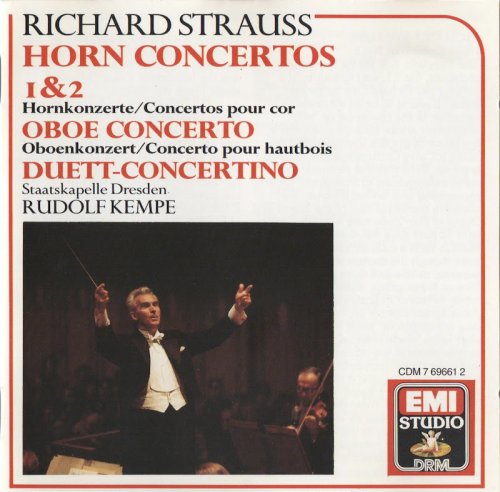
Artist: Staatskapelle Dresden, Rudolf Kempe
Title: Strauss: Wind Concertos
Year Of Release: 1989
Label: EMI
Genre: Classical
Quality: FLAC (image+.cue,scans)
Total Time: 79:13
Total Size: 338 Mb
WebSite: Album Preview
Tracklist: Title: Strauss: Wind Concertos
Year Of Release: 1989
Label: EMI
Genre: Classical
Quality: FLAC (image+.cue,scans)
Total Time: 79:13
Total Size: 338 Mb
WebSite: Album Preview
Richard Strauss (1864-1949)
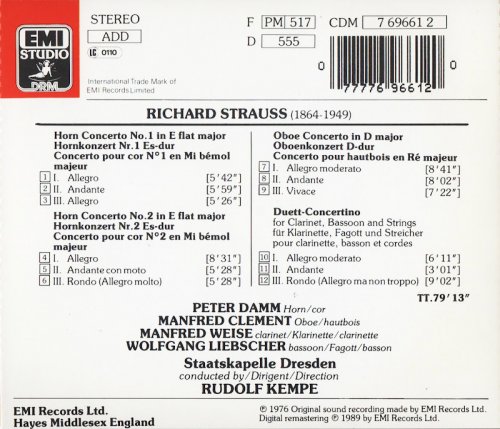
Horn Concerto No.1 In E Flat
1. I. Allegro 5:42
2. II. Andante 5:59
3. III. Allegro 5:26
Horn Concerto No.2 In E Flat Major
4. I. Allegro 8:31
5. II. Andante Con Moto 5:28
6. III. Rondo (Allegro Molto) 5:28
Oboe Concerto In D Major
7. I. Allegro Moderato 8:41
8. II. Andante 8:02
9. III. Vivace 7:22
Duett-Concertino For Clarinet, Bassoon And Strings
10. I. Allegro Moderato 6:11
11. II. Andante 3:01
12. III. Rondo 9:02
Performers:
Peter Damm - horn
Manfred Clement - oboe
Manfred Weise - clarinet
Wolfgang Liebscher - bassoon
Staatskapelle Dresden
Rudolf Kempe - conductor
Although his reputation as a composer rests on having created a number of monumental symphonic tone poems, notably "Also Sprach Zarathustra", "Don Juan", "Ein Heldenleben", and "Death And Transfiguration", Richard Strauss did compose in other forms of the classical realm that had been done by composers of the past, including some of Strauss' own favorites, notably Mozart and Brahms. The instrumental concerto was just such a form; and this EMI recording by Rudolf Kempe and the Dresden State Orchestra, part of their landmark survey of Strauss' major orchestral works dating from the early 1970s, does a great deal to demonstrate this fact, that he was more than, as he self-deprecatingly described himself, "a first rate composer of second-rate music."
The two best known works on this recording are the two horn concertos, both in the key of E Flat Major, but both composed an incredible sixty years apart (the first in 1883; the second in 1943, with World War II raging all around the composer). The concertos, like those they were significantly modeled off of (namely Mozart's famous ones), require a technical skill from the soloist that is exceptionally high (the main difference between them and Mozart's is that trumpets and timpani are present in Strauss', and they're not in Mozart's). Fortunately, Peter Damm, the longtime principal horn player of the Dresden State Orchestra (Strauss' preferred orchestra when it came to his own works), is more than up to the task at hand.
Strauss' D Major Oboe Concerto is even closer to the Mozartean ideal; and it was composed in 1945 for John DeLancie, then a member of a U.S. Army unit that secured the town of Garmisch in the Bavarian region of Germany but, in his day job, the principal oboe for the Pittsburgh Symphony Orchestra (and later the Philadelphia Orchestra). At twenty-five minutes, it is both modern and traditional in scope; and on this recording, it is handled by the D.S.O.'s principal oboist Manfred Clement. Two years later, in 1947, and with still two years to live but the world that he had been a part of for so long in ruins, Strauss composed another Mozart-influenced work, the Duet Concertino for clarinet and bassoon with string orchestra. Again, the soloists are principals from the D.S.O.: clarinetist Manfred Weise, and bassoonist Wolfgang Liebscher.
These are works that showed Strauss not to be only a composer of large tone poems whose orchestrations rival those of Mahler, Wagner, and Schoenberg, but also a composer of classically-shaped works that pay homage to a time that was a part of history and of his being. He would have been proud by the performances here, the soloists, the orchestra, and a veteran Strauss conductor in Kempe.
Read less
The two best known works on this recording are the two horn concertos, both in the key of E Flat Major, but both composed an incredible sixty years apart (the first in 1883; the second in 1943, with World War II raging all around the composer). The concertos, like those they were significantly modeled off of (namely Mozart's famous ones), require a technical skill from the soloist that is exceptionally high (the main difference between them and Mozart's is that trumpets and timpani are present in Strauss', and they're not in Mozart's). Fortunately, Peter Damm, the longtime principal horn player of the Dresden State Orchestra (Strauss' preferred orchestra when it came to his own works), is more than up to the task at hand.
Strauss' D Major Oboe Concerto is even closer to the Mozartean ideal; and it was composed in 1945 for John DeLancie, then a member of a U.S. Army unit that secured the town of Garmisch in the Bavarian region of Germany but, in his day job, the principal oboe for the Pittsburgh Symphony Orchestra (and later the Philadelphia Orchestra). At twenty-five minutes, it is both modern and traditional in scope; and on this recording, it is handled by the D.S.O.'s principal oboist Manfred Clement. Two years later, in 1947, and with still two years to live but the world that he had been a part of for so long in ruins, Strauss composed another Mozart-influenced work, the Duet Concertino for clarinet and bassoon with string orchestra. Again, the soloists are principals from the D.S.O.: clarinetist Manfred Weise, and bassoonist Wolfgang Liebscher.
These are works that showed Strauss not to be only a composer of large tone poems whose orchestrations rival those of Mahler, Wagner, and Schoenberg, but also a composer of classically-shaped works that pay homage to a time that was a part of history and of his being. He would have been proud by the performances here, the soloists, the orchestra, and a veteran Strauss conductor in Kempe.
Read less
DOWNLOAD FROM ISRA.CLOUD
Staatskapelle Dresden Rudolf Kempe Strauss Wind Concertos 89 0909.rar - 336.9 MB
Staatskapelle Dresden Rudolf Kempe Strauss Wind Concertos 89 0909.rar - 336.9 MB

![Florencio Cruz - The Construction Of a Brave Heart (2026) [Hi-Res]](https://www.dibpic.com/uploads/posts/2026-09/1789352654_byra22sahdx5z_600.jpg "Florencio Cruz - The Construction Of a Brave Heart (2026) [Hi-Res]")
![Dick De Graaf - Con Alma (In memory of Rob van Kreeveld) (2026) [Hi-Res]](https://www.dibpic.com/uploads/posts/2026-09/1789489285_folder.jpg "Dick De Graaf - Con Alma (In memory of Rob van Kreeveld) (2026) [Hi-Res]")
![Wau Wau Collectif - Teranga (2026) [Hi-Res]](https://img.israbox.com/img/2026-09/17/630pw5ahv5tv1i1fc595lem27.jpg "Wau Wau Collectif - Teranga (2026) [Hi-Res]")
![Patricia Moreno - Volver (2026) [DSD]](https://www.dibpic.com/uploads/posts/2026-09/1789311311_as37.jpg "Patricia Moreno - Volver (2026) [DSD]")