The Sixteen, Harry Christophers - La Jeune France (1996)
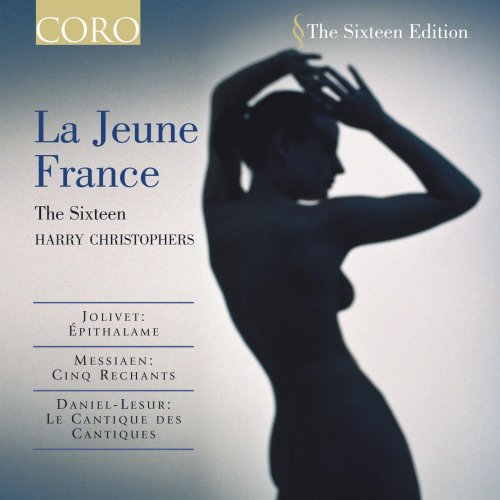
Artist: The Sixteen, Harry Christophers
Title: La Jeune France
Year Of Release: 1996
Label: Coro
Genre: Classical
Quality: FLAC (tracks)
Total Time: 59:52
Total Size: 227 Mb
WebSite: Album Preview
Tracklist: Title: La Jeune France
Year Of Release: 1996
Label: Coro
Genre: Classical
Quality: FLAC (tracks)
Total Time: 59:52
Total Size: 227 Mb
WebSite: Album Preview
1. Épithalame: I 08:34
2. Épithalame: II 08:15
3. Épithalame: III 03:10
4. Cinq Rechants: I 04:54
5. Cinq Rechants: II 03:18
6. Cinq Rechants: III 03:59
7. Cinq Rechants: IV 02:42
8. Cinq Rechants: V 03:33
9. Le Cantique des Cantiques: I - DialogueRebecca Outram 03:31
10. Le Cantique des Cantiques: II - La Voix Du Bien-AiméCarys Lane 03:51
11. Le Cantique Des Cantiques: III - Le SongeCarys Lane 01:45
12. Le Cantique des Cantiques: IV - Le Roi Salomon 01:33
13. Le Cantique des Cantiques: V - Le Jardin ClosCarys Lane 04:00
14. Le Cantique des Cantiques: VI - La SulamiteCarys Lane 03:58
15. Le Cantique des Cantiques: VII - Épithalame 02:49
Performers:
The Sixteen
Conductor: Harry Christophers
Le Jeune France is addressed to a valuable and little-understood area of between-the-wars French music, namely the group "Le Jeune France," which chronologically followed Les Six. Composers André Jolivet, Yves Baudrier, Olivier Messiaen, and Jean-Yves Daniel-Lesur departed from the facile and piquant confections that marked the style of Les Six and introduced a tougher, more spiritually based French idiom informed by the example of Varèse combined with an awareness of expressionism. Although the ultra-obscure Baudrier is not heard from here, the other three are represented by prime postwar examples of their choral output in pieces originally premiered by L'Ensemble Vocale Marcel Couraud.
The Jolivet Epithalame is wild and weird; the liner notes state that the work almost proved impossible even for The Sixteen, being written at such a high level of difficulty and complexity. Texturally the Epithalame is so busy and extreme that at times it makes the chorus sound like a "crowd"; by comparison Messiaen's familiar Rechants (5) sound conservative. Although the Rechants (5) are well done here, the most appealing work on Le Jeune France is Daniel-Lesur's Le Cantique des cantiques. Back in 1953 Le Cantique des cantiques was probably regarded as a throwback to older and unhip liturgical models, but with the passage of time Daniel-Lesur's evocations of chant and long passages of slowly evolving, impressionistic stasis identifies this as a clear harbinger of the "holy minimalist" style to emerge three decades later. It is a masterpiece, and The Sixteen has done well to bring the pioneering music of Daniel-Lesur to the attention of listeners.
This is the now-deleted 1996 Collins issue of Le Jeune France, which in 2004 was reissued on The Sixteen's own label, Coro, along with all of the other Collins issues, as part of its "Sixteen Edition."
The Jolivet Epithalame is wild and weird; the liner notes state that the work almost proved impossible even for The Sixteen, being written at such a high level of difficulty and complexity. Texturally the Epithalame is so busy and extreme that at times it makes the chorus sound like a "crowd"; by comparison Messiaen's familiar Rechants (5) sound conservative. Although the Rechants (5) are well done here, the most appealing work on Le Jeune France is Daniel-Lesur's Le Cantique des cantiques. Back in 1953 Le Cantique des cantiques was probably regarded as a throwback to older and unhip liturgical models, but with the passage of time Daniel-Lesur's evocations of chant and long passages of slowly evolving, impressionistic stasis identifies this as a clear harbinger of the "holy minimalist" style to emerge three decades later. It is a masterpiece, and The Sixteen has done well to bring the pioneering music of Daniel-Lesur to the attention of listeners.
This is the now-deleted 1996 Collins issue of Le Jeune France, which in 2004 was reissued on The Sixteen's own label, Coro, along with all of the other Collins issues, as part of its "Sixteen Edition."
![Peter Knight, Jannis Anastasakis - Feather (2026) [Hi-Res]](https://img.israbox.com/img/2026-09/24/cl5ywh8nazfr3muk2auhbaih8.jpg "Peter Knight, Jannis Anastasakis - Feather (2026) [Hi-Res]")
![Andréel - Quai de Loire (2026) [Hi-Res]](https://img.israbox.com/img/2026-09/27/1jtzj9va72n6b5b9gxjn6e5s4.jpg "Andréel - Quai de Loire (2026) [Hi-Res]")
![Ô De Mon Chéri - Ô de mon Chéri sings Anita O'Day (2026) [Hi-Res]](https://img.israbox.com/img/2026-09/27/l9z4tnexfrf8qj1ma6nb12b64.jpg "Ô De Mon Chéri - Ô de mon Chéri sings Anita O'Day (2026) [Hi-Res]")