Heinz Holliger and Friends - Metamorphoses (1994)
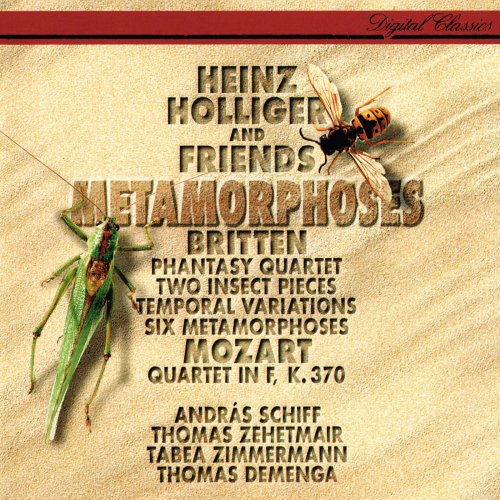
Artist: Heinz Holliger
Title: Metamorphoses
Year Of Release: 1994
Label: Philips
Genre: Classical
Quality: FLAC (tracks) / MP3 320 Kbps
Total Time: 01:05:24
Total Size: 300 / 167 Mb
WebSite: Album Preview
Tracklist: Title: Metamorphoses
Year Of Release: 1994
Label: Philips
Genre: Classical
Quality: FLAC (tracks) / MP3 320 Kbps
Total Time: 01:05:24
Total Size: 300 / 167 Mb
WebSite: Album Preview
1. Britten: 6 Metamorphoses after Ovid, Op. 49 14:42
2. Britten: Temporal Variations 14:36
Phantasy, (Quartet for Oboe, violin, viola and cello) (Benjamin Britten)
3. Phantasy, (Quartet for Oboe, violin, viola and cello) 13:23
2 Insect pieces (Benjamin Britten)
4. 1. The Grasshopper 03:29
5. 2. The Wasp 02:04
Oboe Quartet in F major, K. 370 (Wolfgang Amadeus Mozart)
6. 1. Allegro 09:20
7. 2. Adagio 03:22
8. 3. Rondeau (Allegro) 04:28
Performers:
Cello – Thomas Demenga
Oboe – Heinz Holliger
Piano – András Schiff
Viola – Tabea Zimmermann
Violin – Thomas Zehetmair
Heinz Holliger has bestridden the musical world as the leading oboe player of the day as surely as did, in his time, Leon Goossens. He is a marvellous musician who plays the oboe, and also a marvellous technician. No one who has ever struggled with the instrument can fail to admire Holliger's control, not simply in fingering the notes but in controlling a recalcitrant reed that can betray the greatest player; and his ability, for instance, to fade a note into silence has occasionally become something of a mannerism, to be set against Goossens's idiosyncracies of phrasing. In Britten's pieces which are in their different ways virtuoso compositions for virtuoso players, this is nothing but a contribution. The Metamorphoses after Ovid are a delight to play and to hear played by an artist of Holliger's quality who can respond to the relish of compositional tasks solved with incredible skill. Their first performer was Joy Boughton, an oboist of quality. Holliger's performance here, and of the little Insect Pieces, is entertainment at the highest level. The Temporal Variations are more ambitious. This is a strange piece, packed with invention, providing a player with challenges; and Holliger makes much sense of it.
In Mozart's great Oboe Quartet, he also rises to challenges. Technically, these are not great though it is impossible not to admire the ease with which he throws off the only serious challenge, the passage in the finale when the oboe skirls off into the wrong rhythm until order is restored. But the first movement is better when not played quite so fast, as Holliger has accepted in past performances; and brilliantly as he swerves into the elegant phrases, and makes new music of them, there is a sense in which less makes more. That is often the case with Mozart. It is very interesting to compare this performance with that of Goossens
In Mozart's great Oboe Quartet, he also rises to challenges. Technically, these are not great though it is impossible not to admire the ease with which he throws off the only serious challenge, the passage in the finale when the oboe skirls off into the wrong rhythm until order is restored. But the first movement is better when not played quite so fast, as Holliger has accepted in past performances; and brilliantly as he swerves into the elegant phrases, and makes new music of them, there is a sense in which less makes more. That is often the case with Mozart. It is very interesting to compare this performance with that of Goossens
![Sam Blakeslee Large Group - New Blood (2026) [Hi-Res]](https://www.dibpic.com/uploads/posts/2026-09/1790316052_cover.jpg "Sam Blakeslee Large Group - New Blood (2026) [Hi-Res]")
![Carla Marciano - DAYDREAMING My Beloved Father GIOVANNI (2026) [Hi-Res]](https://img.israbox.com/img/2026-09/25/f7t3j7sz6kh3siah4cno3bapl.jpg "Carla Marciano - DAYDREAMING My Beloved Father GIOVANNI (2026) [Hi-Res]")
![Megiapa - Intentions (2026) [Hi-Res]](https://img.israbox.com/img/2026-09/24/q4beu5vuz2n5fio9ckyoe0a4e.jpg "Megiapa - Intentions (2026) [Hi-Res]")

![Kevin Sun - Kevin Sun, II (2026) [Hi-Res]](https://img.israbox.com/img/2026-09/27/pzwaczrg0dxw87hagkc04824e.jpg "Kevin Sun - Kevin Sun, II (2026) [Hi-Res]")
![Peter Knight, Jannis Anastasakis - Feather (2026) [Hi-Res]](https://img.israbox.com/img/2026-09/24/cl5ywh8nazfr3muk2auhbaih8.jpg "Peter Knight, Jannis Anastasakis - Feather (2026) [Hi-Res]")