Andrea Catzel, Leonardo de Lisi and Reinild Mees - Resphighi: Complete Songs For Voice and Piano, Volume 2 (1998)
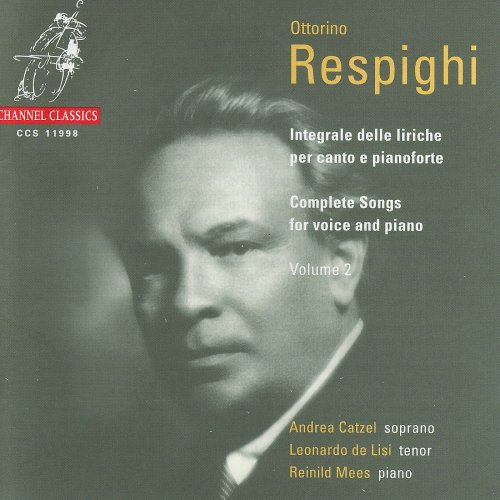
Artist: Andrea Catzel, Leonardo de Lisi, Reinild Mees
Title: Resphighi: Complete Songs For Voice and Piano, Volume 2
Year Of Release: 1998
Label: Channel Classics Records
Genre: Classical
Quality: FLAC (tracks + booklet)
Total Time: 56:51
Total Size: 206 MB
WebSite: Album Preview
Tracklist:Title: Resphighi: Complete Songs For Voice and Piano, Volume 2
Year Of Release: 1998
Label: Channel Classics Records
Genre: Classical
Quality: FLAC (tracks + booklet)
Total Time: 56:51
Total Size: 206 MB
WebSite: Album Preview
1. Storia breve, P. 52 (02:18)
2. Miranda, P. 39 (00:44)
3. Nevicata, P. 65 (01:59)
4. Scherzo, P. 68 (00:52)
5. Nebbie, P. 64 (02:20)
6. Sei Liriche, Prima Serie, P. 90: No. 1. O Falce di Luna Calante (02:30)
7. Sei Liriche, Prima Serie, P. 90: No. 2. Van Li Effluvi de Le Rose (01:44)
8. Sei Liriche, Prima Serie, P. 90: No. 3. Au Milieu du Jardin (01:51)
9. Sei Liriche, Prima Serie, P. 90: No. 4. Noël Ancien (04:06)
10. Sei Liriche, Prima Serie, P. 90: No. 5. Serenata Indiana (03:39)
11. Sei Liriche, Prima Serie, P. 90: No. 6. Pioggia (02:20)
12. E se un giorno tornasse, P. 96 (02:03)
13. Lagrime, P. 9 (03:01)
14. Sei Melodie, P. 89: No. 1. In Alto Mare (01:01)
15. Sei Melodie, P. 89: No. 2. Abbandono (01:41)
16. Sei Melodie, P. 89: No. 3. Mattinata (01:57)
17. Sei Melodie, P. 89: No. 4. Povero Cor (03:27)
18. Sei Melodie, P. 89: No. 5. Si Tu Veux (01:28)
19. Sei Melodie, P. 89: No. 6. Soupir (02:26)
20. Quattro Rispetti Toscani, P. 103: No. 1. Quando Nasceste Voi (03:07)
21. Quattro Rispetti Toscani, P. 103: No. 2. Venitelo a Vedere'l Mi Piccino (01:41)
22. Quattro Rispetti Toscani, P. 103: No. 3. Vien di Là Lontano (03:42)
23. Quattro Rispetti Toscani, P. 103: No. 4. Razzolan Sopra l'aja (03:47)
24. Due Canzoni Dialettali: No. 1. Canzone Sarda (01:48)
25. Due Canzoni Dialettali: No. 2. Le Funtanelle (01:07)
OTTORINO RESPIGHI His Art Songs by Potito Pedarra The subject of Ottorino Respighis (Bologna, 1879 – Rome, 1936) vocal chamber music, “less ambitious yet more genuine and varied” (S. Martinotti) than the operatic one, has not yet been studied systematically, not even by the scholars and musicologists who have published many top-level essays on his music. Respighis art song production takes place in a “controversial moment of the history of Italy during the first thirty years of our century”: in those years this musical form , so popular especially in Germany, in Italy is “suffocated by Operas spreading” (Elio Battaglia). It is true that the German Lied and the Italian song are two musical forms of completely different type.
While in Austria Hugo Wolf (1860 – 1903) devoted himself almost exclusively to Lied composing, in Italy the canzone was still considered as a secondary chamber music form, just an entertainment, mere occasional music in a few words. Here, on the “crisis, nearly total, of the Italian Lied”, Ottorino Respighis experience was grafted, the musician being one of the most prolific composers of his generation. Until then this form was considered an almost exclusive prerogative of Francesco Paolo Tosti (1846-1916), who, “in spite of his not so far-sighted intentions”, still seems to be “the most genuine song-writer in Italy, for, at least from a historical point of view, he does not cover himself with any intellectual cloth, as his contemporaries do” (Elio Battaglia). The lirica (song) represents for Respighi “a sort of a composers intimate journal” (A. Cant).
While in Austria Hugo Wolf (1860 – 1903) devoted himself almost exclusively to Lied composing, in Italy the canzone was still considered as a secondary chamber music form, just an entertainment, mere occasional music in a few words. Here, on the “crisis, nearly total, of the Italian Lied”, Ottorino Respighis experience was grafted, the musician being one of the most prolific composers of his generation. Until then this form was considered an almost exclusive prerogative of Francesco Paolo Tosti (1846-1916), who, “in spite of his not so far-sighted intentions”, still seems to be “the most genuine song-writer in Italy, for, at least from a historical point of view, he does not cover himself with any intellectual cloth, as his contemporaries do” (Elio Battaglia). The lirica (song) represents for Respighi “a sort of a composers intimate journal” (A. Cant).
![Al Di Meola - Tour De Force (1982) [Vinyl]](https://www.dibpic.com/uploads/posts/2026-08/1787118061_0074643837323_600.jpg "Al Di Meola - Tour De Force (1982) [Vinyl]")
![Jim Rotondi & Dena DeRose - Out Of The Past (2026) [Hi-Res]](https://img.israbox.com/img/2026-08/20/5vl5q9l3kviqivp23yv39c9bq.jpg "Jim Rotondi & Dena DeRose - Out Of The Past (2026) [Hi-Res]")