Toshiko Akiyoshi - Toshiko's Blues · Quartet & Trios 1953-1958 (2023)
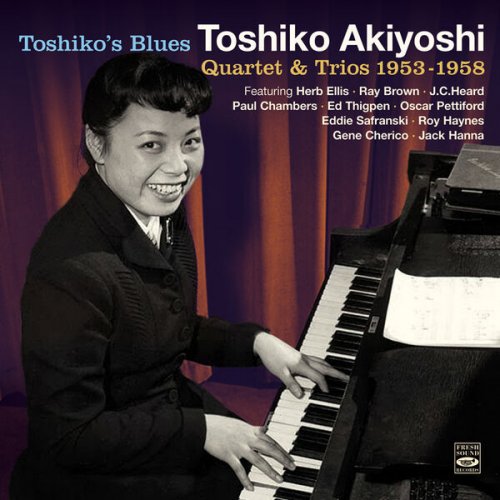
Artist: Toshiko Akiyoshi, Herb Ellis, Ray Brown, Paul Chambers, Oscar Pettiford, Gene Cherico, Eddie Safranski, J.C. Heard, Ed Thigpen, Roy Haynes, Jack Hanna
Title: Toshiko's Blues · Quartet & Trios 1953-1958
Year Of Release: 2023
Label: Fresh Sound Records
Genre: Jazz
Quality: FLAC (tracks)
Total Time: 2:21:17
Total Size: 677 MB
WebSite: Album Preview
Tracklist:Title: Toshiko's Blues · Quartet & Trios 1953-1958
Year Of Release: 2023
Label: Fresh Sound Records
Genre: Jazz
Quality: FLAC (tracks)
Total Time: 2:21:17
Total Size: 677 MB
WebSite: Album Preview
1. What Is This Thing Called Love? (02:47)
2. Gone with the Wind (02:35)
3. I Want to Be Happy (02:16)
4. Toshiko's Blues (03:45)
5. Shadrack (02:43)
6. Solidado (03:31)
7. Squatty Roo (02:41)
8. Laura (Solo) (03:31)
9. Between Me and Myself (05:16)
10. It Could Happen to You (04:01)
11. Kyo-Shu (Nostalgia) (03:42)
12. Homework (03:39)
13. Manhattan Address (02:46)
14. Softly as in a Morning Sunrise (04:08)
15. Soshu Yakyoku (Suzhou Serenade) (01:45)
16. Sunday Afternoon (04:19)
17. Blues for Toshiko (05:16)
18. No Moon at All (05:02)
19. Pea, Bee and Lee (03:22)
20. Thou Swell (05:05)
21. Between Me and Myself (05:56)
22. Blues for Toshiko (05:14)
23. I'll Remember April (07:04)
24. Lover (05:11)
25. The Man I Love (05:28)
26. Minor Mood (04:16)
27. After You've Gone (03:35)
28. We'll Be Together Again (04:31)
29. Tosh's Fantasy - Down a Mountain - Phrygian Waterfull - Running Stream (09:04)
30. Bags' Groove (06:49)
31. Imagination (03:36)
32. Studio J (03:17)
33. The 3rd Movement (01:50)
34. Don't Get Around Much Anymore (03:02)
In 1953, during the Japan tour of producer and promoter Norman Granz’s Jazz at the Philharmonic group, pianist Oscar Peterson had the opportunity to witness the performance of 23-year-old pianist Toshiko Akiyoshi at a Ginza club. Peterson was deeply impressed by her talent and successfully convinced Granz to record her. As a result, Toshiko recorded her debut album in Tokyo, accompanied by Peterson’s esteemed rhythm section of Herb Ellis on guitar, Ray Brown on double bass, and J.C. Heard on drums. The album was released as “Toshiko’s Piano” in the United States and “Amazing Toshiko Akiyoshi” in Japan. Even at that early stage, it was evident that she held a deep admiration for the modernist Bud Powell, a fact that she has never made any effort to hide.
In January 1956, Akiyoshi was granted a prestigious four-year scholarship to attend the Berklee College of Music in Boston, becoming the first-ever Japanese student to enroll in the school. Her talent and unique background quicklymade her popular among fellow students. Since her arrival in Boston, Toshiko had the valuable opportunity to collaborate with George Wein, the respected owner and manager of the renowned Storyville club and record label. Under his guidance, Toshiko recorded her first two albums in the United States, marking the beginning of her successful musical journey.
In addition, George Wein served as the director and founder of the Newport Jazz Festival, where Toshiko had the opportunity to showcase her talents in the 1956 and 1957 editions. Previously, in December 1956, she performed at the London House in Chicago, and in August 1957, she embarked on a highly successful two-month engagement at New York’s Hickory House, which marked her first extended performance outside of Boston.
The release of these early Norgran, Storyville, and Verve albums, alongwith Toshiko’s performance on The Subject Is Jazz TV-show, not only gained recognition from the public but also earned her acclaimfromprominent jazzmusicians. These achievements solidified her position as one of the top pianists in modern jazz.
—Jordi Pujol
In January 1956, Akiyoshi was granted a prestigious four-year scholarship to attend the Berklee College of Music in Boston, becoming the first-ever Japanese student to enroll in the school. Her talent and unique background quicklymade her popular among fellow students. Since her arrival in Boston, Toshiko had the valuable opportunity to collaborate with George Wein, the respected owner and manager of the renowned Storyville club and record label. Under his guidance, Toshiko recorded her first two albums in the United States, marking the beginning of her successful musical journey.
In addition, George Wein served as the director and founder of the Newport Jazz Festival, where Toshiko had the opportunity to showcase her talents in the 1956 and 1957 editions. Previously, in December 1956, she performed at the London House in Chicago, and in August 1957, she embarked on a highly successful two-month engagement at New York’s Hickory House, which marked her first extended performance outside of Boston.
The release of these early Norgran, Storyville, and Verve albums, alongwith Toshiko’s performance on The Subject Is Jazz TV-show, not only gained recognition from the public but also earned her acclaimfromprominent jazzmusicians. These achievements solidified her position as one of the top pianists in modern jazz.
—Jordi Pujol
![Dean Kalaitzidis - Bright Tree (2026) [Hi-Res]](https://img.israbox.com/img/2026-10/18/obltgczcjevcnwjxn6aeyfq09.jpg "Dean Kalaitzidis - Bright Tree (2026) [Hi-Res]")
![Steve Davis - Meets Hank Jones, Volume 2 (2026) [Hi-Res]](https://www.dibpic.com/uploads/posts/2026-10/1791922305_1.jpg "Steve Davis - Meets Hank Jones, Volume 2 (2026) [Hi-Res]")