Various Artists - Simone Spagnolo: Gymnopédie, Tableaux, Silence (2024)
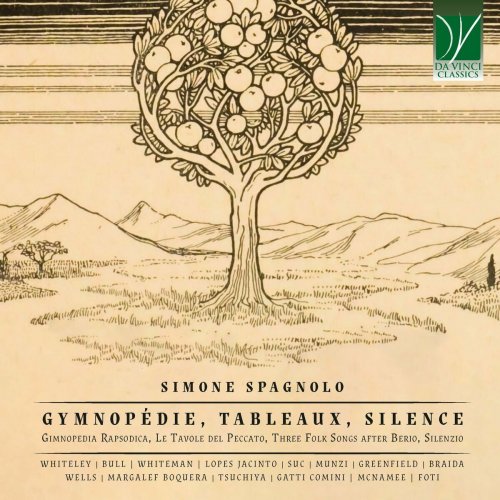
Artist: Clara Gatti Comini, Lucia Foti, Maria McNamee, Alison Wells, Biancamaria Munzi, Cèlia Margalef Boquera, Faith Whiteley, James Greenfield, Louis Suc, Maisie Whiteman, Marika Tsuchiya, Mary Bull, Ruben Lopes Jacinto, Serena Braida
Title: Simone Spagnolo: Gymnopédie, Tableaux, Silence
Year Of Release: 2024
Label: Da Vinci Classics
Genre: Classical
Quality: FLAC (tracks)
Total Time: 43:46 min
Total Size: 164 MB
WebSite: Album Preview
01. Gimnopedia Rapsodica, Processional dance, memories, echos, rhapsodic gestures, and an immaterial voiceTitle: Simone Spagnolo: Gymnopédie, Tableaux, Silence
Year Of Release: 2024
Label: Da Vinci Classics
Genre: Classical
Quality: FLAC (tracks)
Total Time: 43:46 min
Total Size: 164 MB
WebSite: Album Preview
02. Le Tavole del Peccato, Seven musical tableaux from the Original Sin according to Genesis: Tableau I
03. Le Tavole del Peccato, Seven musical tableaux from the Original Sin according to Genesis: Tableau II
04. Le Tavole del Peccato, Seven musical tableaux from the Original Sin according to Genesis: Tableau III
05. Le Tavole del Peccato, Seven musical tableaux from the Original Sin according to Genesis: Tableau IV
06. Le Tavole del Peccato, Seven musical tableaux from the Original Sin according to Genesis: Tableau V
07. Le Tavole del Peccato, Seven musical tableaux from the Original Sin according to Genesis: Tableau VI
08. Le Tavole del Peccato, Seven musical tableaux from the Original Sin according to Genesis: Tableau VII
09. Three Folk Songs after Berio
10. Silenzio (For prepared harp)
Gymnopédie, Tableaux, Silence comprises some of Simone Spagnolo’s most significant chamber works featuring the harp, an instrument celebrated as part of diverse and eclectic ensemble combinations. The compositions here included – Gimnopedia Rapsodica, Le Tavole del Peccato, Three Folk Songs after Berio, and Silenzio – capture different stages of Spagnolo’s creative production, offering a stimulating array of musical idiosyncrasies that range from the use of the prepared harp to graphic scores, from tetrachord-driven structures to re-imagined folkloristic songs.
Such a collection of works, composed across more than a decade, is brought together through a refined stylistic thread made of delicate yet vivid musical gestures, unapologetically rich melodies and counterpoints, evocative harmonic palettes, and a net of musical references that occasionally emerge, subtly, opening the music to wider horizons.
The voice – used as both a spoken and sung device – plays an important role, which does not principally reside in the meaning of the text, but rather in its structural and evocative usage. In Gimnopedia Rapsodica, for instance, a spoken voice emerges towards the end of the piece, as an ephemeral, indeterminate entity that enriches the music’s significance and enhances the listener’s imagination. In Le Tavole del Peccato, on the contrary, the voice is used as a ritualistic, declamatory element, providing narrative context to each tableau.
References to the past and other musical genres also have a prominent function, as for example in Three Folk Songs after Berio. This work, which re-imagines songs originating from different folklores, not only joins material drawn from the popular and the cultivated, but it also contributes to the idea that music – art in general – emerges from a re-elaboration of past models; a concept that was indeed dear to Luciano Berio, a composer whose ideas have influenced Spagnolo’s production in numerous ways.
This album was born from a network of splendid collaborations established with both exceptional young musicians and long-standing colleagues. A special mention goes to Gabriella Dall’Olio, superb musician and educator, who has generously supported the development of this album in many, precious ways
.
Such a collection of works, composed across more than a decade, is brought together through a refined stylistic thread made of delicate yet vivid musical gestures, unapologetically rich melodies and counterpoints, evocative harmonic palettes, and a net of musical references that occasionally emerge, subtly, opening the music to wider horizons.
The voice – used as both a spoken and sung device – plays an important role, which does not principally reside in the meaning of the text, but rather in its structural and evocative usage. In Gimnopedia Rapsodica, for instance, a spoken voice emerges towards the end of the piece, as an ephemeral, indeterminate entity that enriches the music’s significance and enhances the listener’s imagination. In Le Tavole del Peccato, on the contrary, the voice is used as a ritualistic, declamatory element, providing narrative context to each tableau.
References to the past and other musical genres also have a prominent function, as for example in Three Folk Songs after Berio. This work, which re-imagines songs originating from different folklores, not only joins material drawn from the popular and the cultivated, but it also contributes to the idea that music – art in general – emerges from a re-elaboration of past models; a concept that was indeed dear to Luciano Berio, a composer whose ideas have influenced Spagnolo’s production in numerous ways.
This album was born from a network of splendid collaborations established with both exceptional young musicians and long-standing colleagues. A special mention goes to Gabriella Dall’Olio, superb musician and educator, who has generously supported the development of this album in many, precious ways
![Connie Kay - My Blue Heaven (1990) [Hi-Res]](https://www.dibpic.com/uploads/posts/2026-09/1790152757_cover.jpg "Connie Kay - My Blue Heaven (1990) [Hi-Res]")


![Marty Ehrlich - OPEN AIR: The Complete Saxophone Quartet Compositions of Julius Hemphill (2026) [Hi-Res]](https://img.israbox.com/img/2026-09/24/zy8g472z5juijci7osa8npxsr.jpg "Marty Ehrlich - OPEN AIR: The Complete Saxophone Quartet Compositions of Julius Hemphill (2026) [Hi-Res]")
![Margaret Singana - Tribal Fence (2026) [Hi-Res]](https://www.dibpic.com/uploads/posts/2026-09/1790315409_cover.jpg "Margaret Singana - Tribal Fence (2026) [Hi-Res]")
![Jimetta Rose - MettaSun (2026) [Hi-Res]](https://img.israbox.com/img/2026-09/25/wazvmdr6r986fj2clok7djxp6.jpg "Jimetta Rose - MettaSun (2026) [Hi-Res]")