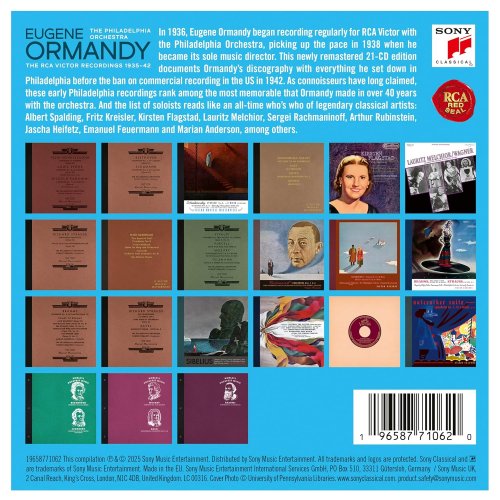
Eugene Ormandy - The RCA Victor Recordings 1935-42 (2025)
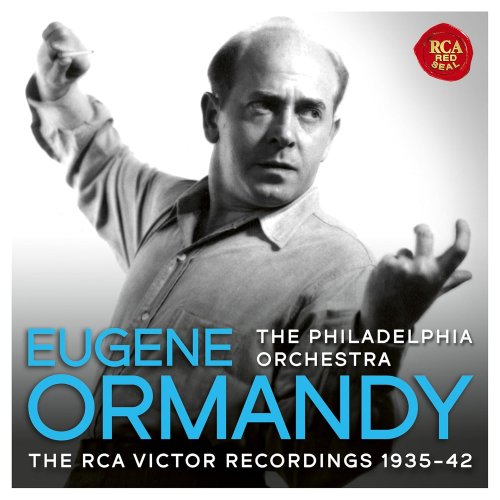
Artist: Eugene Ormandy
Title: The RCA Victor Recordings 1935-42
Year Of Release: 2025
Label: Sony Classical
Genre: Classical
Quality: FLAC (image+.cue,log,scans)
Total Time: 20:30:29
Total Size: 3.76 GB
WebSite: Album Preview
Title: The RCA Victor Recordings 1935-42
Year Of Release: 2025
Label: Sony Classical
Genre: Classical
Quality: FLAC (image+.cue,log,scans)
Total Time: 20:30:29
Total Size: 3.76 GB
WebSite: Album Preview
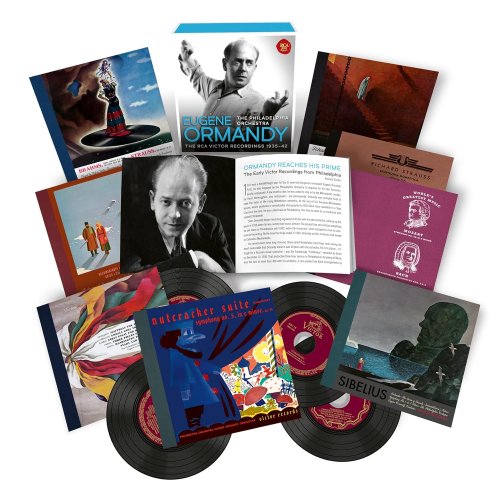
The Rca Victor Recordings 1935-42
1931 was the year of breakthrough for 32-year-old Hungarian immigrant Eugene Ormandy. Initially, he was hired by the Philadelphia Orchestra to represent his short-term prevented idol Toscanini. A few months later, he was asked to represent the also prevented conductor of the Minneapolis Symphony Orchestra - but in this case permanently. Soon Ormandy committed to assuming the direction of this emerging orchestra from the Midwest. After his five years of work in Minneapolis, during which he produced a considerable discography for RCA Victor (available in an 11-CD box from Sony Classical), Ormandy was recalled to Philadelphia, this time as a co-conductor alongside Leopold Stokowski. In 1936 he began making regular recordings for Victor with his new orchestra, and in 1938 he intensified this activity when he became its sole music director. Sony Classical is pleased to continue his comprehensive documentation of Eugene Ormandy's discography with a rerelease of 21 CDs containing everything he recorded in Philadelphia before the musicians union banned commercial recordings in 1942. By the time the strike ended in 1944, Ormandy and the orchestra had already switched to Columbia Masterworks.
1931 was the year of breakthrough for 32-year-old Hungarian immigrant Eugene Ormandy. Initially, he was hired by the Philadelphia Orchestra to represent his short-term prevented idol Toscanini. A few months later, he was asked to represent the also prevented conductor of the Minneapolis Symphony Orchestra - but in this case permanently. Soon Ormandy committed to assuming the direction of this emerging orchestra from the Midwest. After his five years of work in Minneapolis, during which he produced a considerable discography for RCA Victor (available in an 11-CD box from Sony Classical), Ormandy was recalled to Philadelphia, this time as a co-conductor alongside Leopold Stokowski. In 1936 he began making regular recordings for Victor with his new orchestra, and in 1938 he intensified this activity when he became its sole music director. Sony Classical is pleased to continue his comprehensive documentation of Eugene Ormandy's discography with a rerelease of 21 CDs containing everything he recorded in Philadelphia before the musicians union banned commercial recordings in 1942. By the time the strike ended in 1944, Ormandy and the orchestra had already switched to Columbia Masterworks.
Tracklist:
Disc: 1
1 I. Allegro molto appassionato (2025 Remastered Version)
2 II. Andante (2025 Remastered Version)
3 III. Allegretto non troppo - Allegro molto vivace (2025 Remastered Version)
4 I. Allegro molto (2025 Remastered Version)
5 II. Adagio - Andante (2025 Remastered Version)
6 III. Allegro moderato (2025 Remastered Version)
7 Violin Concerto No. 1 in D Major, Op. 6: I. Allegro maestoso - Tempo giusto (2025 Remastered Version)
Disc: 2
1 I. Adagio molto - Allegro con brio (2025 Remastered Version)
2 II. Andante cantabile con moto (2025 Remastered Version)
3 III. Minuet. Allegro molto e vivace (2025 Remastered Version)
4 IV. Finale. Adagio - Allegro molto e vivace (2025 Remastered Version)
5 I. Sostenuto assai (2025 Remastered Version)
6 II. Scherzo. Allegro vivace (2025 Remastered Version)
7 III. Adagio espressivo (2025 Remastered Version)
8 IV. Allegro molto vivace (2025 Remastered Version)
Disc: 3
1 I. Adagio - Allegro non troppo (2025 Remastered Version)
2 II. Allegro con grazia (2025 Remastered Version)
3 III. Allegro molto vivace (2025 Remastered Version)
4 IV. Finale (2025 Remastered Version)
5 1. Overture miniature (2025 Remastered Version)
6 a) Marche (2025 Remastered Version)
7 b) Danse de la fée-dragée (2025 Remastered Version)
8 c) Danse russe "Trépak" (2025 Remastered Version)
9 d) Danse arabe (2025 Remastered Version)
10 e) Danse chinoise (2025 Remastered Version)
11 f) Danse des mirlitons (2025 Remastered Version)
12 3. Valse des fleurs (2025 Remastered Version)
13 Christmas Eve, Act III: Church Scene (2025 Remastered Version)
Disc: 4
1 Promenade I (2025 Remastered Version)
2 1. The Gnome (2025 Remastered Version)
3 Promenade II (2025 Remastered Version)
4 2. The Old Castle (2025 Remastered Version)
5 Promenade III (2025 Remastered Version)
6 3. Tuileries (2025 Remastered Version)
7 4. Bydlo (2025 Remastered Version)
8 Promenade IV (2025 Remastered Version)
9 5. Ballet of the Unhatched Chicks (2025 Remastered Version)
10 6. "Samuel" Goldenberg and Schmuyle (2025 Remastered Version)
11 Promenade V (2025 Remastered Version)
12 7. Limoges - The Market (2025 Remastered Version)
13 8. Catacombs (2025 Remastered Version)
14 Con mortuis in lingua mortua (2025 Remastered Version)
15 9. The Hut on Fowl's Legs (2025 Remastered Version)
16 10. The Knight's Gate (2025 Remastered Version)
17 Les Préludes, S. 97 (2025 Remastered Version)
18 Romanian Rhapsody No. 1 in A Major, Op. 11 (2025 Remastered Version)
19 Préludes, Book I, L. 117: No. 12, Minstrels (2025 Remastered Version)
Disc: 5
1 Ah perfido!, Op. 65 - Konzertarie für Sopran und Orchester (2025 Remastered Version)
2 Oberon, Act II: "Ozean Du Ungeheuer" (2025 Remastered Version)
3 Fidelio, Op. 72, Act I: "Abscheulicher, Wo Eilst Du Hin?" (2025 Remastered Version)
4 Die Walküre, WWV 86B, Act I: "Du bist der Lenz" (2025 Remastered Version)
5 Die Walküre, WWV 86B, Act II: "Ho-Yo-To-Ho" (2025 Remastered Version)
6 Lohengrin, WWV 75, Act I: Elsas Traum (2025 Remastered Version)
7 Lohengrin, WWV 75, Act II, Scene 2: "Euch Lüften, die mein Klagen " (2025 Remastered Version)
8 Tannhäuser, WWV 70, Act II: "Dich teure Halle, grüß ich wieder" (2025 Remastered Version)
9 Tannhäuser, WWV 70, Act III: Elisabeths Gebet (2025 Remastered Version)
10 Götterdämmerung, WWV 86D, Act III: "Starke Scheite schichtet mir dort" (Brünnhilde's Immolation) (2025 Remastered Version)
11 Cantata No. 140: Now Let Every Tongue Adore Thee (2025 Remastered Version)
12 Louise, Act III: "Depuis le jour où je me suis donnée" (2025 Remastered Version)
13 L'enfant prodigue, L. 57: "L'année, en vain chasse l'année" (2025 Remastered Version)
Disc: 6
1 Die Walküre, WWV 86B, Act I: Winterstürme "Spring Song" (2025 Remastered Version)
2 Siegfried, WWV 86c, Act I: Notung! Notung! Neidliches Schwert! (2025 Remastered Version)
3 Siegfried, WWV 86c, Act I: Schmiedelied "Hoho! Hoho! Hohei" Schmiede, mein Hammer" (2025 Remastered Version)
4 Die Meistersinger von Nürnberg, WWV 96, Act I: Am stillen Herd (2025 Remastered Version)
5 Die Meistersinger, WWV 96, Act III: Morgenlich leuchtend "Prize Song" (2025 Remastered Version)
6 Lohengrin, WWV 75, Act III: In fernem Land "Lohengrin's Narrative" (2025 Remastered Version)
7 Parsifal, WWV 111, Act III: Nur eine Waffe taugt (2025 Remastered Version)
8 Wesendonck Lieder, WWV 91: No. 4, Schmerzen (2025 Remastered Version)
9 Wesendonck Lieder, WWV 91: No. 5, Träume (2025 Remastered Version)
10 The Flying Dutchman, WWV 63, Act I: Steuermann Lied (2025 Remastered Version)
11 Tannhäuser, WWV 70, Act I: Dir töne Lob! (2025 Remastered Version)
12 Tannhäuser, WWV 70, Act III: Rome Narrative (2025 Remastered Version)
13 Lohengrin, WWV 75, Act III: Mein lieber Schwan "Lohengrins Abschied und Finale" (2025 Remastered Version)
14 Parsifal, WWV 111, Act II: Amfortas! Die Wunde! (2025 Remastered Version)
15 Die Meistersinger von Nürnberg, WWV 96, Act III: Tanz der Lehrbuben & Einzug der Meister (2025 Remastered Version)
Disc: 7
1 Thema I. Bewegt -Thema II. Sehr lebhaft - Thema III. Ruhig (2025 Remastered Version)
2 Scherzo (munter) - Wiegenlied. Mässig langsam (2025 Remastered Version)
3 Adagio - Langsam (2025 Remastered Version)
4 Finale - Sehr lebhaft (2025 Remastered Version)
5 Der Rosenkavalier, Suite, TrV 227d (2025 Remastered Version)
Disc: 8
1 I. The Explorers. In the Desert. In the Mountains (2025 Remastered Version)
2 II. The Spanish Settlements (2025 Remastered Version)
3 III. The Wagon-Trains Of The Pioneers (2025 Remastered Version)
4 I. Allegro moderato (2025 Remastered Version)
5 II. Molto moderato (2025 Remastered Version)
6 III. Allegro moderato ma vigorosamente (2025 Remastered Version)
7 Cakewalk - Scherzo from Symphony No. 4 (2025 Remastered Version)
8 Hebraic Poem No. 1 (2025 Remastered Version)
9 Hebraic Poem No. 2 (2025 Remastered Version)
Disc: 9
1 I. Allegro molto (2025 Remastered Version)
2 II. Larghetto e spiritoso (2025 Remastered Version)
3 III. Allegro (2025 Remastered Version)
4 Overture. Adagio - Allegro moderato (2025 Remastered Version)
5 Tempo di Menuet (2025 Remastered Version)
6 Lento. Prelude for the Witches (2025 Remastered Version)
7 Echo Dance of the Furies (2025 Remastered Version)
8 Ritornelle (2025 Remastered Version)
9 Prelude to Act III (2025 Remastered Version)
10 Recitative and Aria "When I am laid in earth" (2025 Remastered Version)
11 I. Allegro (2025 Remastered Version)
12 II. Andante grazioso (2025 Remastered Version)
13 V. Menuetto & Trio (2025 Remastered Version)
14 VI. Andante - Allegro assai (2025 Remastered Version)
15 1. Ouverture (2025 Remastered Version)
16 2. Les Plaisirs (2025 Remastered Version)
17 3. Air à L'italien (2025 Remastered Version)
18 4. Menuet II (2025 Remastered Version)
19 5. Rejouissance (2025 Remastered Version)
20 6. Passepied I and II (2025 Remastered Version)
21 7. Polonaise (2025 Remastered Version)
22 Five-Part Fantasy in D Major (2025 Remastered Version)
Disc: 10
1 I. Vivace - Moderato - Vivace (2025 Remastered Version)
2 II. Andante (2025 Remastered Version)
3 III. Allegro vivace - Andante ma non troppo - Tempo I (2025 Remastered Version)
4 I. Allegro vivace - Moderato - Allegro assai (2025 Remastered Version)
5 II. Largo (2025 Remastered Version)
6 III. Allegro vivace (2025 Remastered Version)
Disc: 11
1 I. Allegro ma non tanto (2025 Remastered Version)
2 II. Intermezzo - Adagio (2025 Remastered Version)
3 III. Finale - Alla breve (2025 Remastered Version)
4 I. Allegro molto moderato (2025 Remastered Version)
5 II. Adagio (2025 Remastered Version)
6 III. Allegro moderato molto e marcato - Quasi presto (2025 Remastered Version)
Disc: 12
1 I. Allegro (2025 Remastered Version)
2 II. Andante (2025 Remastered Version)
3 III. Vivace non troppo (2025 Remastered Version)
4 Introduktion. Mäßiges Zeitmaß (2025 Remastered Version)
5 Thema. Mäßig: Don Quixote, der Ritter von der traurigen Gestalt - Maggiore: Sancho Panza (2025 Remastered Version)
6 Variation I. Gemächlich (2025 Remastered Version)
7 Variation II. Kriegerisch (2025 Remastered Version)
8 Variation III. Mäßiges Zeitmass (2025 Remastered Version)
9 Variation IV. Etwas breiter (2025 Remastered Version)
10 Variation V. Sehr langsam (2025 Remastered Version)
11 Variation VI. Schnell (2025 Remastered Version)
12 Variation VII. Ein wenig ruhiger als vorher (2025 Remastered Version)
13 Variation VIII. Gemächlich (2025 Remastered Version)
14 Variation IX. Schnell und stürmisch (2025 Remastered Version)
15 Variation X. Viel breiter (2025 Remastered Version)
16 Finale: Sehr ruhig (2025 Remastered Version)
Disc: 13
1 I. Allegro non troppo (2025 Remastered Version)
2 II. Adagio non troppo (2025 Remastered Version)
3 III. Allegretto grazioso (quasi andantino) (2025 Remastered Version)
4 IV. Allegro con spirito (2025 Remastered Version)
5 Alto Rhapsody, Op. 53 "Harzreise im Winter" (2025 Remastered Version)
6 8 Lieder and Songs, Op. 59, No. 8: Dein blaues Auge hält so still (2025 Remastered Version)
7 5 Poems, Op. 19, No. 4: Der Schmied (2025 Remastered Version)
8 5 Lieder, Op. 105: "Immer leiser wird mein Schlummer" (2025 Remastered Version)
9 Von ewiger Liebe, Op. 43, No. 1 (2025 Remastered Version)
Disc: 14
1 I. Der Held (2025 Remastered Version)
2 II. Des Helden Widersacher (2025 Remastered Version)
3 III. Des Helden Gefährtin (2025 Remastered Version)
4 IV. Des Helden Walstatt (2025 Remastered Version)
5 V. Des Helden Friedenswerke (2025 Remastered Version)
6 VI. Des Helden Weltflucht und Vollendung (2025 Remastered Version)
7 I. Lever du jour (Daybreak) (2025 Remastered Version)
8 II. Pantomime (2025 Remastered Version)
9 III. Danse générale (2025 Remastered Version)
Disc: 15
1 Finlandia, Op. 26 (2025 Remastered Version)
2 Lemminkäinen Suite, Op. 22, No. 2: The Swan of Tuonela (2025 Remastered Version)
3 Lemminkäinen Suite, Op. 22, No. 4: Lemminkäinen's Return (2025 Remastered Version)
4 I. Andante, ma non troppo - Allegro energico (2025 Remastered Version)
5 II. Andante (ma non troppo lento) (2025 Remastered Version)
6 III. Scherzo. Allegro (2025 Remastered Version)
7 IV. Finale (Quasi una fantasia) (2025 Remastered Version)
Disc: 16
1 I. Engelkonzert (2025 Remastered Version)
2 II. Grablegung (2025 Remastered Version)
3 III. Versuchung des heiligen Antonius (2025 Remastered Version)
4 Amelia Goes to the Ball - Overture (2025 Remastered Version)
5 First Essay for Orchestra, Op. 12 (2025 Remastered Version)
6 Dance Tunes for Strings and Percussion (2025 Remastered Version)
7 Evening Piece (2025 Remastered Version)
8 Dance Tunes for Full Orchestra (2025 Remastered Version)
9 Washington Post March (2025 Remastered Version)
10 The Stars and Stripes Forever (2025 Remastered Version)
Disc: 17
1 Prelude and Fugue in F Minor, BWV 534 (Arranged for Orchestra by Lucien Cailliet) (2025 Remastered Version)
2 Jesu, Joy of Man's Desiring (from Cantata No. 147, BWV 147) (2025 Remastered Version)
3 Preludio in E Major from Partita No 3 for Violin Unaccompanied, BWV 1006 (2025 Remastered Version)
4 Prelude and Fugue in B Minor, BWV 544 (2025 Remastered Version)
5 St. Matthew Passion, BWV 244: Herzliebster Jesu (2025 Remastered Version)
6 Frühlingsstimmen - Walzer, Op. 410 (2025 Remastered Version)
7 Wiener Blut Walzer, Op. 354 (2025 Remastered Version)
8 Kaiser-Walzer, Op. 437 (2025 Remastered Version)
Disc: 18
1 1. Overture miniature (2025 Remastered Version)
2 a) Marche. Tempo di marcia viva (2025 Remastered Version)
3 b) Danse de la Fée-Dragée. Andante ma non troppo (2025 Remastered Version)
4 c) Danse russe. Trépak. Tempo di Trepak, molto vivace (2025 Remastered Version)
5 d) Danse arabe. Allegretto (2025 Remastered Version)
6 e) Danse chinoise. Allegro moderato (2025 Remastered Version)
7 f) Danse des mirlitons. Moderato assai (2025 Remastered Version)
8 3. Valse des fleurs. Tempo di Valse (2025 Remastered Version)
9 I. Andante - Allegro con anima (2025 Remastered Version)
10 II. Andante cantabile, con alcuna licenza (2025 Remastered Version)
11 III. Valse - Allegro moderato (2025 Remastered Version)
12 IV. Finale - Andante maestoso - Allegro vivace (2025 Remastered Version)
Disc: 19
1 I. Allegro con brio (2025 Remastered Version)
2 II. Andante con moto (2025 Remastered Version)
3 III. Scherzo - Allegro (2025 Remastered Version)
4 IV. Finale - Allegro (2025 Remastered Version)
5 I. Allegro moderato (2025 Remastered Version)
6 II. Andante con moto (2025 Remastered Version)
Disc: 20
1 I. Allegro molto (2025 Remastered Version)
2 II. Andante (2025 Remastered Version)
3 III. Menuetto. Allegretto (2025 Remastered Version)
4 IV. Finale. Allegro assai (2025 Remastered Version)
5 I. Allegro (2025 Remastered Version)
6 II. Andante (2025 Remastered Version)
7 III. Allegro assai (2025 Remastered Version)
8 I. Allegro (2025 Remastered Version)
9 II. Allegro (2025 Remastered Version)
Disc: 21
1 I. Allegro non troppo (2025 Remastered Version)
2 II. Adagio non troppo (2025 Remastered Version)
3 III. Allegretto grazioso (Quasi Andantino) - Presto ma non assai (2025 Remastered Version)
4 IV. Allegro con spirito (2025 Remastered Version)
1931 was the breakthrough year for 32-year-old Hungarian immigrant Eugene Ormandy. First, he was engaged by the Philadelphia Orchestra to deputize for his idol Toscanini, who was briefly indisposed. Then, a few months later, he was asked to step in for the conductor of the Minneapolis Symphony Orchestra, also indisposed – but in this case permanently. Soon Ormandy was hired to take over that rising Midwestern orchestra. At the end of his five-year tenure in Minneapolis, which produced a considerable discography for RCA Victor (available in an 11-CD Sony Classical box set), Ormandy was called back to Philadelphia, this time to become its co-conductor with Leopold Stokowski. In 1936, he began recording regularly for Victor with his new orchestra, picking up the pace in 1938 when he became its sole music director. Sony Classical is pleased to continue its comprehensive documentation of Eugene Ormandy’s discography with a new 21-CD release of everything he set down in Philadelphia before the ban on commercial recording instigated by the musicians’ union in 1942. By the time the strike ended in 1944, Ormandy and the orchestra had moved to Columbia Masterworks.
As connoisseurs have long known, these early Philadelphia albums are among the most impressive performances Ormandy set down in over 40 years at the orchestra’s helm. The first to be released – fittingly enough for a Russian music specialist – was Tchaikovsky’s “Pathétique” Symphony, recorded by Victor on December 13, 1936. That three-hour session in Philadelphia’s Academy of Music, the orchestra’s home, was the first of more than 400 led by Ormandy. And it was highly productive – Ormandy had a reputation as a fast worker – yielding not only the Tchaikovsky, but also two Bach arrangements by Lucien Cailliet, a Philadelphia Orchestra clarinetist and its staff arranger, the first three movements of Schumann’s Second Symphony and, most importantly, Fritz Kreisler’s arrangement of Paganini’s D major Violin Concerto, with Kreisler himself as soloist.
More Tchaikovsky followed during this early Victor stint: in 1941, Ormandy and the Philadelphians recorded the Fifth Symphony and the Nutcracker Suite. The latter’s matrices suffered from processing problems that rendered them too noisy to release until now. The orchestra’s contract, however, allowed them to re-make the recording for RCA in 1945, even though they’d already gone over to Columbia, and it has been possible to include both versions here.
Ormandy recorded Mussorgsky’s Pictures at an Exhibition, one of his most celebrated interpretations, in 1937, but not in the familiar Ravel orchestration that he would always use later. Having just taken over as sole conductor of the orchestra after Stokowski’s resignation, he wanted his own version of the Pictures, so he commissioned a new score from the orchestra’s house arranger, Lucien Cailliet.
The Philadelphia Orchestra’s most famous Russian connection was with Sergei Rachmaninoff, who premièred a number of his works with them during Stokowski’s tenure. When Ormandy assumed the music directorship, he was thrilled to continue the partnership – especially as he had developed a friendship with the composer at his 1931 Minneapolis SO début concert, in which Rachmaninoff was the soloist. The partnership reached its height in late 1939 when Ormandy mounted a “Rachmaninoff Festival” at the Academy of Music and New York’s Carnegie Hall to mark the 30th anniversary of his Philadelphia Orchestra début. They also took advantage of the opportunity to record three of Rachmaninoff’s concertos for RCA, the First, Third and Fourth, legendary performances that have never been out of the catalogue and are, of course, reissued here.
At the Budapest Academy, Ormandy had studied the violin with a pupil of Brahms’s great friend Joseph Joachim – who also encouraged Ormandy as a child, so Brahms’s music was in his blood from the beginning. As a conductor, Brahms’s symphonies were at the core of his repertoire, and he gave more performances of them with the Philadelphia Orchestra than any other conductor in American musical history. He first recorded the Second with the Philadelphians anonymously for the “World’s Greatest Music” series in March 1939, and nine months later conducted a tauter, “official” version for release on RCA. Both are included here along with Ormandy’s other recordings for “World’s Greatest Music”, all made in 1938: the Mozart G minor, Beethoven’s Fifth, Schubert’s “Unfinished” and the Brandenburg Concertos Nos. 2 and 3.
Two other famous Brahms recordings from 1939 are the Alto Rhapsody with Marian Anderson and the Double Concerto with Jascha Heifetz and Emanuel Feuermann, about which Gramophone’s original reviewer wrote: “Rarely can the powers of two string players have been so fully extended, so richly proved … The whole thing is tremendous: a manifestation, for all who have an ear of the soul, of the composer’s greatness of heart and mind.”
Soloists revered Ormandy throughout his career. Said Isaac Stern: “There was not a single conductor who was a greater colleague in the making of a concerto record.” In addition to the Brahms Double and the Paganini First Concerto with Kreisler, mentioned earlier, the new Sony collection reissues the Mendelssohn and Spohr’s No. 8 with another famous violinist, Albert Spalding, and the Grieg Piano Concerto with Arthur Rubinstein: “A glittering specimen and exuberantly played … The best of the modern readings” (Gramophone).
Sibelius was another leading composer Ormandy knew personally and performed regularly – he also visited him in Finland and brought him to Philadelphia. For an album to mark the composer’s 75th birthday in 1940, he recorded three tone poems, while the next year saw a new recording of the First Symphony (Ormandy’s earlier one was made in Minneapolis in 1935), which he identified as “the first of the master’s symphonies I ever conducted”. Two further versions would follow, in 1962 (for Columbia) and in 1978 (for RCA).
Ormandy and the Philadelphia Orchestra were Victor’s chief Richard Strauss exponents during these years, making the first electrical recording of the Symphonia Domestica in 1938, followed in 1939 by Ein Heldenleben and in 1940 by Don Quixote, with Emanuel Feuermann. Hindemith’s “Mathis der Maler” Symphony was still a new work when Ormandy recorded it in 1940, only six years after the composer introduced it with his own Berlin Philharmonic recording. Strauss family waltzes had already featured in Ormandy’s Minneapolis recordings. The three waltzes in this Philadelphia set earned praise from Gramophone in 1942: “You will enjoy the brilliance of the combinations of tone, and their balance – one of the exciting things about all the best American recordings … Here is full-voiced tonal splendour.”
American music was a prominent feature of this conductor’s repertoire – he was always eager to promote the composers of his adopted homeland. Here we find the first recording of any work by Gian Carlo Menotti, his Amelia Goes to the Ball Overture, and the earliest recording of an orchestral work by Samuel Barber, his First Essay for Orchestra, as well as pieces by Roy Harris and two Sousa marches from the orchestra’s last session before the musicians’ strike shut down commercial recording for the next three years. But not before Ormandy and his Philadelphians had amassed the treasures brought together here for the first time.
As connoisseurs have long known, these early Philadelphia albums are among the most impressive performances Ormandy set down in over 40 years at the orchestra’s helm. The first to be released – fittingly enough for a Russian music specialist – was Tchaikovsky’s “Pathétique” Symphony, recorded by Victor on December 13, 1936. That three-hour session in Philadelphia’s Academy of Music, the orchestra’s home, was the first of more than 400 led by Ormandy. And it was highly productive – Ormandy had a reputation as a fast worker – yielding not only the Tchaikovsky, but also two Bach arrangements by Lucien Cailliet, a Philadelphia Orchestra clarinetist and its staff arranger, the first three movements of Schumann’s Second Symphony and, most importantly, Fritz Kreisler’s arrangement of Paganini’s D major Violin Concerto, with Kreisler himself as soloist.
More Tchaikovsky followed during this early Victor stint: in 1941, Ormandy and the Philadelphians recorded the Fifth Symphony and the Nutcracker Suite. The latter’s matrices suffered from processing problems that rendered them too noisy to release until now. The orchestra’s contract, however, allowed them to re-make the recording for RCA in 1945, even though they’d already gone over to Columbia, and it has been possible to include both versions here.
Ormandy recorded Mussorgsky’s Pictures at an Exhibition, one of his most celebrated interpretations, in 1937, but not in the familiar Ravel orchestration that he would always use later. Having just taken over as sole conductor of the orchestra after Stokowski’s resignation, he wanted his own version of the Pictures, so he commissioned a new score from the orchestra’s house arranger, Lucien Cailliet.
The Philadelphia Orchestra’s most famous Russian connection was with Sergei Rachmaninoff, who premièred a number of his works with them during Stokowski’s tenure. When Ormandy assumed the music directorship, he was thrilled to continue the partnership – especially as he had developed a friendship with the composer at his 1931 Minneapolis SO début concert, in which Rachmaninoff was the soloist. The partnership reached its height in late 1939 when Ormandy mounted a “Rachmaninoff Festival” at the Academy of Music and New York’s Carnegie Hall to mark the 30th anniversary of his Philadelphia Orchestra début. They also took advantage of the opportunity to record three of Rachmaninoff’s concertos for RCA, the First, Third and Fourth, legendary performances that have never been out of the catalogue and are, of course, reissued here.
At the Budapest Academy, Ormandy had studied the violin with a pupil of Brahms’s great friend Joseph Joachim – who also encouraged Ormandy as a child, so Brahms’s music was in his blood from the beginning. As a conductor, Brahms’s symphonies were at the core of his repertoire, and he gave more performances of them with the Philadelphia Orchestra than any other conductor in American musical history. He first recorded the Second with the Philadelphians anonymously for the “World’s Greatest Music” series in March 1939, and nine months later conducted a tauter, “official” version for release on RCA. Both are included here along with Ormandy’s other recordings for “World’s Greatest Music”, all made in 1938: the Mozart G minor, Beethoven’s Fifth, Schubert’s “Unfinished” and the Brandenburg Concertos Nos. 2 and 3.
Two other famous Brahms recordings from 1939 are the Alto Rhapsody with Marian Anderson and the Double Concerto with Jascha Heifetz and Emanuel Feuermann, about which Gramophone’s original reviewer wrote: “Rarely can the powers of two string players have been so fully extended, so richly proved … The whole thing is tremendous: a manifestation, for all who have an ear of the soul, of the composer’s greatness of heart and mind.”
Soloists revered Ormandy throughout his career. Said Isaac Stern: “There was not a single conductor who was a greater colleague in the making of a concerto record.” In addition to the Brahms Double and the Paganini First Concerto with Kreisler, mentioned earlier, the new Sony collection reissues the Mendelssohn and Spohr’s No. 8 with another famous violinist, Albert Spalding, and the Grieg Piano Concerto with Arthur Rubinstein: “A glittering specimen and exuberantly played … The best of the modern readings” (Gramophone).
Sibelius was another leading composer Ormandy knew personally and performed regularly – he also visited him in Finland and brought him to Philadelphia. For an album to mark the composer’s 75th birthday in 1940, he recorded three tone poems, while the next year saw a new recording of the First Symphony (Ormandy’s earlier one was made in Minneapolis in 1935), which he identified as “the first of the master’s symphonies I ever conducted”. Two further versions would follow, in 1962 (for Columbia) and in 1978 (for RCA).
Ormandy and the Philadelphia Orchestra were Victor’s chief Richard Strauss exponents during these years, making the first electrical recording of the Symphonia Domestica in 1938, followed in 1939 by Ein Heldenleben and in 1940 by Don Quixote, with Emanuel Feuermann. Hindemith’s “Mathis der Maler” Symphony was still a new work when Ormandy recorded it in 1940, only six years after the composer introduced it with his own Berlin Philharmonic recording. Strauss family waltzes had already featured in Ormandy’s Minneapolis recordings. The three waltzes in this Philadelphia set earned praise from Gramophone in 1942: “You will enjoy the brilliance of the combinations of tone, and their balance – one of the exciting things about all the best American recordings … Here is full-voiced tonal splendour.”
American music was a prominent feature of this conductor’s repertoire – he was always eager to promote the composers of his adopted homeland. Here we find the first recording of any work by Gian Carlo Menotti, his Amelia Goes to the Ball Overture, and the earliest recording of an orchestral work by Samuel Barber, his First Essay for Orchestra, as well as pieces by Roy Harris and two Sousa marches from the orchestra’s last session before the musicians’ strike shut down commercial recording for the next three years. But not before Ormandy and his Philadelphians had amassed the treasures brought together here for the first time.