Patxi Montero, Michele Fattori, Alice Baccalini, Emiliano Rodolfi, Eduardo Beltran - Mozart, Haydn, Beethoven: Lumi (2025)
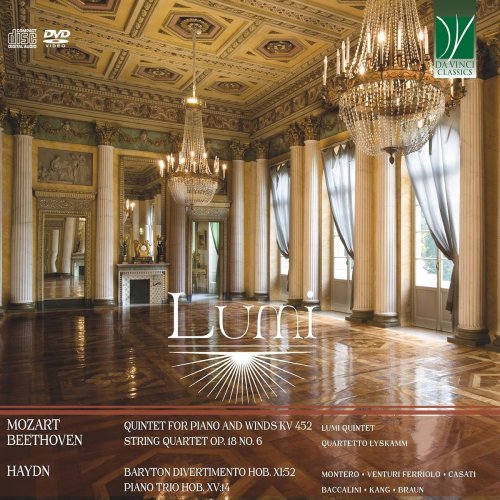
Artist: Patxi Montero, Michele Fattori, Alice Baccalini, Emiliano Rodolfi, Eduardo Beltran, Daniele Bolzonella, Quartetto Lyskamm, Francesca Venturi Ferriolo, Giorgio Casati, Suyeon Kang, Ursina Maria Braun
Title: Mozart, Haydn, Beethoven: Lumi
Year Of Release: 2025
Label: Da Vinci Classics
Genre: Classical
Quality: flac lossless (tracks)
Total Time: 01:23:06
Total Size: 353 mb
WebSite: Album Preview
TracklistTitle: Mozart, Haydn, Beethoven: Lumi
Year Of Release: 2025
Label: Da Vinci Classics
Genre: Classical
Quality: flac lossless (tracks)
Total Time: 01:23:06
Total Size: 353 mb
WebSite: Album Preview
01. Quintet in E-Flat Major, KV 452: I. Largo – Allegro moderato
02. Quintet in E-Flat Major, KV 452: II. Larghetto
03. Quintet in E-Flat Major, KV 452: III. Rondo. Allegretto
04. String Quartet No.6 in B-Flat Major, Op. 18 No. 6: I. Allegro con brio
05. String Quartet No.6 in B-Flat Major, Op. 18 No. 6: II. Adagio ma non troppo
06. String Quartet No.6 in B-Flat Major, Op. 18 No. 6: III. Scherzo. Allegro
07. String Quartet No.6 in B-Flat Major, Op. 18 No. 6: IV. La Malinconia. Allegretto quasi Allegro
08. Baryton Trio in D Major, Hob. XI:52: No. 1, Adagio – Adagio
09. Baryton Trio in D Major, Hob. XI:52: No. 2, Allegro
10. Baryton Trio in D Major, Hob. XI:52: No. 3, Minuet alla zoppa. Trio al contrario
11. Piano Trio in A-Flat Major, Hob. XV:14: No. 1, Allegro moderato
12. Piano Trio in A-Flat Major, Hob. XV:14: II. Adagio – Rondo. Vivace
The French word lumière activates several possible actions that place center stage the precarious force of light: one immediately thinks of illuminating—bringing light to what is obscure—or of shedding light, by candlelight, on the finest articulations of something, casting a beam to explore its limits.
The glow of candlelight is precarious, and the near-limitless availability of modern electricity has dulled our sensibility to it. In the century of the Lumières that glow lasts only briefly—like music—consumed by time and capable of lighting only one side of a thing, so that it may then be integrated into a whole, the outcome of a synthesis of all those facets. If the theme of knowledge’s precariousness is present in Baroque culture—where extraordinary still lifes with skulls, dice, and candles speak of human fragility—in the eighteenth century the problem changes its meaning. Precariousness becomes a value: an element of the human to be consciously affirmed in the face of nature’s boundlessness. That flicker of light can, utopically, reach the Masonic sun of Die Zauberflöte; it must be claimed not merely as a way of feeling but as a way of proceeding. To seize upon a single point—an aspect of experience—and grasp its most delicate, hidden articulations is not an act of omnipotence or a subjugation of nature, but a demand for transparency that, moving by small steps, can extend to the systematic thought of the Encyclopédie. There, too, everything moves under the sign of the human: there is an objective side—the entries, the individual objects classified, analyzed, narrated one by one. Yet this objective side must be integrated into a broader design that recounts how forms of knowledge are woven into the world of human experience, as though systematic knowledge and the study of emotion could never be torn apart. Novel, science, and philosophy—embodied in a figure like Diderot—are in constant communication: a utopian fabric of small cells connecting without interruption, in the hope of a better order built by small steps.
To “dare to know” (sapere aude) means projecting this virtuous filling-in of gaps onto the entire historical world of human institutions—of art and letters—because human beings leave traces of themselves everywhere. The realm of nature is indeed a book inscribed in rhetorical and mathematical characters in which everyone has the right to participate, for the world’s style is a discourse of small forms: discursive, not purely linguistic, because there is a general, rational design in which human limits and candle-lit understanding live together. And this possibility is a promise addressed to all humanity.
The idea of a universal weave also informs the philosophy of music. It has been shaken by a remarkable discovery: in the becoming of sound—in the way sounds articulate among themselves—there exists a harmonic model whereby we never hear a single, pure sound in isolation. Here, too, an ordering principle is at work: every sound is surrounded by a cluster of others that float around it, resonate literally within it, and determine the field of its possible relations. Thus the formal element and the human element—the experimentalism of tonal harmony and the cantabile richness of song—press forward with equal force to narrate the world of affects and emotions, of festivity and of musical interiority.
The choice of Lumi arises from an awareness of this bond, while deliberately selecting a model structurally devoid of words: the world of chamber music in its purest forms—trio, string quartet—or in the hybrid guise of chamber music and serenade, the quintet for piano and winds. One seems to enter the realm of pure form, of the tight logic of instrumental music; yet this is how it appears to us, not to the composers who commit themselves to these genres. In the DVD we briefly discuss the structure of these pieces; we now take it up again in order to make its meaning explicit from this specific point of view.
Thus the fully established Haydn of the Trio in A-flat major relies on a series of theatrical models to narrate the boldness of his harmonic conception. The aim is to lead the listener—and the amateur practitioner of music-making—into a most refined conversation in which the initial cue of one instrument is developed by another. As in a wordless stage scene, the instruments converse: the violin at times echoes the last concertante phrases of the others, at times develops them autonomously. Through the dialogic expedient of mime, form acquires a relentless clarity while expressing itself in profoundly human attitudes, balancing utterance and writing so that neither may prevail over the other.
A form of extreme civility presents itself: no text could sustain gestural intentions made of pure music. A similar play unfolds in the Adagio, where the piano develops the violin’s melody, comments on it, varies it, always seeking completion in the strings’ magical staccato figures. An aria is mimed, a concertato, a whole mimetic horizon that lends Haydn’s music the sheen of a mirror. The same sense of participation extends to Prince Esterházy’s use of the baryton. Here, too, one begins from a limit to be overcome: an instrument that evokes the popular, to be inserted into the highly evolved writing of a dark-hued string trio—an ensemble where the dusky colors of viola and cello interweave. In this sphere there is, first of all, an awareness of a writing that plays with the timbral elegance of an instrument not agile yet capable of astonishing harmonic color, of precious dancing drones, of quasi-sacred forms of song. Everything must occur together, in the deft and light evocation of a rural world. The phraseological dimension enables precisely these imitative games, allowing the listener to participate in a coded dialogue—what will become a hallmark of Romanticism.
The same sensation takes shape in listening to Mozart’s Quintet K. 452, perhaps the most celebrated work in this collection: what in Haydn is dialogue becomes in Mozart dramatic mimesis—the theater of divertimento, of pathos, of the coup de théâtre. Yet here, too, it becomes imperative to impose a discipline of transparency on this manner of narration by transforming the various compositional sections into a concatenation of scenes. One might speak of a form narrated in figura, according to the ancient Baroque model; but Mozart’s paradisal world has far more ironic and earthy accents. For irony is intrinsic to this Enlightenment habit of rereading the genres: if there is a universal bond in the way the world of experience is organized—if the novel can become an analogon of the science of human behavior—then every musical form has a double in other arts. And this ambiguity emerges with full rights in the choice to entitle a string quartet with the theme of Melancholy, as Beethoven does in op. 18. Melancholy arises from a sense of defeat and, at the same time, from a process of intellectual overexcitement: faced with the Sublime—with the immensity of stars or galaxies, faced with spectacles in which the subjugating power of the infinite erupts, whether in the small or in the great—the mind withdraws, in Enlightenment fashion, into its limits, feeling nostalgia for a missing fullness that intuits the infinite yet cannot grasp it. And after this weariness, which looms from afar until it imposes itself upon the listener, there comes a dancing, light finale. To close a string quartet with such a powerful contrast is to carry that tension into the transparent dialectic of dramatic form, clouding it with a gesture that seems consolatory.
Lumi thus takes shape in the intermingling of very clear intentions: behind the theme of classicism lies a profound expressive awareness which—as Charles Rosen rightly observed—turns it into a style, into a game of recurring elements that return under an ironic veil and make themselves recognized. Precisely for this reason it makes sense to resort to instruments as close as possible to the originals. The brilliance of modern instruments is certainly overwhelming when set against the more tenuous, opaque, and light colors of early instruments.
The music of the classical style reveals itself, then, as a continuous sliding among nuances, coloring the occurrence of feelings in the act—their anatomy. The whole world of penumbras, of the stubborn will to illuminate by candlelight the articulations of human feeling—together with music’s crystalline form—finds, in the domain of reduced and allusive sonorities capable of singing without blaring, a profound image of the music’s diffuse function, and of its deep ethical, civic, and educational commitment. The formation of refined taste in the individual listener seems to propose an exercise in humility in listening to the world—quite the opposite of what Horkheimer and Adorno read in the Enlightenment. Small worlds, small spaces, few listeners compared with today’s concert halls: theaters of expressive opacity that ask to be illuminated by candlelight. And thus crescendos—deprived of the natural brilliance of modern instruments—gain a more ambiguous, hidden thickness; they demand far greater attentiveness. In this leaning-in of the ear toward the warm, opaque world of the early instrument, there perhaps lies the modern listener’s own sapere aude.
![Florian Stoffner - bijou (2026) [Hi-Res]](https://www.dibpic.com/uploads/posts/2026-07/1784835081_cover.jpg "Florian Stoffner - bijou (2026) [Hi-Res]")
![Ancient Infinity Orchestra - It's Always About Liberation (2026) [Hi-Res]](https://www.dibpic.com/uploads/posts/2026-07/1784644511_folder.jpg "Ancient Infinity Orchestra - It's Always About Liberation (2026) [Hi-Res]")
![Catherine Sikora & Finola Merivale - Abhaile (2026) [Hi-Res]](https://www.dibpic.com/uploads/posts/2026-07/1784834364_cover.jpg "Catherine Sikora & Finola Merivale - Abhaile (2026) [Hi-Res]")
![Daniel Herskedal, Eyolf Dale & Helge Andreas Norbakken - Movements of Air (Deluxe Edition) (2026) [Hi-Res]](https://www.dibpic.com/uploads/posts/2026-07/1784664059_a3233301775_10.jpg "Daniel Herskedal, Eyolf Dale & Helge Andreas Norbakken - Movements of Air (Deluxe Edition) (2026) [Hi-Res]")