Blasio-Redorici Piano Duo - Myricae: Piano Four Hands in 20th-Century Italy (2025)
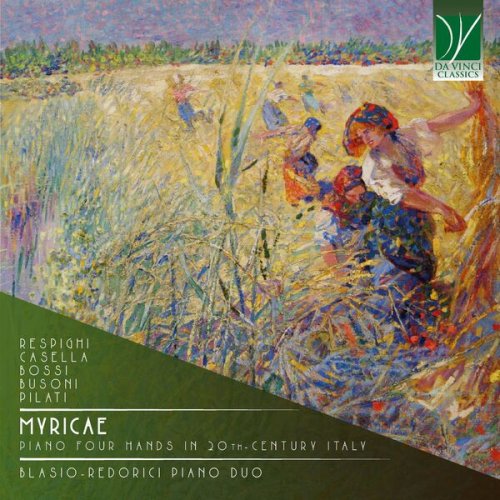
Artist: Blasio-Redorici Piano Duo
Title: Myricae: Piano Four Hands in 20th-Century Italy
Year Of Release: 2025
Label: Da Vinci Classics
Genre: Classical Piano
Quality: flac lossless (tracks)
Total Time: 00:54:11
Total Size: 173 mb
WebSite: Album Preview
TracklistTitle: Myricae: Piano Four Hands in 20th-Century Italy
Year Of Release: 2025
Label: Da Vinci Classics
Genre: Classical Piano
Quality: flac lossless (tracks)
Total Time: 00:54:11
Total Size: 173 mb
WebSite: Album Preview
01. Sei piccoli pezzi, P. 149: No. 1, Romanza
02. Sei piccoli pezzi, P. 149: No. 2, Canto di caccia siciliano
03. Sei piccoli pezzi, P. 149: No. 3, Canzone armena
04. Sei piccoli pezzi, P. 149: No. 4, Natale, Natale!
05. Sei piccoli pezzi, pt. 149: No. 5, Cantilena scozzese
06. Sei piccoli pezzi, P. 149: No. 6, Piccoli highlanders
07. Pagine di guerra, Op. 25: No. 1, Nel Belgio: sfilata di artiglieria pesante tedesca
08. Pagine di guerra, Op. 25: No. 2, In Francia: davanti alle rovine della cattedrale di Reims
09. Pagine di guerra, Op. 25: No. 3, In Russia: carica di cavalleria cosacca
10. Pagine di guerra, Op. 25: No. 4, In Alsazia: croci di legno…
11. Pupazzetti, Op. 27: No. 1, Marcietta
12. Pupazzetti, Op. 27: No. 2, Berceuse
13. Pupazzetti, Op. 27: No. 3, Serenata
14. Pupazzetti, Op. 27: No. 4, Notturnino
15. Pupazzetti, Op. 27: No. 5, Polka
16. Suite de valses, Op. 93: No. 1, Carezzevole
17. Suite de valses, Op. 93: No. 2, Stesso andamento
18. Suite de valses, Op. 93: No. 3, Mosso e con passione
19. Suite de valses, Op. 93: No. 4, Agitato
20. Suite de valses, Op. 93: No. 5, Con slancio
21. Suite de valses, Op. 93: No. 6, Con dolore
22. Suite de valses, Op. 93: No. 7, Con vivacità
23. Finnländische Volksweisen, Op. 27, K 227: No. 1, Andante molto espressivo – Allegretto moderato – Presto
24. Finnländische Volksweisen, Op. 27, K 227: No. 2, Andantino – Tranquillo – Vivace
25. Entrata alla ciaccona
When surveying the most recent musicological publications, one cannot but observe a phenomenon that might aptly be described as emblematic. In recent years, indeed, scholars and performers alike appear to have shown a gradual increase of interest in initiatives aimed at enhancing the value of Italian piano music. This clarification, seemingly almost superfluous in itself, is in fact highly significant for introducing the context in which the original idea underlying the recording project here presented took shape. In line with the movement of rediscovery that, for several decades now, has been focused particularly on the Italian early twentieth century, this album offers a listening itinerary whose individual stages correspond to some of the foremost compositions originally conceived for piano four hands by masters hailing from the Belpaese. The period of reference extends from the final decades of the nineteenth century to the first half of the twentieth, and in this respect it seems useful to provide a few historical remarks to frame the scenario in which our composers operated.
Throughout the nineteenth century in Italy, melodrama was by far the dominant genre, overshadowing all others; it not only marked the most significant events in the musical life of the nation, but also shaped the taste of both public and critics. This state of affairs corresponded to the near-total absence from public performance of music associated with the instrumental tradition, whose most illustrious manifestations had been interrupted around the mid-eighteenth century. Consequently, for most of the nineteenth century, the development within Italy of a piano literature of any considerable significance was in effect stifled—contrary to what occurred on European concert stages, where the presence of charismatic pianist-composers and virtuosi of the calibre of Fryderyk Chopin, Franz Liszt and many others considerably increased public interest in the keyboard.
This tendency began to be challenged in the second half of the nineteenth century, when a significant awakening of national artistic consciousness led to a gradual rehabilitation of instrumental music. Credit is due above all to a group of composers—among them Giovanni Sgambati, Giuseppe Martucci, Marco Enrico Bossi and Ferruccio Busoni—who, looking to the output of the great Romantic masters of Central Europe, helped to rethread the strands of a discourse long severed, as well as—more significantly—to the work of many composers born at the close of the century. Some of these—Ottorino Respighi, Ildebrando Pizzetti, Gian Francesco Malipiero and Alfredo Casella—are famously encompassed within the label generazione dell’Ottanta coined by Massimo Mila, while others, such as Mario Pilati, emerged at the beginning of the twentieth century. It was, in fact, above all through the work of the latter that a true process of renewal of language and style took place—one which reflected, on the one hand, the ferment of avant-garde aesthetics coursing through Europe, and, on the other, the allure of rediscovery of the past and the fascination exerted by folk traditions.
As in the case of instrumental music conceived for other ensembles, so too did Italian piano production, in the transitional period between the two centuries, progressively emancipate itself from subordination to the operatic tradition. Although for some of our composers the piano was not among the privileged means for conveying the highest realisations of their musical poetics, it nonetheless—particularly in the four-hand medium—provided an important laboratory for experimentation, far removed from the salon context to which it had long been confined.
Turning to the compositions featured on this recording, it is interesting to note how the works under consideration can be linked by a notional fil rouge underpinning the structure of the entire album. Two central themes, identifiable with the archetypal symbols of travel and genius loci, are represented not only through the suggestions evoked by the composers’ places of origin, but also through the changing atmospheres experienced by the composers themselves in their perception of distant places and situations. In this light, travel—arising from real experience—tends emblematically to assume idealised connotations, revealing in these refined creations the multifaceted character of the Italian musical spirit.
The programme opens with Ottorino Respighi’s (1879–1936) Sei piccoli pezzi P. 149, composed in 1926 and ideally dedicated to the world of childhood. Distinguished by a simplicity more apparent than real, the individual numbers—explicitly intended to delineate a musical itinerary touching such geographical areas as Sicily, Armenia and Scotland, as well as to evoke particular situations—form a collection of refined character pieces, replete with veiled allusions to composers beloved of the Bolognese master, such as Schumann (Romanza), Fauré (Canzone Armena) and Bartók (Piccoli highlanders).
A sudden change of scene comes with the two polyptychs by Alfredo Casella (1883–1947), both dating from 1915. The Pagine di guerra Op. 25 immediately project the listener into the impetuous, hallucinatory atmosphere of these four “musical films”, each inspired by the viewing of cinematic footage from various fronts of the First World War. It is interesting to note how the Turinese composer succeeds in conveying the madness of the wartime climate through a harsh, astringent language privileging, among other things, polytonality, dissonant chromaticism, and harmonic parallelisms. These same compositional devices are largely employed also in Pupazzetti Op. 27, although here the artistic aim is rather to emphasise the grotesque, as well as the parodistic and at times childlike estrangement that characterises these short pieces. Ultimately, they offer an emblematic stylisation of influences traceable to Casella’s Parisian experience, between Diaghilev’s Ballets Russes and Stravinskian neoclassicism.
The accumulated tension is here released in the lightness of Marco Enrico Bossi’s (1861–1925) Suite de Valses Op. 93, composed in 1893. In the succession of these seven elegant waltzes, it is particularly evident how the composer from Salò, whilst maintaining his own stylistic imprint, looked to the example of the masters beyond the Alps, and in particular to the piano music—both solo and four-hand—of Franz Schubert and Johannes Brahms.
An analogous attitude of admiration for different musical traditions also characterises Ferruccio Busoni’s (1866–1924) Finnländische Volksweisen (Finnish Folksongs) Op. 27 (K 227), composed in 1888—the year in which the pianist-composer from Empoli was appointed to a teaching post at the Helsinki Conservatory. During his stay in Finland, a genuine interest in the local culture and traditions bore fascinating fruit in the form of a set of variations on four folk melodies drawn from Wegelius’s collection, reworked into a cultivated context suffused with contrapuntal writing. The result is two pieces in which the succession of tempo markings corresponds to a juxtaposition of distinct sections and changes of character, ranging from rigorous sobriety to enthusiastic exaltation.
Finally, the Entrata alla ciaccona by the Neapolitan composer Mario Pilati (1903–1938)—the focus of a captivating process of rediscovery initiated in recent years—constitutes a rarity in the repertoire for piano four hands. It is the only piece for this medium to have been published by the composer, although the catalogue of works compiled by his heirs also lists a Minuetto, of which no trace has to date been found in primary sources. Details regarding its genesis are likewise uncertain, although it is possible to hypothesise an initial draft in 1924, followed by a revision in 1930 in preparation for its publication, which took place in 1933 by Ricordi. The result is a composition of refined workmanship, in which the austere character of the dance assumes sophisticated connotations in a canonic form, enriched by a harmonic palette in which the young composer appears to have two principal points of reference: on the one hand, the tradition descending from the Neapolitan compositional school, in whose sources he had himself been immersed; on the other, the music of Ildebrando Pizzetti, the contemporary whom Pilati esteemed above all others from his student days in the conservatoire.
In conclusion, one might affirm that the representative hallmark of the album lies in its variety. From the symbolist transfiguration of Pupazzetti to the cinematic tension animating Casella’s Pagine di guerra, from the intimate and popular atmospheres of the musical worlds of Busoni and Respighi to the cultivated elaboration of dance forms linking Bossi’s Suite de Valses and Pilati’s Entrata alla ciaccona, there clearly emerges its ultimate purpose: to promote the rediscovery of a musical heritage which, despite its heterogeneity, reveals a profound poetic coherence and a surprising expressive modernity.
![Eddie Maynard And His Orchestra - Rodgers and Hart's Pal Joey (2026) [Hi-Res]](https://img.israbox.com/img/2026-07/23/e0w50eocnfn3au1jwy71pkn2r.jpg "Eddie Maynard And His Orchestra - Rodgers and Hart's Pal Joey (2026) [Hi-Res]")
![Bob Baldwin - BSpoke (2026) [Hi-Res]](https://www.dibpic.com/uploads/posts/2026-07/1784876277_scfje3hosz0nk_600.jpg "Bob Baldwin - BSpoke (2026) [Hi-Res]")
![Ancient Infinity Orchestra - It's Always About Liberation (2026) [Hi-Res]](https://www.dibpic.com/uploads/posts/2026-07/1784644511_folder.jpg "Ancient Infinity Orchestra - It's Always About Liberation (2026) [Hi-Res]")
![Reza Askari & ROAR Quintet - xAYb v8v dYAx (2026) [Hi-Res]](https://www.dibpic.com/uploads/posts/2026-07/1784643712_folder.jpg "Reza Askari & ROAR Quintet - xAYb v8v dYAx (2026) [Hi-Res]")
![David Mash - Mashinations (2020) [Hi-Res]](https://www.dibpic.com/uploads/posts/2026-07/1784789021_cover.jpg "David Mash - Mashinations (2020) [Hi-Res]")