Bruno Pasquier, Ludwig Quartet - Brahms: String Quartets Nos. 1 & 2 (1996) CD-Rip
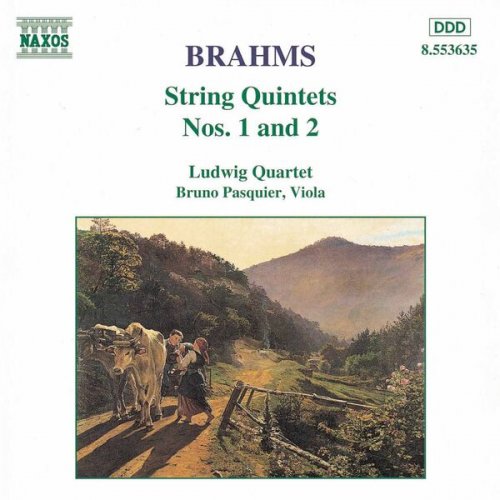
Artist: Bruno Pasquier, Ludwig Quartet
Title: Brahms: String Quartets Nos. 1 & 2
Year Of Release: 1996
Label: Naxos
Genre: Classical
Quality: FLAC (image+.cue,log,scans) / FLAC (tracks)
Total Time: 59:56
Total Size: 306 / 300 Mb
WebSite: Album Preview
Tracklist:Title: Brahms: String Quartets Nos. 1 & 2
Year Of Release: 1996
Label: Naxos
Genre: Classical
Quality: FLAC (image+.cue,log,scans) / FLAC (tracks)
Total Time: 59:56
Total Size: 306 / 300 Mb
WebSite: Album Preview
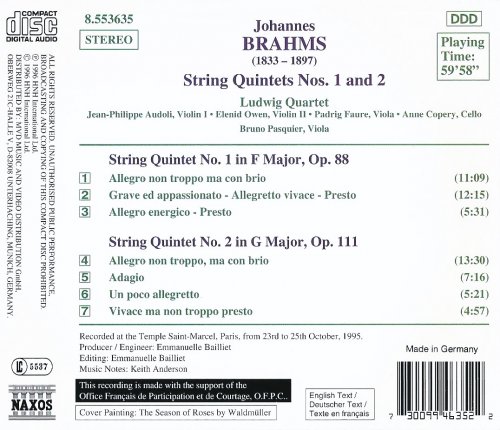
String Quintet No. 1 in F Major, Op. 88 (Johannes Brahms)
01. I. Allegro non troppo ma con brio (00:11:10)
02. II. Grave ed appassionato - Allegretto vivace - Presto (00:12:14)
03. III. Allegro energico: Presto (00:05:34)
String Quintet No. 2 in G Major, Op. 111 (Johannes Brahms)
04. I. Allegro non troppo, ma con brio (00:13:28)
05. II. Adagio (00:07:13)
06. III. Un poco allegretto (00:05:22)
07. IV. Vivace ma non troppo presto (00:04:55)
Total length: 00:59:56
Label: Naxos
Performers:
Bruno Pasquier (viola)
Ludwig Quartet
Here is an outstanding opportunity to explore Brahms' two string quintets beautifully played at a budget price. Brahms wrote his two string quintets at the height of his creative powers using, as did Mozart in his quintets, an additional viola to add to the string quartet. These works are both lyrical and accessible, full of waltz melodies and gypsy tunes. The performers on this CD are the Ludwig Quartet, a French ensemble which has served as the resident quartet at Yale University, together with violist Bruno Pasquier. The CD is ideal for the listener wanting to get to know Brahms's chamber music.
Brahms composed the string quintet no. 1 in F major, op. 88 in 1882. By this time, he had composed his first two symphonies, the second piano concerto, and the violin concerto. The quintet is in three movements rather than the usual four and features melody. This quintet is one of Brahms's less often played chamber works. The first movement opens with a lyrical, strong, and rocking theme reminiscent of Schubert followed by a slower, even more songlike theme given first to the cello and then to the upper strings. The themes are developed with counterpoint, and upon the return the five instruments play in unison to lead to a triumphant conclusion. The second movement is actually a combination of a slow movement and a scherzo. It opens with a glowing slow theme in the middle strings which is interupted twice by rapid passages, in which Brahms borrowed from works written in his youth. The finale is in sonata form but is in counterpoint throughout. It opens with two large chords. Listen for the lively, giddy and piping theme that occurs throughout this movement in the high register of the violin accompanied by the low register of the cello.
The string quintet no 2 in G major op. 111 dates from 1890. By this time, Brahms had composed all four of his symphonies and had some fear that he might be burned-out as a composer. In fact, he wrote this work as his farewell to composition, but, fortunately, he did not follow-through on his intention. The work is in four movements, with the outer movements being strong and cheerful and the two middle movements melancholy and reflective. The work opens with a powerful theme for the cello which has to battle against a loud, ringing accompaniment in the higher strings to make itself heard. Brahms initially intended the opening theme of this work for a symphony. The second theme is a Vienniese dance which moves gracefully from the lower to the upper strings. The opening movement is lengthy but tightly written. It is exquisitely performed here. The second movement is a theme with variations that builds in intensity. Note the long frilly cadence for the solo viola before the theme returns near the end of the movement. (The term for this type of solo passage is "roulade".) The third movement is quiet and melancholy, slightly quick, with a contrasting waltz-like section in the middle. The finale is a brief and lively rondo, and in it Brahms used gypsy themes. Note the very fast, jerky dancing theme with which Brahms brings the work to a joyous conclusion. This quintet has always been more frequently performed than the first quintet.
Brahms himself expressed special affection for both his string quintets. In their lyricism and strength, they are excellent works for the new listener to Brahms's chamber music. I encourage you to get to know Brahms's string quintets with this fine CD.
Brahms composed the string quintet no. 1 in F major, op. 88 in 1882. By this time, he had composed his first two symphonies, the second piano concerto, and the violin concerto. The quintet is in three movements rather than the usual four and features melody. This quintet is one of Brahms's less often played chamber works. The first movement opens with a lyrical, strong, and rocking theme reminiscent of Schubert followed by a slower, even more songlike theme given first to the cello and then to the upper strings. The themes are developed with counterpoint, and upon the return the five instruments play in unison to lead to a triumphant conclusion. The second movement is actually a combination of a slow movement and a scherzo. It opens with a glowing slow theme in the middle strings which is interupted twice by rapid passages, in which Brahms borrowed from works written in his youth. The finale is in sonata form but is in counterpoint throughout. It opens with two large chords. Listen for the lively, giddy and piping theme that occurs throughout this movement in the high register of the violin accompanied by the low register of the cello.
The string quintet no 2 in G major op. 111 dates from 1890. By this time, Brahms had composed all four of his symphonies and had some fear that he might be burned-out as a composer. In fact, he wrote this work as his farewell to composition, but, fortunately, he did not follow-through on his intention. The work is in four movements, with the outer movements being strong and cheerful and the two middle movements melancholy and reflective. The work opens with a powerful theme for the cello which has to battle against a loud, ringing accompaniment in the higher strings to make itself heard. Brahms initially intended the opening theme of this work for a symphony. The second theme is a Vienniese dance which moves gracefully from the lower to the upper strings. The opening movement is lengthy but tightly written. It is exquisitely performed here. The second movement is a theme with variations that builds in intensity. Note the long frilly cadence for the solo viola before the theme returns near the end of the movement. (The term for this type of solo passage is "roulade".) The third movement is quiet and melancholy, slightly quick, with a contrasting waltz-like section in the middle. The finale is a brief and lively rondo, and in it Brahms used gypsy themes. Note the very fast, jerky dancing theme with which Brahms brings the work to a joyous conclusion. This quintet has always been more frequently performed than the first quintet.
Brahms himself expressed special affection for both his string quintets. In their lyricism and strength, they are excellent works for the new listener to Brahms's chamber music. I encourage you to get to know Brahms's string quintets with this fine CD.
![Deep Gray Sea - The Long Glide Home (2026) [Hi-Res]](https://www.dibpic.com/uploads/posts/2026-08/1788023957_cover.jpg "Deep Gray Sea - The Long Glide Home (2026) [Hi-Res]")
![VA - The Art of HiFi Vol. 6: Guitars (2024) [DXD]](https://www.dibpic.com/uploads/posts/2026-08/1787932559_oct0054.jpg "VA - The Art of HiFi Vol. 6: Guitars (2024) [DXD]")