Russell Weismann - Wonderful Splendor (2021)
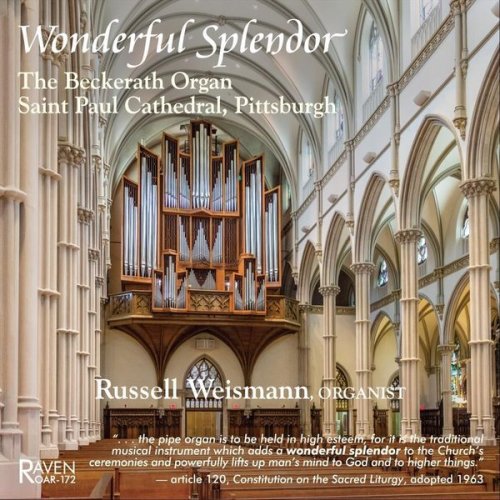
Artist: Russell Weismann
Title: Wonderful Splendor
Year Of Release: 2021
Label: Raven
Genre: Classical
Quality: FLAC (tracks)
Total Time: 1:15:36
Total Size: 297 MB
WebSite: Album Preview
Tracklist:Title: Wonderful Splendor
Year Of Release: 2021
Label: Raven
Genre: Classical
Quality: FLAC (tracks)
Total Time: 1:15:36
Total Size: 297 MB
WebSite: Album Preview
1. Russell Weismann – Praeludium in A Minor, BWV 551 (06:04)
2. Russell Weismann – Partita über "Freu dich sehr, o meine Seele": I. (01:33)
3. Russell Weismann – Partita über "Freu dich sehr, o meine Seele": II. (01:27)
4. Russell Weismann – Partita über "Freu dich sehr, o meine Seele": III. (01:13)
5. Russell Weismann – Partita über "Freu dich sehr, o meine Seele": IV. (01:17)
6. Russell Weismann – Partita über "Freu dich sehr, o meine Seele": V. (01:11)
7. Russell Weismann – Partita über "Freu dich sehr, o meine Seele": VI. (01:08)
8. Russell Weismann – Partita über "Freu dich sehr, o meine Seele": VII. (01:12)
9. Russell Weismann – Partita über "Freu dich sehr, o meine Seele": VIII. (01:07)
10. Russell Weismann – Partita über "Freu dich sehr, o meine Seele": IX. (01:06)
11. Russell Weismann – Partita über "Freu dich sehr, o meine Seele": X. (01:12)
12. Russell Weismann – Partita über "Freu dich sehr, o meine Seele": XI. (01:42)
13. Russell Weismann – Partita über "Freu dich sehr, o meine Seele": XII. (03:44)
14. Russell Weismann – Battaglia (05:02)
15. Russell Weismann – Eleven Chorale Preludes, Op. 122: No. 5 "Schmücke dich, o Liebe Seele" (03:03)
16. Russell Weismann – Eleven Chorale Preludes, Op. 122: No. 9 "Herzlich tut mich verlangen" (03:50)
17. Russell Weismann – Organ Sonata No. 8 in E Minor, Op. 132: IV. Passacaglia (09:57)
18. Russell Weismann – Herzlich lieb hab ich dich, o Herr, Krebs-WV 526 (06:37)
19. Russell Weismann – Messe pour les paroisses: offertoire sur les grands jeux (08:22)
20. Russell Weismann – Fiori Musicali, Op. 12: 31. Messa degli apostoli, toccata per l’elevatione (04:54)
21. Russell Weismann – Praeludium in D, "Alleluja" (03:59)
22. Russell Weismann – Fugue in D, "Alleluja" (05:44)
Organ recordings are common and populous in the niche classical music world of the pipe organ. What makes this recording unique is that its repertoire was selected by the organ’s builder, Rudolf von Beckerath, to be played on dedication programs of his instruments (some pieces are similar to music that Beckerath recommended). Another intent is to represent the spectrum of the organ’s tonal resources.
The organ’s association with the Christian church dates as far back as the seventh century, and although its use is not officially recognized in Canon Law, the organ and the Roman Catholic Church have enjoyed a prosperous relationship over centuries and through schisms and wars. Today the organ remains an integral detail in the Church’s liturgical life.
On October 11, 1962, the Second Vatican Council, the first major ecumenical council of the Church in nearly a century, was opened by Pope John XXIII in Saint Peter’s Basilica, Vatican City. The Council sought modernization of the Roman Church, and reconstruction of the Church’s liturgy was a major objective.
Sacrosanctum Concilium (the “Constitution on the Sacred Liturgy”) was the first document produced by the Council and it reshaped modern Roman Catholic worship into what we experience today. A detailed chapter on sacred music comprises a large portion of the document, adopted in 1963. In it, Article 120 reads: "In the Latin Church the pipe organ is to be held in high esteem, for it is the traditional musical instrument which adds a wonderful splendor to the Church’s ceremonies and powerfully lifts up man’s mind to God and to higher things."
On December 8, 1962, less than two months following the opening of Vatican II, the monumental organ built by Rudolf von Beckerath for Saint Paul Cathedral in Pittsburgh, Pennsylvania, was dedicated. This instrument, fully embodying the term “wonderful splendor” in both sight and sound, was the first mechanical action organ built in an American Catholic Cathedral during the 20th century. With its construction coinciding with Vatican II, the St. Paul Beckerath organ is uniquely wedded to the Council. John Joseph Wright, who became Bishop of Pittsburgh in 1959, was a leading architect of Vatican II and held great interest in the cathedral’s organ project. He took a short leave from the Council in December of 1962 to be present at the organ’s dedication-week festivities, which opened with a Solemn Pontifical Mass and Blessing of the Organ on the Solemnity of the Immaculate Conception (December 8), and included performances by Paul Koch, Fernando Germani, E. Power Biggs with the Pittsburgh Symphony Orchestra, and Robert Noehren. The week concluded with a Solemn Mass celebrated on December 16 with the Choir of Men and Boys of Saint Paul Cathedral under the direction on Paul Koch, Organist and Choirmaster, and accompanied by Matthew Cvetic. The Mass was celebrated by the Right Reverend Monsignor Andrew J. Pauley, Rector of the Cathedral.
The organ’s inaugural week was dedicated to Pope John XXIII. In the dedication program, Bishop Wright wrote:
"Such a dedication to the Chief Shepherd of Universal Christendom is timely and worthy. The 'royal instrument' that is a mighty organ proclaims that majesty of God and of His Kingdom which the Church is the more prepared to preach, eloquently and confidently, as a result of the magnificent Council over which Pope John presides; the great organ is a striking symbol, as the council will be, of the harmony arising out of diversity by which the Church echoes God’s single truth with a resonance enriched by the myriad differences of temperament, opinions and talents among the men and nations comprising the world-wide Catholic flock. An organ… built by the renowned craftsmen of the von Beckerath Company… will refresh the souls of thousands for years to come. Its very building is a work of renewal on one level, and that far from the least important, which typifies the desired renewal on every level which the Ecumenical Council both seeks and represents; all excellence is encouraged by such pursuit of excellence as has prompted the planning of Saint Paul’s new organ."
Saint Paul’s organ, as the fourth and still the largest Beckerath imported to the United States, was preceded by the large and widely heralded, first Beckerath organ imported and installed in 1957 at Trinity Evangelical Lutheran Church in Cleveland, Ohio. Trinity’s organ of 44 stops on four manuals resulted from the consultation of Robert Noehren, Professor of Organ at the University of Michigan. Noehren met Beckerath while on a study tour in Hamburg, Germany, and was particularly interested in Beckerath’s ability to build mechanical action organs based on principles and traditions of 17th- and 18th-century organ building in northern Germany. Following the success of Beckerath’s installation in Cleveland, Noehren again acted as a consultant for Saint Paul Cathedral and full-heartedly recommended Beckerath.
The organ’s association with the Christian church dates as far back as the seventh century, and although its use is not officially recognized in Canon Law, the organ and the Roman Catholic Church have enjoyed a prosperous relationship over centuries and through schisms and wars. Today the organ remains an integral detail in the Church’s liturgical life.
On October 11, 1962, the Second Vatican Council, the first major ecumenical council of the Church in nearly a century, was opened by Pope John XXIII in Saint Peter’s Basilica, Vatican City. The Council sought modernization of the Roman Church, and reconstruction of the Church’s liturgy was a major objective.
Sacrosanctum Concilium (the “Constitution on the Sacred Liturgy”) was the first document produced by the Council and it reshaped modern Roman Catholic worship into what we experience today. A detailed chapter on sacred music comprises a large portion of the document, adopted in 1963. In it, Article 120 reads: "In the Latin Church the pipe organ is to be held in high esteem, for it is the traditional musical instrument which adds a wonderful splendor to the Church’s ceremonies and powerfully lifts up man’s mind to God and to higher things."
On December 8, 1962, less than two months following the opening of Vatican II, the monumental organ built by Rudolf von Beckerath for Saint Paul Cathedral in Pittsburgh, Pennsylvania, was dedicated. This instrument, fully embodying the term “wonderful splendor” in both sight and sound, was the first mechanical action organ built in an American Catholic Cathedral during the 20th century. With its construction coinciding with Vatican II, the St. Paul Beckerath organ is uniquely wedded to the Council. John Joseph Wright, who became Bishop of Pittsburgh in 1959, was a leading architect of Vatican II and held great interest in the cathedral’s organ project. He took a short leave from the Council in December of 1962 to be present at the organ’s dedication-week festivities, which opened with a Solemn Pontifical Mass and Blessing of the Organ on the Solemnity of the Immaculate Conception (December 8), and included performances by Paul Koch, Fernando Germani, E. Power Biggs with the Pittsburgh Symphony Orchestra, and Robert Noehren. The week concluded with a Solemn Mass celebrated on December 16 with the Choir of Men and Boys of Saint Paul Cathedral under the direction on Paul Koch, Organist and Choirmaster, and accompanied by Matthew Cvetic. The Mass was celebrated by the Right Reverend Monsignor Andrew J. Pauley, Rector of the Cathedral.
The organ’s inaugural week was dedicated to Pope John XXIII. In the dedication program, Bishop Wright wrote:
"Such a dedication to the Chief Shepherd of Universal Christendom is timely and worthy. The 'royal instrument' that is a mighty organ proclaims that majesty of God and of His Kingdom which the Church is the more prepared to preach, eloquently and confidently, as a result of the magnificent Council over which Pope John presides; the great organ is a striking symbol, as the council will be, of the harmony arising out of diversity by which the Church echoes God’s single truth with a resonance enriched by the myriad differences of temperament, opinions and talents among the men and nations comprising the world-wide Catholic flock. An organ… built by the renowned craftsmen of the von Beckerath Company… will refresh the souls of thousands for years to come. Its very building is a work of renewal on one level, and that far from the least important, which typifies the desired renewal on every level which the Ecumenical Council both seeks and represents; all excellence is encouraged by such pursuit of excellence as has prompted the planning of Saint Paul’s new organ."
Saint Paul’s organ, as the fourth and still the largest Beckerath imported to the United States, was preceded by the large and widely heralded, first Beckerath organ imported and installed in 1957 at Trinity Evangelical Lutheran Church in Cleveland, Ohio. Trinity’s organ of 44 stops on four manuals resulted from the consultation of Robert Noehren, Professor of Organ at the University of Michigan. Noehren met Beckerath while on a study tour in Hamburg, Germany, and was particularly interested in Beckerath’s ability to build mechanical action organs based on principles and traditions of 17th- and 18th-century organ building in northern Germany. Following the success of Beckerath’s installation in Cleveland, Noehren again acted as a consultant for Saint Paul Cathedral and full-heartedly recommended Beckerath.

![Herbie Mann - Sultry Serenade (1957) [1997]](https://www.dibpic.com/uploads/posts/2020-04/1587064639_herbie-mann_1957.jpg "Herbie Mann - Sultry Serenade (1957) [1997]")
![Dick De Graaf - Con Alma (In memory of Rob van Kreeveld) (2026) [Hi-Res]](https://www.dibpic.com/uploads/posts/2026-09/1789489285_folder.jpg "Dick De Graaf - Con Alma (In memory of Rob van Kreeveld) (2026) [Hi-Res]")
![Bob James - One (1974) [2021 DSD64]](https://www.dibpic.com/uploads/posts/2021-09/1632427901_folder.jpg "Bob James - One (1974) [2021 DSD64]")