Andrzej Pikul & Messages Quartet - Ginastera: Piano Chamber Music (2025) Hi-Res
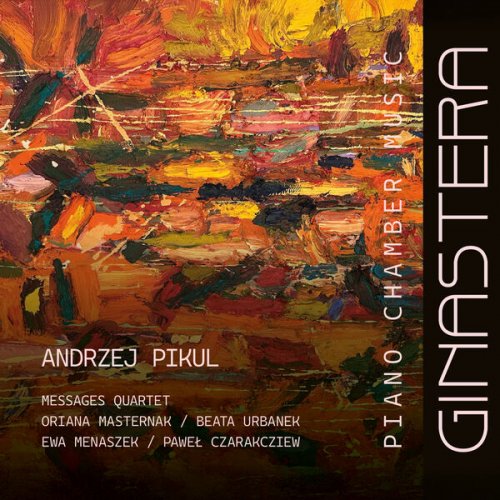
Artist: Andrzej Pikul, Messages Quartet
Title: Ginastera: Piano Chamber Music
Year Of Release: 2025
Label: DUX
Genre: Classical
Quality: FLAC 16/24 Bit (96 KHz / tracks+booklet)
Total Time: 77:15 min
Total Size: 315 MB / 1,3 GB
WebSite: Album Preview
Tracklist:Title: Ginastera: Piano Chamber Music
Year Of Release: 2025
Label: DUX
Genre: Classical
Quality: FLAC 16/24 Bit (96 KHz / tracks+booklet)
Total Time: 77:15 min
Total Size: 315 MB / 1,3 GB
WebSite: Album Preview
01. Pampeana No. 1 op. 16: Rhapsody for violin and piano
02. Dos Canciones op. 3: Canción al árbol del olvido
03. Dos Canciones op. 3: Canción a la luna lunanca
04. Cinco canciones populares argentinas op. 10: Chacarera
05. Cinco canciones populares argentinas op. 10: Triste
06. Cinco canciones populares argentinas op. 10: Zamba
07. Cinco canciones populares argentinas op. 10: Arrorro
08. Cinco canciones populares argentinas op. 10: Gato
09. Pampeana No. 2 op. 21: Rhapsody for cello and piano
10. Quintet for piano and string quartet op. 29: Introduzione
11. Quintet for piano and string quartet op. 29: Cadenza I per viola e violoncello
12. Quintet for piano and string quartet op. 29: Scherzo fantastico
13. Quintet for piano and string quartet op. 29: Cadenza II per due violini
14. Quintet for piano and string quartet op. 29: Piccola musica notturna
15. Quintet for piano and string quartet op. 29: Cadenza III per pianoforte
16. Quintet for piano and string quartet op. 29: Finale
17. Sonata for cello and piano op. 49: Allegro deciso
18. Sonata for cello and piano op. 49: Adagio passionato
19. Sonata for cello and piano op. 49: Presto mormoroso
20. Sonata for cello and piano op. 49: Allegro con fuoco
The concept for the album arose from Andrzej Pikul's long-standing fascination with the works of Argentine composer Alberto Ginastera. It features chamber works from various periods, written for piano, strings, or voice. They reflect influences from Argentine traditional music as well as a touch of the cosmopolitan avant-garde.
Ginastra has developed his own idiom of imagined folklore, in which the piano takes on the role of the traditional guitar, utilizing, among other things, its characteristic chords and the rhythms of traditional gaucho dance that recur in the accompaniment. At the same time, he boldly experiments with form, enriching classical structures with virtuosic solo cadences by individual instruments. All compositions are characterized by striking contrasts: from violent, shifting accents, syncopated dance rhythms, orgiastic chordal eruptions, to tranquility and intimate cantilena, with refined color and a surreal atmosphere. For performers, they are an opportunity to show off their virtuosity and versatile musical imagination.
Ginastra has developed his own idiom of imagined folklore, in which the piano takes on the role of the traditional guitar, utilizing, among other things, its characteristic chords and the rhythms of traditional gaucho dance that recur in the accompaniment. At the same time, he boldly experiments with form, enriching classical structures with virtuosic solo cadences by individual instruments. All compositions are characterized by striking contrasts: from violent, shifting accents, syncopated dance rhythms, orgiastic chordal eruptions, to tranquility and intimate cantilena, with refined color and a surreal atmosphere. For performers, they are an opportunity to show off their virtuosity and versatile musical imagination.
![Cal Tjader, Charlie Byrd - Tambu (1973) [1998]](https://www.dibpic.com/uploads/posts/2026-07/1784530840_ctt500.jpg "Cal Tjader, Charlie Byrd - Tambu (1973) [1998]")