Artist:
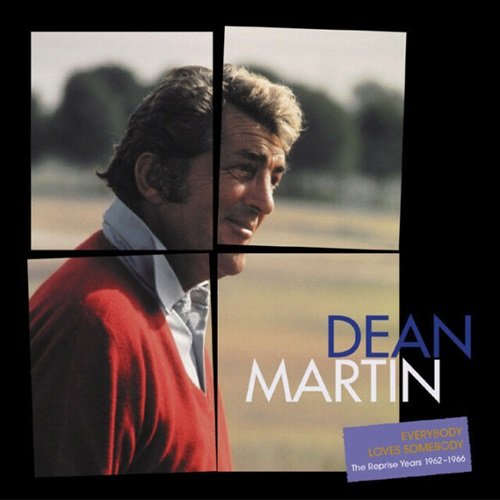
Dean Martin
Title:
Everybody Loves Somebody - The Reprise Years 1962–1966
Year Of Release:
2001
Label:
Bear Family Records
Genre:
Pop, Vocal, Jazz, Easy Listening
Quality:
Mp3 320 / Flac (tracks, ,cue, log)
Total Time: 06:48:49
Total Size: 998 Mb / 2,5 Gb (covers)
WebSite:
Album Preview
Tracklist:CD 1:01. Senza fine 2:51
02. Dame su amor 2:16
03. Baby‐O 3:01
04. Just Close Your Eyes 2:57
05. Tik‐A‐Tee, Tik‐A‐Tay 2:23
06. C’est si bon 2:53
07. The Poor People of Paris 2:58
08. The River Seine 2:21
09. I Love Paris 3:02
10. The Last Time I Saw Paris 2:47
11. Mimi 2:25
12. April in Paris 3:34
13. Darling, je vous aime beaucoup 3:19
14. Gigi 3:40
15. La Vie en rose 2:25
16. C’est magnifique 2:39
17. Mam’selle 3:26
18. Manana 2:32
19. South of the Border 1:52
20. Tangerine 2:06
21. In a Little Spanish Town 2:33
22. Alla en el Rancho Grande 2:18
23. What a Difference a Day Made 2:46
24. Always in My Heart 2:45
25. Magic Is the Moonlight 2:39
26. Besame Mucho 2:27
27. From the Bottom of My Heart (Dammi, Dammi, Dammi) 2:40
28. Who’s Got the Action 2:37
29. La Paloma 3:05
CD 2:01. Sam’s Song 2:44
02. Anytime 2:22
03. Room Full of Roses 3:02
04. My Heart Cries for You 3:12
05. I’m So Lonesome I Could Cry 2:38
06. Shutters and Boards 2:52
07. Singing the Blues 2:10
08. Ain’t Gonna Try Anymore 2:20
09. Face in a Crowd 2:50
10. Things 2:39
11. Blue Blue Day 1:49
12. Hey Good Lookin’ 1:47
13. I Walk the Line 2:27
14. My Sugar’s Gone 2:59
15. Candy Kisses 3:04
16. Take Good Care of Her 3:23
17. I Can’t Help It (If I’m Still in Love With You) 2:43
18. I’m Gonna Change Everything 2:31
19. Bouquet of Roses 2:59
20. From Lover to Loser 3:06
21. Rockin’ Alone in an Old Rockin’ Chair 2:29
22. Second Hand Rose 2:17
23. Corrine Corrina 2:43
24. The Middle of the Night Is My Cryin’ Time 2:49
25. Just a Little Lovin’ 2:05
26. Via Vento 2:03
27. Mama Roma 2:09
28. Grazie, Prego, Scusi 2:21
29. Marina 2:52
30. Take Me 2:43
CD 3:01. La Giostra (The Merry‐Go‐Round) 2:38
02. Smile 2:58
03. I’m Confessin’ (That I Love You) 3:17
04. Fools Rush In 3:05
05. I’ll Buy That Dream 3:16
06. If You Were the Only Girl in the World 3:03
07. Gimme a Little Kiss (Will Ya, Huh)? 2:18
08. My Melancholy Baby 2:46
09. Baby Won’t You Please Come Home 2:17
10. I Don’t Know Why (I Just Do) 2:35
11. Blue Moon 3:07
12. Everybody Loves Somebody 3:11
13. Hands Across the Table 2:18
14. Style 4:28
15. Mr. Booze 5:07
16. Don’t Be a Do‐Badder 1:18
17. Any Man Who Loves His Mother 1:41
18. Everybody Loves Somebody 2:47
19. Your Other Love 2:30
20. We Open in Venice 2:13
21. Bianca 2:46
22. If This Isn’t Love 2:33
23. Fugue for Tinhorns 1:32
24. The Oldest Established (Permanent Floating Crap Game in New York) 2:33
25. Guys and Dolls 2:51
26. Guys and Dolls (reprise) 1:54
27. Peace on Earth / Silent Night 3:30
CD 4:01. Siesta Fiesta 2:35
02. A Little Voice 2:08
03. So Long Baby 2:38
04. The Door Is Still Open My Heart 2:55
05. You’re Nobody ’til Somebody Loves You 1:58
06. Every Minute, Every Hour 2:10
07. We’ll Sing in the Sunshine 2:51
08. Clinging Vine 2:25
09. Always Together 2:51
10. In the Misty Moonlight 2:46
11. Have a Heart 2:40
12. You’ll Always Be the One I Love 2:01
13. Wedding Bells 2:43
14. Sophia 2:58
15. Send Me the Pillow You Dream On 2:31
16. I’ll Be Seeing You 2:41
17. Send Me Some Lovin’ 2:39
18. In the Chapel in the Moonlight 2:34
19. My Heart Is an Open Book 2:01
20. I’ll Be Seeing You 2:38
21. Remember Me (I’m the One Who Loves You) 2:28
22. Here Comes My Baby 3:19
23. Welcome to My World 2:22
24. The Birds and the Bees 2:08
25. I Don’t Think You Love Me Anymore 2:36
26. My Shoes Keep Walking Back to You 2:55
27. Born to Lose 2:28
CD 5:01. King of the Road 2:25
02. Take These Chains From My Heart 2:45
03. Walk on By 2:42
04. Bumming Around 2:44
05. Red Roses for a Blue Lady 2:46
06. Love Love Love 2:41
07. Houston 2:43
08. Little Lovely One 2:08
09. I Will 2:23
10. Down Home 2:52
11. Old Yellow Line 2:21
12. The First Thing Ev’ry Morning (and the Last Thing Ev’ry Night) 2:11
13. Everybody but Me 2:14
14. You’re the Reason I’m in Love 2:17
15. Hammer and Nails 2:26
16. Snap Your Fingers 2:27
17. Detour 2:45
18. Somewhere There’s a Someone 2:16
19. That Old Clock on the Wall 2:59
20. South of the Border 2:42
21. Empty Saddles 2:21
22. Red Sails in the Sunset 2:37
23. On the Sunny Side of the Street 2:34
24. The Glory of Love 2:21
25. Side by Side 2:14
26. If I Knew Susie 2:13
27. The Last Rond‐Up 3:12
CD 6:01. Who’s Got the Action (Soundtrack version) 0:32
02. Any Man Who Loves His Mother (Soundtrack version) 1:50
03. Style (Soundtrack version) 3:25
04. Mr. Booze (Soundtrack version) 1:56
05. Don’t Be a Do‐Badder (Soundtrack version) 0:34
06. ’s Wonderful (Soundtrack version) 1:43
07. ’s Wonderful (Solo Soundtrack version) 1:11
08. Sophia (Soundtrack version) 0:31
09. Empty Saddles / If I Knew Susie (Soundtrack version) 1:47
10. On the Sunny Side of the Street / The Last Round Up (Soundtrack version) 0:41
11. South of the Border (Soundtrack version) 0:59
12. Red Sails in the Sunset (Soundtrack version) 0:23
13. Side by Side (Soundtrack version) 0:33
14. The Glory of Love (Soundtrack version) 0:25
15. The Glory of Love (end) (Soundtrack version) 1:05
16. Unidentified: True Love (Italian) 3:03
17. Unidentified: Everybody Loves Somebody (Italian) 2:49
18. Unidentified: Everybody Loves Somebody (Spanish) 2:48
19. Unidentified: Everybody Loves Somebody (French) 2:48
20. Unidentified: Everybody Loves Somebody (Japanese) 2:49
21. Radio Advertising: What a Way to Go (1) 0:57
22. Radio Advertising: What a Way to Go (2) 0:54
23. Radio Advertising: Who’s Been Sleeping in My Bed (1) 1:00
24. Radio Advertising: Who’s Been Sleeping in My Bed (2) 0:57
25. Radio Advertising: Who’s Been Sleeping in My Bed (3) 0:56
26. Radio Advertising: The Silencers (1) 1:00
27. Radio Advertising: The Silencers (2) 1:02
28. Radio Advertising: The Silencers (3) 0:58
Enjoying great success in music, film, television, and the stage, Dean Martin was less an entertainer than an icon, the eternal essence of cool. A member of the legendary Rat Pack, he lived and died the high life of booze, broads and bright lights, always projecting a sense of utter detachment and serenity; along with Frank Sinatra, Sammy Davis, Jr. and the other chosen few who breathed the same rarefied air, Martin -- highball and cigarette always firmly in hand -- embodied the glorious excess of a world long gone, a world without rules or consequences. Throughout it all, he remained just outside the radar of understanding, the most distant star in the firmament; as his biographer Nick Tosches once noted, Martin was what the Italians called a menefreghista -- "one who simply does not give a f***."
Dino Paul Crocetti was born on June 7, 1917 in Steubenville, Ohio; the son of an immigrant barber, he spoke only Italian until the age of five, and at school was the target of much ridicule for his broken English. He ultimately quit school at the age of 16, going to work in the steel mills; as a boxer named Kid Crochet, he also fought a handful of amateur bouts, and later delivered bootleg liquor. After landing a job as a croupier in a local speakeasy, he made his first connections with the underworld, bringing him into contact with club owners all over the Midwest; initially rechristening himself Dean Martini, he had a nose job and set out to become a crooner, modeling himself after his acknowledged idol, Bing Crosby. Hired by bandleader Sammy Watkins, he dropped the second "i" from his stage name and eventually enjoyed minor success on the New York club circuit, winning over audiences with his loose, mellow vocal style.
Despite his good looks and easygoing charm, Martin's early years as an entertainer were largely unsuccessful. In 1946 -- the year he issued his first single, "Which Way Did My Heart Go?" -- he first met another struggling performer, a comic named Jerry Lewis; later that year, while Lewis was playing Atlantic City's 500 Club, another act abruptly quit the show, and the comedian suggested Martin to fill the void. Initially, the two performed separately, but one night they threw out their routines and teamed on-stage, a Mutt-and-Jeff combo whose wildly improvisational comedy quickly made them a star attraction along the Boardwalk. Within months, Martin and Lewis' salaries rocketed from $350 to $5000 a week, and by the end of the 1940s they were the most popular comedy duo in the nation. In 1949, they made their film debut in My Friend Irma, and their supporting work proved so popular with audiences that their roles were significantly expanded for the sequel, the following year's My Friend Irma Goes West.
With 1951's At War with the Army, Martin and Lewis earned their first star billing. The picture established the basic formula of all of their subsequent movie work, with Martin the suave straight man forced to suffer the bizarre antics of the manic fool Lewis. Critics often loathed the duo, but audiences couldn't get enough -- in all, they headlined 13 comedies for Paramount, among them 1952's Jumping Jacks, 1953's Scared Stiff and 1955's Artists and Models, a superior effort directed by Frank Tashlin. For 1956's Hollywood or Bust, Tashlin was again in the director's seat, but the movie was the team's last; after Martin and Lewis' relationship soured to the point where they were no longer even speaking to one another, they announced their breakup following the conclusion of their July 25, 1956 performance at the Copacabana, which celebrated to the day the tenth anniversary of their first show.
While most onlookers predicted continued superstardom for Lewis, the general consensus was that Martin would falter as a solo act; after all, outside of the 1953 smash "That's Amore," his solo singing career had never quite hit its stride, and in light of the continued ascendancy of rock & roll, his future looked dim. After suffering a failure with Ten Thousand Bedrooms, Martin's next move was to appear in the 1958 drama The Young Lions, starring alongside Montgomery Clift and Marlon Brando; that same year he also hosted The Dean Martin Show, the first of his color specials for NBC television. Both projects were successful, as were his live appearances at the Sands Hotel in Las Vegas; in particular, The Young Lions proved him a highly capable dramatic actor. Combined with another hit single, "Volare," Martin was everywhere that year, and with the continued success of his many TV specials, he effectively conquered movies, music, television and the stage all at the same time -- a claim no other entertainer, not even Sinatra, could make.
Even at the peak of his fame, however, Martin remained strangely contemptuous of stardom; for a man whose presence in the public eye was almost constant, he was utterly elusive, beyond the realm of mortal understanding. As his celebrity and power grew, he slipped even further away: in early 1959, his movie with Sinatra, Some Came Running, hit theaters, and with it came the dawning of the Rat Pack. Together, Sinatra and Martin -- in tandem with their acolytes Sammy Davis, Jr., Peter Lawford, Joey Bishop and Shirley MacLaine -- set new standards of celebrity hipsterdom, becoming avatars of the good life; flexing their muscle not only in show business but also in politics -- their ties to John F. Kennedy, Lawford's brother-in-law and an honorary Rat Packer code-named "Chicky Baby," are now legend -- they were the new American gods, and Las Vegas was their Mount Olympus.
Martin -- who continued to impress critics in films like the 1959 Howard Hawks classic Rio Bravo -- was Sinatra's right-hand man, the drunkest and most enigmatic member of the Rat Pack (so named in homage to the Holmby Hills Rat Pack, a bygone drinking circle that had once gathered around Humphrey Bogart); his allegiance to Sinatra was total, and Martin even left his longtime label Capitol to record for and financially back Sinatra's own Reprise imprint. In 1960, the Rat Pack starred in Ocean's Eleven, filming in Las Vegas during the day and then taking over the Sands each night; two years later, they reconvened for Sergeants 3. However, in late 1963 -- while filming the third Rat Pack opus, Robin and the Seven Hoods -- the news came that Kennedy had been assassinated; in effect, as America struggled to pick up the pieces, the Rat Pack's reign was over. With Vietnam and the civil rights movement looming on the horizon, there was no longer room for the boozy, happy-go-lucky lifestyle of before -- the fun was truly over.
Yet somehow Martin forged on; in 1964, at the peak of Beatlemania, he knocked the Fab Four out of the top spot on the charts with his single "Everybody Loves Somebody," and that same year starred in Billy Wilder's acrid Kiss Me, Stupid, a film which crystallized his persona as the lecherous but lovable lush. In 1965, after years of overtures from NBC, Martin finally agreed to host his own weekly variety series; The Dean Martin Show was an enormous hit, running for nine seasons before later spawning a number of hit Celebrity Roast specials during the 1970s. In films, he also remained successful, starring in a series of spy spoofs as secret agent Matt Helm. However, by the late '70s, Martin's health began to fail, and his career was primarily confined to casino club stages; in 1987, his son Dean Paul died in an airplane crash, a blow from which he never recovered. After bailing out of a 1988 reunion tour with Sinatra and Davis, Martin spent his final years in solitude; he died on Christmas Day, 1995.~Jason Ankeny


![Marc Doffey - Illusion (2026) [Hi-Res]](https://img.israbox.com/img/2026-10/23/4s1g29hao0h3ahyqpfvsyzmoj.jpg "Marc Doffey - Illusion (2026) [Hi-Res]")
![Sen Morimoto - Time Is On Your Side (2026) [Hi-Res]](https://www.dibpic.com/uploads/posts/2026-10/1792841010_ib8j6tuzd1vdz_600.jpg "Sen Morimoto - Time Is On Your Side (2026) [Hi-Res]")