Ensemble Ensemble - Live at Atelier du Plateau (Live) (2025) Hi-Res
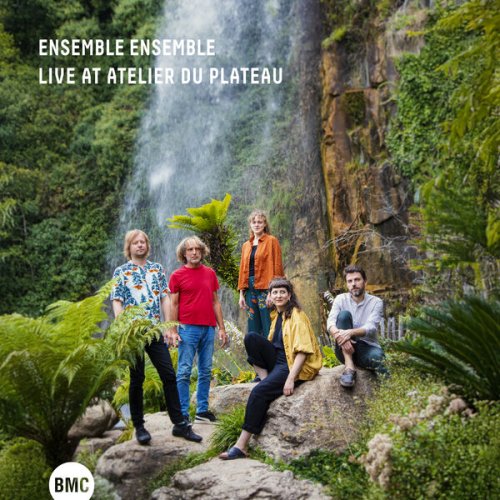
Artist: Ensemble Ensemble, Mari Kvien Brunvoll, George Dumitriu, Eve Risser, Kim Myhr, Toma Gouband
Title: Live at Atelier du Plateau (Live)
Year Of Release: 2025
Label: BMC Records
Genre: Jazz
Quality: FLAC (tracks) / FLAC 24 Bit (88,2 KHz / tracks)
Total Time: 45:21 min
Total Size: 192 / 762 MB
WebSite: Album Preview
Tracklist:Title: Live at Atelier du Plateau (Live)
Year Of Release: 2025
Label: BMC Records
Genre: Jazz
Quality: FLAC (tracks) / FLAC 24 Bit (88,2 KHz / tracks)
Total Time: 45:21 min
Total Size: 192 / 762 MB
WebSite: Album Preview
01. En Route (On the way) (Live)
02. Venter (Waiting) (Live)
03. En Sang om Døden (A song about death) (Live)
04. Ka da (What then) (Live)
05. Framtida (Future) (Live)
There is something pensive in the music of Ensemble Ensemble. Pensive. That is how one would describe a person who is gazing into space, and whose attention and willpower seem to be in suspense, their thinking fluid and ongoing, their emotions in action but in the background, as an ambience, almost imperceptible, like a gas, or a shade of colour. A pensive person may seem haunted by something, or just lost in thought. They can be static or in motion — walking, for example. In either case their posture and appearance are not directed at the surrounding world, and are somehow neutralized, removed from the petty everyday theatre of social interactions. The ordinary passing of time seems suspended, and one is thrust into some other place. Gesture, posture, gait, all seem vacant, disaffected, but actually they are in action. They open the way for the free succession of forms, movements and figures that populate this inner space seen by none. The pensive person is present, but has granted leave of absence to some part of themselves, inviting anyone who looks at them to return to themselves instead of launching out into the world.
It is somewhat in this manner that we can approach the music of the five members of the Ensemble Ensemble: Mari Kvien Brunvoll (vocals, electronics), Eve Risser (piano, flute, vocals), George Dumitriu (violin, viola), Kim Myhr (guitar) and Toma Gouband (drums, percussion). The paradox of pensive music is that these five individuals are lively, precise, and attentive to one other. Thus, the way each of them plays has no trace of errant wandering. They generate a music which is full of contained emotions and suspended time on the verge of nostalgia. Each one resolutely speaks their own language, without seeking to distort or translate it. We immediately recognize the typical sounds and instrumental preferences of each musician, but their convergence is neither an accumulation of egos nor a synchronization of statements: it designates an inner place, it makes room for it, and for us. We get there, thanks to them when we listen.
What is this inner place? I perceive it as a space of reminiscences. Mari Kvien Brunvoll sketches a tune that she seems to read in real-time, in a distant place, perhaps even in an afterlife, syllable by syllable, vowel by vowel, sometimes reverberated, duplicated, or modulated electronically. Toma Gouband, with the collisions of a few stones, a liquid of drops and waves to which Georges Dumitriu’s pizzicati respond to which Georges Dumitriu’s pizzicati respond, when he is not invoking the memory of the folk fiddles of Eastern and Northern Europe – they reach us as if through a filter that selects a few harmonics, the brilliance of an overtone, and the inflection of a dance formula. Kim Myhr’s guitar and Eve Risser’s piano, explored in their textural and percussive depth, define each harmonic context with a formula, a fragment, a sketch, each time suggesting a world of underwater references references, brushing the surface, then disappearing as the group ripples on. Nothing is insisted on, nothing lasts forever. Each sound situation, each musical time bubble, even without trying, releases buried memories that worm their way into the loops and drone sounds of the instruments. Then they access the voice, finally becoming the air we breathe. For us listeners it is a strange feeling of familiarity, that of crossing an echo chamber with a thousand connotations, specific to each person according to their own history of jazz, their own history of folklore, their own history of sound.
The composer Béla Bartók, who studied thousands of peasant songs and dances, passionately collecting them throughout Hungary, Romania, Slovakia and beyond, is known to have gradually integrated into his language characteristics of the melodic and rhythmic universe of folk music. After transcribing them, he first published original harmonizations of them, then used them as the main themes of more ambitious works, before leading to what is sometimes called his “imaginary folklore”: musical expressions that seem to come more or less directly from a specific repertoire and region, but are actually invented by the composer on the basis of a knowledge and intuition of folklore that had become his second nature. Both Bartók’s ethnomusicological research – which in the 1930s took him to Anatolia – and his compositional practice gradually transformed the fervent nationalist of the early days into a sharp critic of restrictions of identities.
After all, couldn’t we call the music that Ensemble Ensemble invites us to hear an “imaginary folklore”, freely inspired by Norwegian and Alsatian repertoires, and by a sonic vocabulary fed by multiple musical cultures, whether oral or not, experimental or not, electrified or not? Just like Bartók, but through a collective coming together, their music lives folklore out in the present. Pensive, then, but without melancholy, it walks through a different space-time, devoid of history and geography — a place that belongs to no one, and where we all resonate together.
It is somewhat in this manner that we can approach the music of the five members of the Ensemble Ensemble: Mari Kvien Brunvoll (vocals, electronics), Eve Risser (piano, flute, vocals), George Dumitriu (violin, viola), Kim Myhr (guitar) and Toma Gouband (drums, percussion). The paradox of pensive music is that these five individuals are lively, precise, and attentive to one other. Thus, the way each of them plays has no trace of errant wandering. They generate a music which is full of contained emotions and suspended time on the verge of nostalgia. Each one resolutely speaks their own language, without seeking to distort or translate it. We immediately recognize the typical sounds and instrumental preferences of each musician, but their convergence is neither an accumulation of egos nor a synchronization of statements: it designates an inner place, it makes room for it, and for us. We get there, thanks to them when we listen.
What is this inner place? I perceive it as a space of reminiscences. Mari Kvien Brunvoll sketches a tune that she seems to read in real-time, in a distant place, perhaps even in an afterlife, syllable by syllable, vowel by vowel, sometimes reverberated, duplicated, or modulated electronically. Toma Gouband, with the collisions of a few stones, a liquid of drops and waves to which Georges Dumitriu’s pizzicati respond to which Georges Dumitriu’s pizzicati respond, when he is not invoking the memory of the folk fiddles of Eastern and Northern Europe – they reach us as if through a filter that selects a few harmonics, the brilliance of an overtone, and the inflection of a dance formula. Kim Myhr’s guitar and Eve Risser’s piano, explored in their textural and percussive depth, define each harmonic context with a formula, a fragment, a sketch, each time suggesting a world of underwater references references, brushing the surface, then disappearing as the group ripples on. Nothing is insisted on, nothing lasts forever. Each sound situation, each musical time bubble, even without trying, releases buried memories that worm their way into the loops and drone sounds of the instruments. Then they access the voice, finally becoming the air we breathe. For us listeners it is a strange feeling of familiarity, that of crossing an echo chamber with a thousand connotations, specific to each person according to their own history of jazz, their own history of folklore, their own history of sound.
The composer Béla Bartók, who studied thousands of peasant songs and dances, passionately collecting them throughout Hungary, Romania, Slovakia and beyond, is known to have gradually integrated into his language characteristics of the melodic and rhythmic universe of folk music. After transcribing them, he first published original harmonizations of them, then used them as the main themes of more ambitious works, before leading to what is sometimes called his “imaginary folklore”: musical expressions that seem to come more or less directly from a specific repertoire and region, but are actually invented by the composer on the basis of a knowledge and intuition of folklore that had become his second nature. Both Bartók’s ethnomusicological research – which in the 1930s took him to Anatolia – and his compositional practice gradually transformed the fervent nationalist of the early days into a sharp critic of restrictions of identities.
After all, couldn’t we call the music that Ensemble Ensemble invites us to hear an “imaginary folklore”, freely inspired by Norwegian and Alsatian repertoires, and by a sonic vocabulary fed by multiple musical cultures, whether oral or not, experimental or not, electrified or not? Just like Bartók, but through a collective coming together, their music lives folklore out in the present. Pensive, then, but without melancholy, it walks through a different space-time, devoid of history and geography — a place that belongs to no one, and where we all resonate together.


![Jakob Manz - Supernova - Live at Alte Oper Frankfurt (2026) [Hi-Res]](https://www.dibpic.com/uploads/posts/2026-10/1791892754_folder.jpg "Jakob Manz - Supernova - Live at Alte Oper Frankfurt (2026) [Hi-Res]")
![Sonia Johnson - Chrysalis (2019) [Hi-Res]](https://www.dibpic.com/uploads/posts/2019-11/1573748285_folder.jpg "Sonia Johnson - Chrysalis (2019) [Hi-Res]")