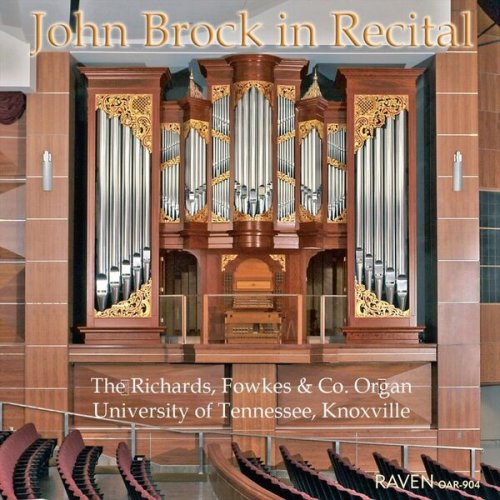
Artist:
John Brock
Title:
John Brock in Recital, The Richards, Fowkes Organ, University of Tennessee, Knoxville
Year Of Release:
2008
Label:
Raven
Genre:
Classical
Quality:
FLAC (tracks)
Total Time: 1:07:25
Total Size: 245 MB
WebSite:
Album Preview
Tracklist:1. John Brock – Praeludium in D Major, BuxWV 139 (06:09)
2. John Brock – Nun komm, der Heiden Heiland (09:36)
3. John Brock – Pastorale in F Major, BWV 590: I. Alla Siciliana (02:34)
4. John Brock – Pastorale in F Major, BWV 590: II. Allemande (03:17)
5. John Brock – Pastorale in F Major, BWV 590: III. Aria (02:56)
6. John Brock – Pastorale in F Major, BWV 590: IV. Alla Gigue (05:27)
7. John Brock – Prelude in B Minor, BWV 544 (06:21)
8. John Brock – Fugue in B Minor, BWV 544 (06:03)
9. John Brock – Herzlich tut mich verlangen, Op. 122, No. 10 (6/4) (04:14)
10. John Brock – Herzlich tut mich verlangen, Op. 122, No. 9 (02:16)
11. John Brock – Fugue in A-Flat Minor (06:13)
12. John Brock – Sonata for Organ, Op. 86: I. Andante; allegro (04:20)
13. John Brock – Sonata for Organ, Op. 86: II. Larghetto (03:52)
14. John Brock – Sonata for Organ, Op. 86: III. Vivace (04:00)
The Music Dieterich Buxtehude’s Praeludium in D and the Chorale Fantasia on “Nun komm der Heiden Heiland” (Savior of the Nations Come) by his pupil Nicolaus Bruhns represent the two most common treatments of the organ by North German organists-composers. The Praeludium is a multi-sectional piece in which relatively free rhapsodic material alternates with metrically stricter passages. The registration is based on elements of the organ’s plenum (i.e. the ensemble of principal stops) with the hands usually playing together on the same keyboard. In the Chorale Fantasia the two hands are primarily playing on different keyboards with various solo colors being contrasted with quieter more accompanimental sounds. Each of the four sections of the Fantasia is based on a different phrase of the chorale.
The Pastorale is unique among Bach’s organ works. The first movement has some of the earmarks of earlier Italian pastorales, especially the musette-like drone bass, but the other three movements resemble more closely the movements of a harpsichord suite. The fourth movement, especially reminiscent of the gigues found in Bach’s suites and partitas, has a fugal treatment of its theme in both the A and B sections with the theme inverted for B. While it is relatively certain that Bach composed all of the movements it is unclear whether he himself grouped them together into a suite as they have been traditionally performed.
The Prelude and Fugue in B Minor “pro organo pleno” (i.e., for the full organ) is one of Bach’s mature works in this genre. Evidence points to the work’s being composed during the composer’s Leipzig years 1723-1750. The Prelude is notable for its appoggiatura chords (strong-beat dissonances that resolve on a weaker beat), chromatic harmonies, and sweeping scale figures. One can also note here some subtle hints of the “storm and stress” that we associate with the music of Bach’s son Carl Philipp Emanuel. The subject of the Fugue is quite simple and reserved, as is typical for Bach in his later years, but the fugue itself is one of his most powerful and profound. A new countersubject that Bach introduces about two-thirds of the way through the movement dominates the end of the fugue.
Most of Johannes Brahms’ organ music is in a rather serious and melancholy vein. The Eleven Chorale Preludes were his last compositions, written in 1896, the year before he died and the year in which his dear friend Clara Schumann died. Most of the chorales in the collection are focused in some way on the hereafter. The text of “Herzlich tut mich verlangen” (My heart is filled with longing) speaks of being surrounded on earth by sorrow and woe and longing for a blessed end and eternal joy.
“Herzlich tut mich erfreuen” (My heart is filled with joy), the most cheerful of the eleven, speaks of being uplifted by the beautiful summertime when God renews all creation for eternity and all creatures become glorious and pure. In these settings Brahms is able to capture the moods of these texts in a very special way.
Brahms’ Fugue in A-flat minor was written in 1856 as one of a number of compositional exercises involving counterpoint. On first hearing one is struck by the beauty and depth of emotion in the piece. Further analysis reveals a wealth of contrapuntal intricacies as well, including diminution (twice as fast) and augmentation (twice as slow) of the subject and its inversion in various combinations, along with two different counter-subjects and their inversions.
Vincent Persichetti was one of the most respected of American composers of the mid-20th century. He wrote prolifically for all media – many works for various small instrumental combinations in addition to his highly regarded works for band, orchestra, and piano. The Sonata for Organ, written on commission from the St. Louis Chapter of the American Guild of Organists and premiered in 1960, is one of ten works for the organ. Persichetti’s linear style is well suited to the organ, and he wrote very idiomatically for the instrument, having been an accomplished keyboard player himself. The Sonata makes much use of polytonality with the melodic interval of the seventh playing a crucial role. The first movement is in a quasi-sonata form in which two playful themes are interrupted by a fortissimo outburst that serves as a sort of development. The lyrical second movement is in a song-like form with some use of quartal harmony. The final movement returns to the tonal idiom of the first; a toccata-like opening theme with sharp rhythms is contrasted with a broader and more lyrical second theme. The movement ends furioso on the full organ.


![Luli Maidana - Mi jardín azul (2026) [Hi-Res]](https://img.israbox.com/img/2026-08/03/lvqvn7sakbha1sz8d3ovengl6.jpg "Luli Maidana - Mi jardín azul (2026) [Hi-Res]")