Aude Heurtematte - Scheidt & Sweelinck Organ Music: 1981 Jürgen Ahrend organ, Museum in the former Augustinian Monastery, Toulouse, France (2021)
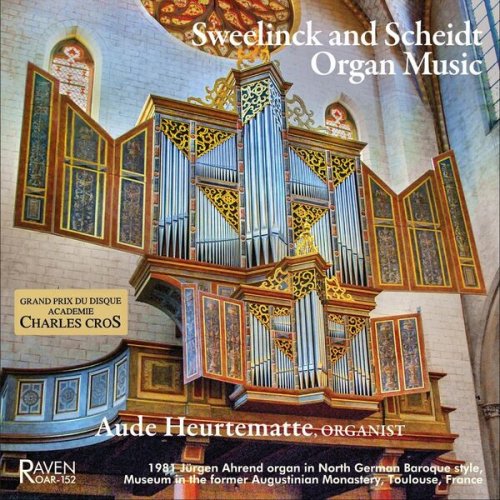
Artist: Aude Heurtematte
Title: Scheidt & Sweelinck Organ Music: 1981 Jürgen Ahrend organ, Museum in the former Augustinian Monastery, Toulouse, France
Year Of Release: 2021
Label: Raven
Genre: Classical
Quality: FLAC (tracks)
Total Time: 1:16:28
Total Size: 296 MB
WebSite: Album Preview
Tracklist:Title: Scheidt & Sweelinck Organ Music: 1981 Jürgen Ahrend organ, Museum in the former Augustinian Monastery, Toulouse, France
Year Of Release: 2021
Label: Raven
Genre: Classical
Quality: FLAC (tracks)
Total Time: 1:16:28
Total Size: 296 MB
WebSite: Album Preview
1. Aude Heurtematte – Allein Gott in der Höh sei Ehr (04:17)
2. Aude Heurtematte – Mein junges Leben hat ein End’ (08:13)
3. Aude Heurtematte – Onder een linde groen (05:27)
4. Aude Heurtematte – Engelsche fortuyn (04:06)
5. Aude Heurtematte – Malle Sijmen (01:32)
6. Aude Heurtematte – Echo fantasia, SwWV 261 (05:00)
7. Aude Heurtematte – Fantasia, SwWV 273 (14:01)
8. Aude Heurtematte – Cantio Sacra “Warum betrübst du dich, mein Herz” (14:46)
9. Aude Heurtematte – Variationen über eine Gagliarda von John Dowland (07:52)
10. Aude Heurtematte – Magnificat 9. toni (07:47)
11. Aude Heurtematte – Modus ludendi pleno Organo pedaliter (03:21)
The famous restorer and builder of organs in the North German/Dutch baroque style, Jürgen Ahrend (born 28 April 1930 in Treuenhagen near Göttingen, Germany), built in 1981 the organ heard on this CD, recorded by Aude Heurtematte just 10 years after the organ was built. Released in 1994, the CD received the Grand Prix du Disque.
Ahrend’s reputation was established by his mechanical and tonal success in restoring or reconstructing important baroque organs, including at least five built by Arp Schnitger (1648-1719), as well as building new organs. Ahrend founded his firm at age 24 in 1954 with Gerhard Brunzema (1927–1992) in Leer-Loga, Germany (East Friesland), where many significant, extant Baroque organs were available for study. Before Brunzema left in 1971 to work in Canada, the firm had built or restored 74 organs. Between 1972 and 2004, Jürgen Ahrend and his employees built, reconstructed or restored 90 more organs, earning worldwide accolades.
Ahrend built only two organs in France: the first in 1974 for the religious community in Taizé (the organ was relocated ca. 1980 to the cathedral in Lyon); the second organ, recorded on this CD, was created in 1981 for the Toulouse convent church built by the Augustinian Hermits and consecrated in 1504 to replace one destroyed by fire in 1463 (it dated from the 13th century). Following the French Revolution (1787-1799), the state took ownership of the monastery and its buildings became a museum early in the 19th century. Since its creation, the museum has housed a large collection of Roman sculptures, Gothic remnants from 12th-century cloisters destoyed during the Revolution and thereafter, and 14th- to 19th-century paintings.
Impetus to build the organ in the museum/ former monastery church was initiated by Xavier Darasse (1934-1992), who had been appointed professor of organ at the Toulouse Conservatory in 1965. The project was embraced by Denis Milhaud, chief curator of the museum, and Pierre Baudis, the mayor of Toulouse. The organ is designed to render music of the Dutch and German Baroque, primarily. The organ case, built by Ahrend’s firm, was decorated by Pierre Bellin.
Ahrend’s reputation was established by his mechanical and tonal success in restoring or reconstructing important baroque organs, including at least five built by Arp Schnitger (1648-1719), as well as building new organs. Ahrend founded his firm at age 24 in 1954 with Gerhard Brunzema (1927–1992) in Leer-Loga, Germany (East Friesland), where many significant, extant Baroque organs were available for study. Before Brunzema left in 1971 to work in Canada, the firm had built or restored 74 organs. Between 1972 and 2004, Jürgen Ahrend and his employees built, reconstructed or restored 90 more organs, earning worldwide accolades.
Ahrend built only two organs in France: the first in 1974 for the religious community in Taizé (the organ was relocated ca. 1980 to the cathedral in Lyon); the second organ, recorded on this CD, was created in 1981 for the Toulouse convent church built by the Augustinian Hermits and consecrated in 1504 to replace one destroyed by fire in 1463 (it dated from the 13th century). Following the French Revolution (1787-1799), the state took ownership of the monastery and its buildings became a museum early in the 19th century. Since its creation, the museum has housed a large collection of Roman sculptures, Gothic remnants from 12th-century cloisters destoyed during the Revolution and thereafter, and 14th- to 19th-century paintings.
Impetus to build the organ in the museum/ former monastery church was initiated by Xavier Darasse (1934-1992), who had been appointed professor of organ at the Toulouse Conservatory in 1965. The project was embraced by Denis Milhaud, chief curator of the museum, and Pierre Baudis, the mayor of Toulouse. The organ is designed to render music of the Dutch and German Baroque, primarily. The organ case, built by Ahrend’s firm, was decorated by Pierre Bellin.
![Life Force - Fearless Warriors (1981) [2007]](https://www.dibpic.com/uploads/posts/2026-09/1789570834_fearless-warriors.jpg "Life Force - Fearless Warriors (1981) [2007]")
![Matt Wilson's Good Trouble - Love Is The Whole Thing, We Are Only Pieces (2026) [Hi-Res]](https://img.israbox.com/img/2026-09/17/3usp5d1ulg59mxlcl1tdjphwr.jpg "Matt Wilson's Good Trouble - Love Is The Whole Thing, We Are Only Pieces (2026) [Hi-Res]")
![Hans P. Kjorstad - Inn (2026) [Hi-Res]](https://img.israbox.com/img/2026-09/19/qtofk2w5h4qdv245dp9ta74g7.jpg "Hans P. Kjorstad - Inn (2026) [Hi-Res]")
![Pablo Ziegler & Roberta Gambarini - Blues Porteño (Love Letters From Buenos Aires) (2026) [Hi-Res]](https://www.dibpic.com/uploads/posts/2026-09/1789484702_folder.jpg "Pablo Ziegler & Roberta Gambarini - Blues Porteño (Love Letters From Buenos Aires) (2026) [Hi-Res]")
![Koma - SPIRITS (2026) [Hi-Res]](https://img.israbox.com/img/2026-09/18/v46pmaja6np8t48crp54c9uxh.jpg "Koma - SPIRITS (2026) [Hi-Res]")
![KOUROU FIA - COKORA (2026) [Hi-Res]](https://img.israbox.com/img/2026-09/17/64n287hrqdurfo94mrcaya7o5.jpg "KOUROU FIA - COKORA (2026) [Hi-Res]")