Adam Brakel - In TImes of Crisis (2015)
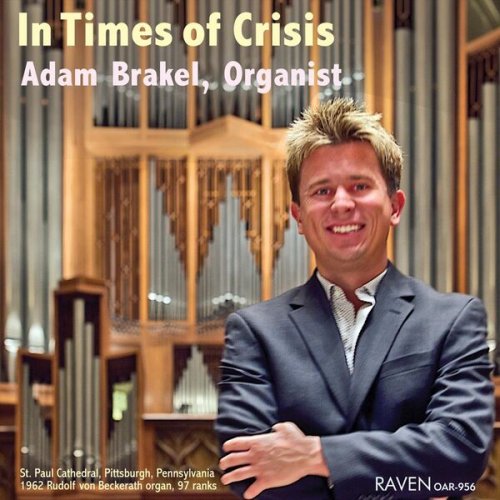
Artist: Adam Brakel
Title: In TImes of Crisis
Year Of Release: 2015
Label: Raven
Genre: Classical
Quality: FLAC (tracks)
Total Time: 1:13:53
Total Size: 278 MB
WebSite: Album Preview
Tracklist:Title: In TImes of Crisis
Year Of Release: 2015
Label: Raven
Genre: Classical
Quality: FLAC (tracks)
Total Time: 1:13:53
Total Size: 278 MB
WebSite: Album Preview
1. Adam Brakel – Drei Tonstücke, Op. 22: No. 1 in F Major (04:42)
2. Adam Brakel – Drei Tonstücke, Op. 22: No. 2 in C Major (02:16)
3. Adam Brakel – Drei Tonstücke, Op. 22: No. 3 in A Minor (03:43)
4. Adam Brakel – Symphony No. 5 in F Minor: I. Allegro vivace (09:45)
5. Adam Brakel – Passacaglia in D Minor, BuxWV 161 (05:43)
6. Adam Brakel – Passagaglia and Fugue in C Minor, BWV 582 (12:57)
7. Adam Brakel – Passacaglia in F Minor (06:24)
8. Adam Brakel – Praeludium in G Major (06:58)
9. Adam Brakel – Premier Livre d'Orgue: Récit de Tierce en taille (04:54)
10. Adam Brakel – Sunday Music: Moto Ostinato (04:37)
11. Adam Brakel – Sunday Music: Finale (11:48)
Reviews James Hildreth in The American Organist, July 2015:
For this, his second CD (the first, Romantic and Virtuosic, was reviewed in the Oct. 2014 TAO), Adam Brakel has chosen a substantial, eclectic program that follows a historical path, documenting times of crisis and instability in society, as reflected in music. Brakel's fellow Duquesne University alum (and composer of one of the works on this program) Vincent Rone has written thoughtful, perspicacious program notes relating the music of each historical period to salient social conditions of that time. These include the 30 Years' War and the Peace of Westphalia of 1648, the French Revolution of 1789, the 1848 Revolution and the rise of nationalism in the 19th century, "program music" versus "absolute music," the decline of French organ music after the early 1700s, and the conflicts arising from the issues surrounding the world wars and the rise of communism during the 20th century.
The repertoire, in order of performance, includes the Drei Tonstucke of Niels Wilhelm Gade, considered the foremost Danish composer of the 19th century. These works, full of rich harmonic, melodic, and contrapuntal invention, deserve much more recognition than they presently receive. Brakel performs them with drama and virtuosic flair. The Allegro vivace from Widor's Symphony No. 5 that comes next is given an exciting, animated performance with controlled rhythmic drive. Three passacaglias follow: the Passacaglia in D Minor of Buxtehude. Bach's Passacaglia and Fugue in C Minor, and the Passacaglia in F Minor composed by Vincent Rone in 2006. The latter work is influenced by works in the same genre by Reger and Willan, as well as parts of Howard Shore's score for Lord of the Rings. It is a well-constructed, compelling work that rightfully deserves its place alongside other major passacaglias. Brakel performs the demanding work with conviction and aplomb. Other early works are Praeludium in G Major of Bruhns and de Grigny's Recit de tierce en taille from the Premier Livre d'Orgue. Brakel's performances of the early works are historically informed without being bound by pedantic adherence to the "rules" of authenticity. They are rendered with a natural musicality that highlights the elements of affekt and stylus phatasticus that permeate these works. Hisregistrations in the passacaglias and praeludium are varied and stylistically appropriate, utilizing many of the Beckerath's tonal resources that are congenial to the music. Brakel concludes the program with spellbinding performances of Petr Eben's Moto Ostinato and Finale from Sunday Music. He intrepidly renders the notoriously difficult passages with apparent ease and clarity. These are among the best recorded performances of Eben's music.
Brakel was associate organist of St. Paul Cathedral in Pittsburgh during his time as a student at Duquesne. It was on this organ that he began his professional career. Ideally located high in the gallery, it is an instrument with which he is clearly familiar and that he holds in high regard. This was the first mechanical-action organ to be installed in a North American cathedral in the 20th century. The wide swath of repertoire provides Brakel an opportunity, which he brilliantly seizes, to explore the many facets of tone available on the large instrument. The recording highlights the spacious acoustical environment into which the organ speaks from its lofty position, giving the listener the effect of hearing it from below, in the nave.
Adam Brakel is quickly earning a well-deserved reputation as one of the finest young organists in the profession. His playing is distinguished for its energy, passion, transcendent virtuosity that serves the music without distracting, and, most importantly, musical maturity and communicative power. Here are stunning performances by one of the finest young organists on the scene, on one of North America's finest instruments.
For this, his second CD (the first, Romantic and Virtuosic, was reviewed in the Oct. 2014 TAO), Adam Brakel has chosen a substantial, eclectic program that follows a historical path, documenting times of crisis and instability in society, as reflected in music. Brakel's fellow Duquesne University alum (and composer of one of the works on this program) Vincent Rone has written thoughtful, perspicacious program notes relating the music of each historical period to salient social conditions of that time. These include the 30 Years' War and the Peace of Westphalia of 1648, the French Revolution of 1789, the 1848 Revolution and the rise of nationalism in the 19th century, "program music" versus "absolute music," the decline of French organ music after the early 1700s, and the conflicts arising from the issues surrounding the world wars and the rise of communism during the 20th century.
The repertoire, in order of performance, includes the Drei Tonstucke of Niels Wilhelm Gade, considered the foremost Danish composer of the 19th century. These works, full of rich harmonic, melodic, and contrapuntal invention, deserve much more recognition than they presently receive. Brakel performs them with drama and virtuosic flair. The Allegro vivace from Widor's Symphony No. 5 that comes next is given an exciting, animated performance with controlled rhythmic drive. Three passacaglias follow: the Passacaglia in D Minor of Buxtehude. Bach's Passacaglia and Fugue in C Minor, and the Passacaglia in F Minor composed by Vincent Rone in 2006. The latter work is influenced by works in the same genre by Reger and Willan, as well as parts of Howard Shore's score for Lord of the Rings. It is a well-constructed, compelling work that rightfully deserves its place alongside other major passacaglias. Brakel performs the demanding work with conviction and aplomb. Other early works are Praeludium in G Major of Bruhns and de Grigny's Recit de tierce en taille from the Premier Livre d'Orgue. Brakel's performances of the early works are historically informed without being bound by pedantic adherence to the "rules" of authenticity. They are rendered with a natural musicality that highlights the elements of affekt and stylus phatasticus that permeate these works. Hisregistrations in the passacaglias and praeludium are varied and stylistically appropriate, utilizing many of the Beckerath's tonal resources that are congenial to the music. Brakel concludes the program with spellbinding performances of Petr Eben's Moto Ostinato and Finale from Sunday Music. He intrepidly renders the notoriously difficult passages with apparent ease and clarity. These are among the best recorded performances of Eben's music.
Brakel was associate organist of St. Paul Cathedral in Pittsburgh during his time as a student at Duquesne. It was on this organ that he began his professional career. Ideally located high in the gallery, it is an instrument with which he is clearly familiar and that he holds in high regard. This was the first mechanical-action organ to be installed in a North American cathedral in the 20th century. The wide swath of repertoire provides Brakel an opportunity, which he brilliantly seizes, to explore the many facets of tone available on the large instrument. The recording highlights the spacious acoustical environment into which the organ speaks from its lofty position, giving the listener the effect of hearing it from below, in the nave.
Adam Brakel is quickly earning a well-deserved reputation as one of the finest young organists in the profession. His playing is distinguished for its energy, passion, transcendent virtuosity that serves the music without distracting, and, most importantly, musical maturity and communicative power. Here are stunning performances by one of the finest young organists on the scene, on one of North America's finest instruments.
![José Pérez Vargas - JPV Grupo (En Vivo en la Cuerda Mecánica) (2026) [Hi-Res]](https://www.dibpic.com/uploads/posts/2026-08/1785782599_eck7ipp5ygycv_600.jpg "José Pérez Vargas - JPV Grupo (En Vivo en la Cuerda Mecánica) (2026) [Hi-Res]")
![paulo escobar - After Knowledge (2026) [Hi-Res]](https://img.israbox.com/img/2026-08/03/c20x9qlysai0pnw4pazlm2364.jpg "paulo escobar - After Knowledge (2026) [Hi-Res]")
![Luli Maidana - Mi jardín azul (2026) [Hi-Res]](https://img.israbox.com/img/2026-08/03/lvqvn7sakbha1sz8d3ovengl6.jpg "Luli Maidana - Mi jardín azul (2026) [Hi-Res]")
![Joep Van Rhijn - Blow Out (2026) [Hi-Res]](https://www.dibpic.com/uploads/posts/2026-08/1785567190_cover.jpg "Joep Van Rhijn - Blow Out (2026) [Hi-Res]")