Murray Forbes Somerville - J. S. Bach: Great Chorales of the Clavierübung on the 1957 Flentrop organ, Busch Hall, Harvard University (2004)
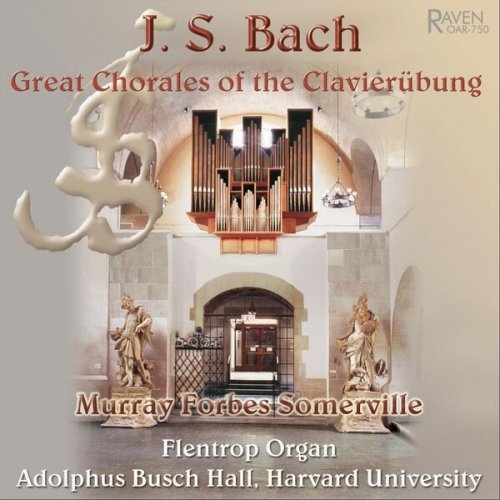
Artist: Murray Forbes Somerville
Title: J. S. Bach: Great Chorales of the Clavierübung on the 1957 Flentrop organ, Busch Hall, Harvard University
Year Of Release: 2004
Label: Raven
Genre: Classical
Quality: FLAC (tracks)
Total Time: 1:06:53
Total Size: 320 MB
WebSite: Album Preview
Tracklist:Title: J. S. Bach: Great Chorales of the Clavierübung on the 1957 Flentrop organ, Busch Hall, Harvard University
Year Of Release: 2004
Label: Raven
Genre: Classical
Quality: FLAC (tracks)
Total Time: 1:06:53
Total Size: 320 MB
WebSite: Album Preview
1. Murray Forbes Somerville – Prelude in E-Flat, BWV 552 (08:27)
2. Murray Forbes Somerville – Kyrie, Gott Vater, BWV 669 (03:44)
3. Murray Forbes Somerville – Christe, aller Welt Trost, BWV 670 (05:05)
4. Murray Forbes Somerville – Kyrie, Gott heiliger Geist, BWV 671 (05:27)
5. Murray Forbes Somerville – Allein Gott in der Höh sei her, BWV 676 (04:44)
6. Murray Forbes Somerville – Dies sind die heil'gen zehn Gebot, BWV 678 (05:07)
7. Murray Forbes Somerville – Wir glauben all' an einen Gott, BWV 680 (03:14)
8. Murray Forbes Somerville – Vater unser im Himmelreich, BWV 682 (08:45)
9. Murray Forbes Somerville – Christ, unser Herr, zum Jordan kam, BWV 684 (04:01)
10. Murray Forbes Somerville – Aus tiefer Noth schrei' ich zu dir, BWV 686 (06:39)
11. Murray Forbes Somerville – Jesus Christus, unser Heiland, BWV 688 (03:53)
12. Murray Forbes Somerville – Fugue in E-Flat, BWV 552 (07:42)
At one time, musicology contented itself with answering the questions what, how and when; nowadays, post-modern musicology also seeks to answer the question why? What is the Third Part of the Clavierübung? The first organ music published by Bach, for the Michaelmas Fair in Leipzig in 1739, it consists of a number of chorale preludes, with a prelude at the beginning and a fugue at the end. Since many of the chorales set are properly part of the Lutheran communion service, some have called it a “German Organ Mass” – but Bach could never have intended it for that, since alternatim settings are not in the Lutheran tradition. The latter chorales that he set here are included in the Catechism of Martin Luther. Insofar as Bach was a devout Lutheran, well-versed in theology, and since each chorale is set in “great” settings for manuals and pedals and small settings for manuals alone, some have thought this division might correspond to Luther’s greater and lesser Catechism, calling the collection the “Catechism chorales.” Certainly the work forms a unique whole in Bach’s output.
Why did he write it? As Gregory Butler’s 1989 study of the engraving history of the first edition makes clear, Bach had several second thoughts about the contents of this collection while it was being put together. Even the great E-flat Prelude and Fugue appears to have been an afterthought, as were several of the manualiter settings. Christoph Wolff, in his monumental book Bach, the Learned Musician demonstrates that one of Bach’s quests throughout his life was to demonstrate his academic, intellectual prowess in musical ways; this volume can be seen as another example of that, like the Art of Fugue or the B minor Mass. Indeed, since this collection was published not very long after the famous Dresden performance of the Kyrie and Gloria of the Mass, another theory holds that the initial impetus for this work may have been the organ recital that Bach also gave on that occasion. And, like the B minor Mass, these pieces have outgrown their liturgical context; while the manualiter settings could be used as preludes for congregational song, the great preludes here recorded are too long and complicated for ordinary liturgical use.
The publication date itself may also have significance, since the year 1739 was the occasion of the bicentenary both of Luther’s sermon in St. Thomas in Leipzig and of the Augsburg confession. And this collection was published less than two years after Scheibe’s vehement public attack on Bach’s music; perhaps this was a form of rebuttal, even though the charge of over-sophistication would hardly have been refuted by these intensely cerebral and formalistic works.
Why did he write it? As Gregory Butler’s 1989 study of the engraving history of the first edition makes clear, Bach had several second thoughts about the contents of this collection while it was being put together. Even the great E-flat Prelude and Fugue appears to have been an afterthought, as were several of the manualiter settings. Christoph Wolff, in his monumental book Bach, the Learned Musician demonstrates that one of Bach’s quests throughout his life was to demonstrate his academic, intellectual prowess in musical ways; this volume can be seen as another example of that, like the Art of Fugue or the B minor Mass. Indeed, since this collection was published not very long after the famous Dresden performance of the Kyrie and Gloria of the Mass, another theory holds that the initial impetus for this work may have been the organ recital that Bach also gave on that occasion. And, like the B minor Mass, these pieces have outgrown their liturgical context; while the manualiter settings could be used as preludes for congregational song, the great preludes here recorded are too long and complicated for ordinary liturgical use.
The publication date itself may also have significance, since the year 1739 was the occasion of the bicentenary both of Luther’s sermon in St. Thomas in Leipzig and of the Augsburg confession. And this collection was published less than two years after Scheibe’s vehement public attack on Bach’s music; perhaps this was a form of rebuttal, even though the charge of over-sophistication would hardly have been refuted by these intensely cerebral and formalistic works.
![George Brooks - George Brooks Summit - 25th Anniversary Edition (Anniversary Remix) (2026) [Hi-Res]](https://www.dibpic.com/uploads/posts/2026-08/1785560388_uomicwzdn4koy_600.jpg "George Brooks - George Brooks Summit - 25th Anniversary Edition (Anniversary Remix) (2026) [Hi-Res]")
![Isaiah Collier - JOY (2026) [Hi-Res]](https://www.dibpic.com/uploads/posts/2026-07/1785475369_pmwehr0rydwbv_600.jpg "Isaiah Collier - JOY (2026) [Hi-Res]")