Andrus Madsen - Johann Pachelbel: Organ, Harpsichord & Clavichord music (2010)
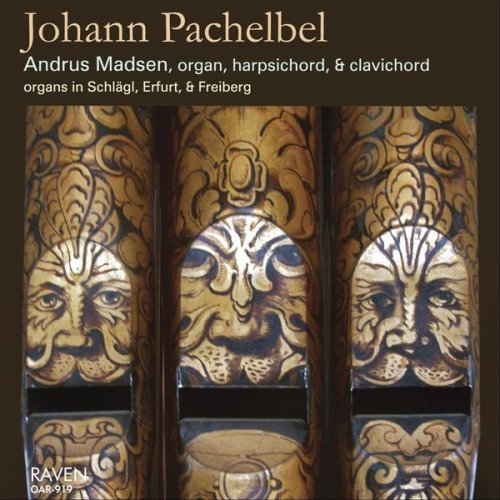
Artist: Andrus Madsen
Title: Johann Pachelbel: Organ, Harpsichord & Clavichord music
Year Of Release: 2010
Label: Raven
Genre: Classical
Quality: FLAC (tracks)
Total Time: 2:35:08
Total Size: 757 MB
WebSite: Album Preview
Tracklist:Title: Johann Pachelbel: Organ, Harpsichord & Clavichord music
Year Of Release: 2010
Label: Raven
Genre: Classical
Quality: FLAC (tracks)
Total Time: 2:35:08
Total Size: 757 MB
WebSite: Album Preview
Disc 1
1. Andrus Madsen – Toccata in E Major, P. 462 (02:12)
2. Andrus Madsen – Prelude in G Major, P. 410 (01:31)
3. Andrus Madsen – Fuga in C Major “Nachtigall,” P. 131 (02:35)
4. Andrus Madsen – Toccata in G Major, P. 467 (01:50)
5. Andrus Madsen – Fantasie in G Major, P. 128 (02:26)
6. Andrus Madsen – Warum betrübst du dich, P. 484 (03:59)
7. Andrus Madsen – Es spricht der unweisen Mund wohl, P. 114 (02:16)
8. Andrus Madsen – Durch Adam’s Fall is ganz verderbt, P. 104 (02:58)
9. Andrus Madsen – Suite in E Major, P. 436: Prelude (Improvised) (01:34)
10. Andrus Madsen – Suite in E Major, P. 436: Allemande (04:01)
11. Andrus Madsen – Suite in E Major, P. 436: Courante (01:56)
12. Andrus Madsen – Suite in E Major, P. 436: Sarabande (01:29)
13. Andrus Madsen – Suite in E Major, P. 436: Double (01:58)
14. Andrus Madsen – Suite in E Major, P. 436: Gigue (02:55)
15. Andrus Madsen – Prelude in A Major (Improvised) (01:11)
16. Andrus Madsen – Fuga in A Major, P. 163 (02:05)
17. Andrus Madsen – Fugue in D Major, P. 153 (02:06)
18. Andrus Madsen – Ich ruf zu dir Herr Jesu Christ, P. 42 (04:39)
19. Andrus Madsen – Ein feste Burg ist unser Gott, P. 106 (04:31)
20. Andrus Madsen – O Lamm Gottes unschuldig, P. 393 (05:41)
21. Andrus Madsen – Was mein Gott will das g’scheh allzeit, P. 488 (01:43)
22. Andrus Madsen – An Wasserflüssen Babylon, P. 17 (05:44)
23. Andrus Madsen – An Wasserflüssen Babylon, Weimar MS. (04:51)
24. Andrus Madsen – Magnificat Octavi Toni, P. 353 (01:22)
25. Andrus Madsen – Magnificat Octavi Toni, P. 356 (01:10)
26. Andrus Madsen – Magnificat Octavi Toni, P. 349 (01:25)
27. Andrus Madsen – Magnificat Octavi Toni, P. 347 (01:23)
28. Andrus Madsen – Ciaccona in D Major, P. 41 (05:59)
Disc 2
1. Andrus Madsen – Toccata in F Major, P. 464 (02:47)
2. Andrus Madsen – Toccata in G Major, P. 468 (01:46)
3. Andrus Madsen – Fuga in G Major, P. 160 (02:20)
4. Andrus Madsen – Gelobet seist du Jesu Christ, P. 166 (01:33)
5. Andrus Madsen – Toccata in C Major, P. 457 (02:04)
6. Andrus Madsen – Fuga in C Major, P. 151 (03:30)
7. Andrus Madsen – Fantasie in E-Flat Major, P. 127 (04:14)
8. Andrus Madsen – Wenn wit in höchsten Nöten sein, P. 501 (04:01)
9. Andrus Madsen – Fuga in D Major, P. 154 (02:43)
10. Andrus Madsen – Vom Himmel hoch, P. 52 (01:33)
11. Andrus Madsen – Wie schön leuchtet den Morgenstern, P. 501 (03:15)
12. Andrus Madsen – Suite in G Major, P. 443: Prelude (Improvised) (01:38)
13. Andrus Madsen – Suite in G Major, P. 443: Allemande (02:27)
14. Andrus Madsen – Suite in G Major, P. 443: Courante (01:13)
15. Andrus Madsen – Suite in G Major, P. 443: Sarabande (01:25)
16. Andrus Madsen – Christus der ist mein Leben, P. 376 (07:38)
17. Andrus Madsen – Suite in G Major, P. 442: Allemande (02:16)
18. Andrus Madsen – Suite in G Major, P. 442: Courante (01:22)
19. Andrus Madsen – Suite in G Major, P. 442: Ballet (01:05)
20. Andrus Madsen – Suite in G Major, P. 442: Sarabande (01:04)
21. Andrus Madsen – Suite in G Major, P. 442: Gigue (01:39)
22. Andrus Madsen – Toccata in G Major, P. 466 (02:12)
23. Andrus Madsen – Fuga in C Major, P. 152 (02:05)
24. Andrus Madsen – Herr Gott dich loben alle Wir, P. 183 (02:05)
25. Andrus Madsen – O Mensch bewein dein Sünde groß, P. 396 (05:28)
26. Andrus Madsen – Wo Gott zum Haus nicht gibt sein Gunst, P. 512 (02:38)
27. Andrus Madsen – Toccata in F Major (Improvised) (03:32)
28. Andrus Madsen – Magnificat Sexti Toni, P. 334 (01:16)
29. Andrus Madsen – Magnificat Sexti Toni, P. 326, Pt. A (01:20)
30. Andrus Madsen – Magnificat Sexti Toni, P. 326, Pt. B (01:08)
31. Andrus Madsen – Magnificat Sexti Toni, P. 326, Pt. C (01:11)
32. Andrus Madsen – Toccata in F Major, P. 463 (02:45)
General Notes from the Performer
I have felt a certain affinity with the music of Johann Pachelbel since I first came to know it as a student in my early teens. Among the first pieces I learned on the organ were the E minor Toccata, and portions of the partita Christus der ist mein Leben. Both the freewheeling improvisatory whimsy of the toccata and the gentle, personal expression of the partita appeal to me deeply. I think that many musicians overlook much of his output, assuming it to be as insubstantial as can be many of the poor, strung out, empty performances of his Kanon in D. I believe that Kanon is a very nice work, however, and when played well, can be quite exciting. The same can be said of his keyboard music. Because so much of Pachelbel’s music tends toward the improvisatory or the expressive, he places a fair amount of responsibility in the performer’s hands. When it is played in a dull manner the music suffers tremendously, but when played well it can be very special.
Pachelbel worked with a wide variety of keyboard instruments during his career. He was active in music centers where widely differing organ building traditions existed. Though he was born in Nürnberg, in his youth he spent time in two Catholic cities, Regensburg (1670-73) and Vienna (1673-77). The Catholic south German/Austrian organ was quite different stylistically from those in Protestant Germany, and was also used differently during the service. Many of the great organists Pachelbel came to know during this time, such as Froberger, Muffat, and Kerll, were playing in an Italianate style. In the Putz/Egedacher organ at Stift Schlägl, I found the perfect organ to play some of his more Italianate works. Many of Pachelbel’s toccatas as well as the Ciaccona in d display a strong affinity to Kerll and Froberger, and at Stift Schlägl they sound right at home.
The bulk of Pachelbel’s career was spent in central Germany as he held three posts successively in Thüringen: Eisenach (1677), Erfurt (1678-1690), and Gotha (1692-1695). In Erfurt, Pachelbel played an organ built in 1649 by Ludwig Compenius at the Predigerkirche. Unfortunately, all that remains of this organ is the case. The next organ Compenius built, also in Erfurt at the Michaeliskirche, was likewise mostly lost, but most of the prospect pipes survived. In 2000, Rühle Orgelbau reconstructed the Compenius organ, approximating what it might have been like. The 8’ Principal in the manual consists largely of original pipework, and while it is sometimes slow to speak (a complaint also leveled against
Pachelbel’s organ at the Predigerkirche (played by J. S. Bach in 1663), its gentle sound can be quite beautiful. On disc 1, I used nothing but Compenius’ 8’ Principal to play Ich ruf zu dir Herr Jesu Christ. Compenius’ somewhat vulnerable sounding 8’ Principal only adds to the poignant pathos of this heartfelt plea to Jesus. Pachelbel’s organ at the Predigerkirche was much larger than the Michaeliskirche organ. With a 6’ Quint in the Oberwerk, it appears to have been designed with a 16’ principal chorus in mind. Sadly, not much survives in central Germany from the late 17th century, particularly when it comes to larger organs. So I turned to the Silbermann organ at the Petrikirche, built in 1735. The principal chorus is conceived with a 16’ foundation, and, while there is no 6’ Quint in the Hauptwerk, the Hauptwerk mixture sounds right only when played in conjunction with a 16’ stop.
Pachelbel also played harpsichord and clavichord. He certainly would have been familiar with German, Flemish, and French harpsichord making traditions. I chose to play a copy of a Flemish double harpsichord built in the ravalement style by Robert Hicks in 1990. Such an instrument hybridizes elements from the early 17th-century Flemish instrument-building craft with the more refined, early 18th-century French taste for iron stringing. This particular instrument, I think, has a strong personality and can be quite expressive, making it a great voice for the plaintive Suite in e on disc 1.
The clavichord was a beloved instrument in the home during the late 17th century. Its strength lies in its ability to create dynamic shading, and it is capable of creating a pianissimo which tests the limits of human hearing. Because the 17th-century clavichord is a soft-spoken instrument, it is not well suited to a large hall. However, in a cozy parlor at home it is the perfect instrument for intimate musical expression. For this recording I chose a clavichord built by Christopher Clarke in 1974. The instrument is based in the south German style of ca. 1700.
It appears quite likely that, during the 17th century, much of what organists and harpsichordists played in public was improvised. I have made an effort to improvise in situations where Pachelbel himself was likely to have improvised. It was not uncommon to precede the performance of a suite on the lute or the keyboard with an improvised prelude; indeed, many preludes from the mid- to late-17th century were written to sound improvised. I improvised preludes to two of Pachelbel’s suites, one on each disc as well as a prelude to the A minor Fugue on disc 1. It is known that, during Vespers at St. Sebaldus in Nuremberg, Pachelbel began and ended the Magnificat with toccatas either written or improvised. On disc 2, I improvised a toccata before the Magnificat Fugues and followed them with a Toccata by Pachelbel himself. I have also made an effort to play Pachelbel’s toccatas and preludes with the spontaneity I hope to achieve in my improvisations.
It was very difficult to choose which pieces to play for this recording. I had originally planned to record only one disc, but the more time I spent with Pachelbel’s music, the more I came to the conclusion that I could not stop at only 70 minutes of music. Too much of the music is just too good to miss. Even so, I had to eliminate some pieces I recorded because they would not fit in the time available on two CDs. Each disc begins with a toccata such as would often begin a church service. Also, each disc features a set of Magnificat Fugues near the end of the disc, in the same position they would occupy toward the end of a Vespers service. One might even say that the pieces on each disc are arranged so as to loosely resemble the order of a Vespers service, with chorale preludes substituting for psalm settings (though I have indulged the exception of sandwiching the keyboard suites in the middle of both discs).
One other difficulty in choosing pieces for a recording of music by Pachelbel lies in the fact that many of the works attributed to him are of doubtful authenticity. The phrase “ascription questioned” may indeed be the true theme of the Pachelbel thematic catalog. The keyboard suites attributed to Pachelbel have a particularly sticky history. In 1901, Max Seiffert and Adolf Sandberger published a group of suites which all came from two sources, the Sandberger and the Eckelt manuscripts. The Sandberger manuscript was lost at the end of World War II, and recent scholars now question Seiffert’s and Sandberger’s attribution of the suites they published in 1901. The authorship of all but two of the twenty suites from that 1901 collection is now questionable. One of the two authentic suites is the G minor suite PWC 433 appearing on disc 2.
The authorship of the other Suite in G Minor PWC 432 on disc 2 has been questioned, but not attributed to someone else. The only surviving source for the E minor suite PWV 436 is the Seiffert and Sandberger 1901 publication as their only source was the lost Sandberger manuscript. Because the suite is written in a style not distant from that of Johann Jakob Froberger, it has since been attributed to Froberger, and appears in Siegbert Rampe’s edition of the Froberger works as a work of uncertain Froberger authorship. Unless the Sandberger manuscript resurfaces, we will never know whether the suite was anonymously included in a Pachelbel manuscript or whether it is really the work of Pachelbel. For now, I will accept the opinion of the last scholar to critically consider the manuscript, Adolf Sandberger, who believed the E minor suite to be the work of Johann Pachelbel. Andrus Madsen
I have felt a certain affinity with the music of Johann Pachelbel since I first came to know it as a student in my early teens. Among the first pieces I learned on the organ were the E minor Toccata, and portions of the partita Christus der ist mein Leben. Both the freewheeling improvisatory whimsy of the toccata and the gentle, personal expression of the partita appeal to me deeply. I think that many musicians overlook much of his output, assuming it to be as insubstantial as can be many of the poor, strung out, empty performances of his Kanon in D. I believe that Kanon is a very nice work, however, and when played well, can be quite exciting. The same can be said of his keyboard music. Because so much of Pachelbel’s music tends toward the improvisatory or the expressive, he places a fair amount of responsibility in the performer’s hands. When it is played in a dull manner the music suffers tremendously, but when played well it can be very special.
Pachelbel worked with a wide variety of keyboard instruments during his career. He was active in music centers where widely differing organ building traditions existed. Though he was born in Nürnberg, in his youth he spent time in two Catholic cities, Regensburg (1670-73) and Vienna (1673-77). The Catholic south German/Austrian organ was quite different stylistically from those in Protestant Germany, and was also used differently during the service. Many of the great organists Pachelbel came to know during this time, such as Froberger, Muffat, and Kerll, were playing in an Italianate style. In the Putz/Egedacher organ at Stift Schlägl, I found the perfect organ to play some of his more Italianate works. Many of Pachelbel’s toccatas as well as the Ciaccona in d display a strong affinity to Kerll and Froberger, and at Stift Schlägl they sound right at home.
The bulk of Pachelbel’s career was spent in central Germany as he held three posts successively in Thüringen: Eisenach (1677), Erfurt (1678-1690), and Gotha (1692-1695). In Erfurt, Pachelbel played an organ built in 1649 by Ludwig Compenius at the Predigerkirche. Unfortunately, all that remains of this organ is the case. The next organ Compenius built, also in Erfurt at the Michaeliskirche, was likewise mostly lost, but most of the prospect pipes survived. In 2000, Rühle Orgelbau reconstructed the Compenius organ, approximating what it might have been like. The 8’ Principal in the manual consists largely of original pipework, and while it is sometimes slow to speak (a complaint also leveled against
Pachelbel’s organ at the Predigerkirche (played by J. S. Bach in 1663), its gentle sound can be quite beautiful. On disc 1, I used nothing but Compenius’ 8’ Principal to play Ich ruf zu dir Herr Jesu Christ. Compenius’ somewhat vulnerable sounding 8’ Principal only adds to the poignant pathos of this heartfelt plea to Jesus. Pachelbel’s organ at the Predigerkirche was much larger than the Michaeliskirche organ. With a 6’ Quint in the Oberwerk, it appears to have been designed with a 16’ principal chorus in mind. Sadly, not much survives in central Germany from the late 17th century, particularly when it comes to larger organs. So I turned to the Silbermann organ at the Petrikirche, built in 1735. The principal chorus is conceived with a 16’ foundation, and, while there is no 6’ Quint in the Hauptwerk, the Hauptwerk mixture sounds right only when played in conjunction with a 16’ stop.
Pachelbel also played harpsichord and clavichord. He certainly would have been familiar with German, Flemish, and French harpsichord making traditions. I chose to play a copy of a Flemish double harpsichord built in the ravalement style by Robert Hicks in 1990. Such an instrument hybridizes elements from the early 17th-century Flemish instrument-building craft with the more refined, early 18th-century French taste for iron stringing. This particular instrument, I think, has a strong personality and can be quite expressive, making it a great voice for the plaintive Suite in e on disc 1.
The clavichord was a beloved instrument in the home during the late 17th century. Its strength lies in its ability to create dynamic shading, and it is capable of creating a pianissimo which tests the limits of human hearing. Because the 17th-century clavichord is a soft-spoken instrument, it is not well suited to a large hall. However, in a cozy parlor at home it is the perfect instrument for intimate musical expression. For this recording I chose a clavichord built by Christopher Clarke in 1974. The instrument is based in the south German style of ca. 1700.
It appears quite likely that, during the 17th century, much of what organists and harpsichordists played in public was improvised. I have made an effort to improvise in situations where Pachelbel himself was likely to have improvised. It was not uncommon to precede the performance of a suite on the lute or the keyboard with an improvised prelude; indeed, many preludes from the mid- to late-17th century were written to sound improvised. I improvised preludes to two of Pachelbel’s suites, one on each disc as well as a prelude to the A minor Fugue on disc 1. It is known that, during Vespers at St. Sebaldus in Nuremberg, Pachelbel began and ended the Magnificat with toccatas either written or improvised. On disc 2, I improvised a toccata before the Magnificat Fugues and followed them with a Toccata by Pachelbel himself. I have also made an effort to play Pachelbel’s toccatas and preludes with the spontaneity I hope to achieve in my improvisations.
It was very difficult to choose which pieces to play for this recording. I had originally planned to record only one disc, but the more time I spent with Pachelbel’s music, the more I came to the conclusion that I could not stop at only 70 minutes of music. Too much of the music is just too good to miss. Even so, I had to eliminate some pieces I recorded because they would not fit in the time available on two CDs. Each disc begins with a toccata such as would often begin a church service. Also, each disc features a set of Magnificat Fugues near the end of the disc, in the same position they would occupy toward the end of a Vespers service. One might even say that the pieces on each disc are arranged so as to loosely resemble the order of a Vespers service, with chorale preludes substituting for psalm settings (though I have indulged the exception of sandwiching the keyboard suites in the middle of both discs).
One other difficulty in choosing pieces for a recording of music by Pachelbel lies in the fact that many of the works attributed to him are of doubtful authenticity. The phrase “ascription questioned” may indeed be the true theme of the Pachelbel thematic catalog. The keyboard suites attributed to Pachelbel have a particularly sticky history. In 1901, Max Seiffert and Adolf Sandberger published a group of suites which all came from two sources, the Sandberger and the Eckelt manuscripts. The Sandberger manuscript was lost at the end of World War II, and recent scholars now question Seiffert’s and Sandberger’s attribution of the suites they published in 1901. The authorship of all but two of the twenty suites from that 1901 collection is now questionable. One of the two authentic suites is the G minor suite PWC 433 appearing on disc 2.
The authorship of the other Suite in G Minor PWC 432 on disc 2 has been questioned, but not attributed to someone else. The only surviving source for the E minor suite PWV 436 is the Seiffert and Sandberger 1901 publication as their only source was the lost Sandberger manuscript. Because the suite is written in a style not distant from that of Johann Jakob Froberger, it has since been attributed to Froberger, and appears in Siegbert Rampe’s edition of the Froberger works as a work of uncertain Froberger authorship. Unless the Sandberger manuscript resurfaces, we will never know whether the suite was anonymously included in a Pachelbel manuscript or whether it is really the work of Pachelbel. For now, I will accept the opinion of the last scholar to critically consider the manuscript, Adolf Sandberger, who believed the E minor suite to be the work of Johann Pachelbel. Andrus Madsen
![Dino Siani - Pianoforte e Orchestra / I Solisti e gli Archi (2026) [Hi-Res]](https://img.israbox.com/img/2026-07/30/w73w7u4gf9zujnwitnrytw81f.jpg "Dino Siani - Pianoforte e Orchestra / I Solisti e gli Archi (2026) [Hi-Res]")
![Joep Van Rhijn - Paper Planes (2026) [Hi-Res]](https://www.dibpic.com/uploads/posts/2026-08/1785566812_ww9ou53n1t6xk_600.jpg "Joep Van Rhijn - Paper Planes (2026) [Hi-Res]")
![Denny Zeitlin - Odyssey (2026) [Hi-Res]](https://www.dibpic.com/uploads/posts/2026-07/1785347772_a3679071701_10.jpg "Denny Zeitlin - Odyssey (2026) [Hi-Res]")