Budapest Strauss Ensemble, Istvan Bogar - Wedding Celebrations: Marches, Polkas, Waltzes (1994)
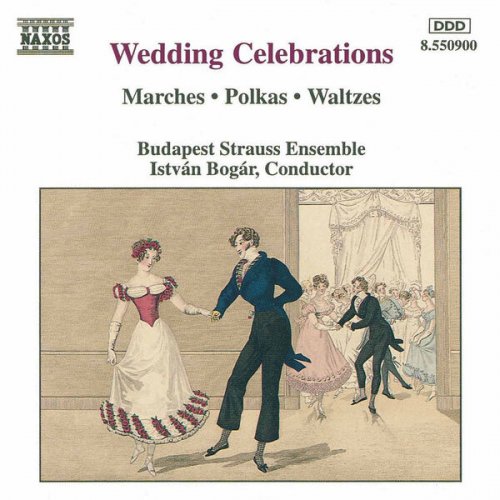
Artist: Budapest Strauss Ensemble, Istvan Bogar
Title: Wedding Celebrations: Marches, Polkas, Waltzes
Year Of Release: 1994
Label: Naxos
Genre: Classical
Quality: FLAC (tracks)
Total Time: 53:24
Total Size: 289 Mb
WebSite: Album Preview
Tracklist:Title: Wedding Celebrations: Marches, Polkas, Waltzes
Year Of Release: 1994
Label: Naxos
Genre: Classical
Quality: FLAC (tracks)
Total Time: 53:24
Total Size: 289 Mb
WebSite: Album Preview
01. Wien bleibt Wien, Marsch (00:03:24)
02. La vie parisienne, Polka (00:02:27)
Figaro, Op. 320 (Johann Strauss II)
03. Figaro-Polka francaise, Op. 320 (00:04:06)
04. Souvenir de Herkulesbad (00:03:52)
Der Zigeunerbaron (the Gypsy Baron) (Johann Strauss II)
05. Einzugs-Marsch [from Der Zigeunerbaron] (00:02:52)
Frauenherz, Op. 166 (Josef Strauss)
06. Frauenherz, Polka maqur, Op. 166 (00:04:15)
Die Fledermaus (Johann Strauss II)
07. Bohmisch-Polka (from Die Fledermaus) (00:01:46)
The Danube Waves (Iosif Ivanovici)
08. Donauwellen, Walzer (00:05:26)
09. Bavarian Ländler (00:02:21)
Annen-Polka, Op. 117 (Johann Strauss II)
10. Annen-Polka francaise, Op. 117 (00:03:49)
Wein, Weib und Gesang!, Op. 333 (Johann Strauss II)
11. Wein, Weib und Gesang, Walzer, Op. 333 (00:04:00)
12. Tyrolean Woodcutters' March (00:04:04)
Flora, Op. 54 (Josef Strauss)
13. Flora, Polka mazur, Op. 54 (00:04:21)
Spanischer, Op. 433 (Johann Strauss II)
14. Spanischer Tanz (from Die Fledermaus) (00:01:13)
15. La vie parisienne, Cancan (00:02:29)
Radetzky March, Op. 228 (Johann Strauss I)
16. Radetzky-Marsch, Op. 228 (00:02:59)
Total length: 00:53:24
Label: Naxos
Performers:
Budapest Strauss Ensemble
Istvan Bogar
Despite its title, this disc of festive music is not especially connected to wedding celebrations and should not be mistaken as a bridal sampler. Instead, the program is a survey of nineteenth century polkas, waltzes, and marches drawn from Viennese and French operettas and the dance repertoire of salon orchestras. Buoyant pieces by members of the celebrated Strauss family and Jacques Offenbach are presented side-by-side with music by less famous but industrious composers, such as Johann Schrammel, Jakob Pazeller, and Iosif Ivanovici. This even-handed approach to programming gives a reasonably accurate impression of the music of the times and displays the uneven mix of excellence and triteness that surely existed then. István Bogár's arrangements for the Budapest Strauss Ensemble are consistent and unpretentious, and he blends the elegance of the ball with the more mundane sounds of Austro-Hungarian light music. Notably, Bogár includes the accordion and various band instruments, such as the saxophone, to suggest the ad hoc nature of the period's ensembles. While a few pieces are exceptionally well known -- Wein, Weib und Gesang by Johann Strauss II and the rambunctious Can Can from La vie parisienne by Offenbach are two standouts -- they do not draw inordinate attention to themselves in their modest presentation here.
DOWNLOAD FROM ISRA.CLOUD
Budapest Strauss Ensemble & Istvan Bogar - Wedding Celebrations (1994) FLAC.rar - 289.5 MB
Budapest Strauss Ensemble & Istvan Bogar - Wedding Celebrations (1994) FLAC.rar - 289.5 MB
![Malia & Boris Blank - Convergence (Reference Edition) (2026) [Hi-Res]](https://www.dibpic.com/uploads/posts/2026-07/1785500208_y33vh1kxh0z4e_600.jpg "Malia & Boris Blank - Convergence (Reference Edition) (2026) [Hi-Res]")
![Freddie Hubbard - The Artistry of Freddie Hubbard (1962/2026) [Hi-Res]](https://www.dibpic.com/uploads/posts/2026-07/1785432174_cover.jpg "Freddie Hubbard - The Artistry of Freddie Hubbard (1962/2026) [Hi-Res]")