Robert Schubert - China Wind: the clarinet music of Julian Yu, Volume 1 (2012) Hi-Res
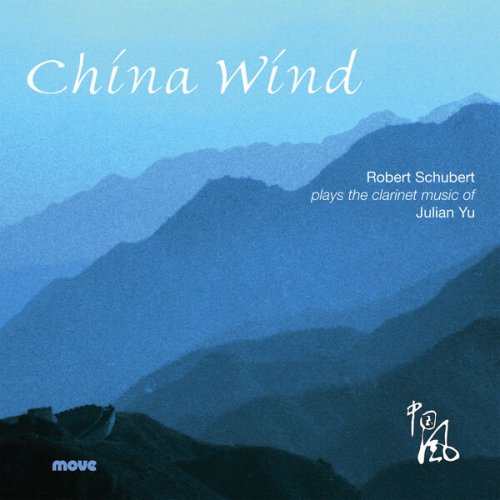
Artist: Robert Schubert
Title: China Wind: the clarinet music of Julian Yu, Volume 1
Year Of Release: 2012
Label: Move Records
Genre: Classical
Quality: FLAC 16/24 Bit (44,1 KHz / tracks+booklet)
Total Time: 61:07 min
Total Size: 223 / 526 MB
WebSite: Album Preview
Tracklist:Title: China Wind: the clarinet music of Julian Yu, Volume 1
Year Of Release: 2012
Label: Move Records
Genre: Classical
Quality: FLAC 16/24 Bit (44,1 KHz / tracks+booklet)
Total Time: 61:07 min
Total Size: 223 / 526 MB
WebSite: Album Preview
01. Concerto on Chinese Themes - Moderato
02. Concerto on Chinese Themes - Lento
03. Concerto on Chinese Themes - Vivace
04. The Lamenations of Micius
05. Atanos
06. Sol Do La Re
07. Since We Parted
08. Silent and Alone
09. Lingering Thoughts
The playing from clarinettist Robert Schubert and his collaborators is exceptionally fine, and the high fidelity tone-colour and sound quality of the recordings capture beautiful, rich sounds from the various ensembles.
Julian Yu has always been fascinated by the organization, discipline and formularisation of Western classical music. These qualities, which also belong to Chinese folk music, can imply limitation, but Yu builds from such foundations with great freedom. The music of Atanos is non-programmatic and follows its own inner laws.
Yu originally wrote Sol Do La Re as an exercise in counterpoint for string quartet while he was studying in Japan in 1985. While not strictly serialist, the piece is built around a ground bass of twelve tones. The tone row is arranged pentatonically, and is repeated ten times as a ground bass, above which the music gradually unfolds as a work of extraordinary beauty and emotional intensity. In 1996 Yu wrote a version for clarinet and string trio.
In 1997, Robert asked Yu to write a new work featuring the clarinet, The Lamentation of Micius. Yu had come across some ancient music known as 'Micius Laments the Silk' while he was a student at the Central Conservatory of Music, Beijing. Micius, an ancient philosopher, had lamented that pure silk was dyed with different colours, and likened this process to what happens to people when they mix with the world, taking on the 'colours' of their environment, and losing their purity and innocence.
The raw material for Concerto on Chinese Themes for Clarinet and String Orchestra comes from northern Chinese instrumental music for wind and percussion. This is exuberant music, full of easily-remembered melodies, strident sounds and striking rhythms.
Silent And Alone is a setting of three poems by Li Yu (937-978), the last emperor of the Southern Tang Dynasty. Imprisoned after he was overthrown, Li Yu wrote in his diary that he “washed his face with his tears every day”, so miserable did he feel. Silent and Alone was originally written for tenor and orchestra. Yu's reworking of the piece for clarinet, piano and string quartet is no mere transcription; this version has fresh nuances of timbre and expression.
This recording demonstrates Julian Yu's remarkable versatility, emotional breadth and mastery of compositional style and technique.
Julian Yu has always been fascinated by the organization, discipline and formularisation of Western classical music. These qualities, which also belong to Chinese folk music, can imply limitation, but Yu builds from such foundations with great freedom. The music of Atanos is non-programmatic and follows its own inner laws.
Yu originally wrote Sol Do La Re as an exercise in counterpoint for string quartet while he was studying in Japan in 1985. While not strictly serialist, the piece is built around a ground bass of twelve tones. The tone row is arranged pentatonically, and is repeated ten times as a ground bass, above which the music gradually unfolds as a work of extraordinary beauty and emotional intensity. In 1996 Yu wrote a version for clarinet and string trio.
In 1997, Robert asked Yu to write a new work featuring the clarinet, The Lamentation of Micius. Yu had come across some ancient music known as 'Micius Laments the Silk' while he was a student at the Central Conservatory of Music, Beijing. Micius, an ancient philosopher, had lamented that pure silk was dyed with different colours, and likened this process to what happens to people when they mix with the world, taking on the 'colours' of their environment, and losing their purity and innocence.
The raw material for Concerto on Chinese Themes for Clarinet and String Orchestra comes from northern Chinese instrumental music for wind and percussion. This is exuberant music, full of easily-remembered melodies, strident sounds and striking rhythms.
Silent And Alone is a setting of three poems by Li Yu (937-978), the last emperor of the Southern Tang Dynasty. Imprisoned after he was overthrown, Li Yu wrote in his diary that he “washed his face with his tears every day”, so miserable did he feel. Silent and Alone was originally written for tenor and orchestra. Yu's reworking of the piece for clarinet, piano and string quartet is no mere transcription; this version has fresh nuances of timbre and expression.
This recording demonstrates Julian Yu's remarkable versatility, emotional breadth and mastery of compositional style and technique.

![Noel McKay - Songs About Bad People (2026) [Hi-Res]](https://img.israbox.com/img/2026-09/25/nxf8m3t6d1fmsqf6yxa9rd38t.jpg "Noel McKay - Songs About Bad People (2026) [Hi-Res]")
![Juliana Blumenschein - Constelação Feminina (2026) [Hi-Res]](https://img.israbox.com/img/2026-09/28/tmypga5chmsxo6n0lv5flw25o.jpg "Juliana Blumenschein - Constelação Feminina (2026) [Hi-Res]")
![Alberto N. A. Turra - The TAAN Trio walks the Major Arcana walk (2026) [Hi-Res]](https://img.israbox.com/img/2026-09/27/5vyv8d6brv3sql23ksk8z65dm.jpg "Alberto N. A. Turra - The TAAN Trio walks the Major Arcana walk (2026) [Hi-Res]")
![Constanza Pellicci & Ana Gamboa - Secreto desorden de los sentidos (2026) [Hi-Res]](https://img.israbox.com/img/2026-09/26/xi5951dowc7dyrb7terbkcn0i.jpg "Constanza Pellicci & Ana Gamboa - Secreto desorden de los sentidos (2026) [Hi-Res]")
![Kevin Sun - Kevin Sun, II (2026) [Hi-Res]](https://img.israbox.com/img/2026-09/27/pzwaczrg0dxw87hagkc04824e.jpg "Kevin Sun - Kevin Sun, II (2026) [Hi-Res]")