Jack Mitchener - Romantic to Modern: 100 Years of Organ Music from France and Germany (ca. 1840-1940) (2014)
- 03 Jan, 13:34
- change text size:
Facebook
Twitter
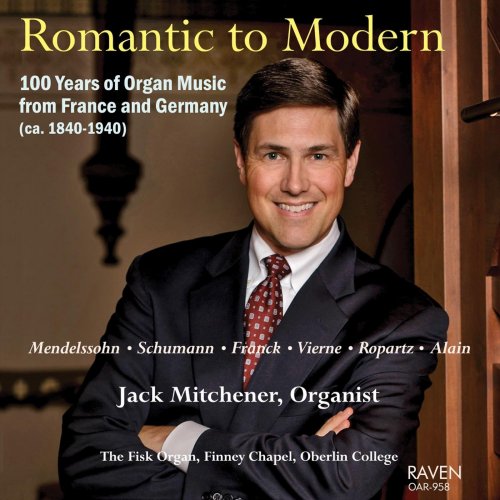
Artist: Jack Mitchener
Title: Romantic to Modern: 100 Years of Organ Music from France and Germany (ca. 1840-1940)
Year Of Release: 2014
Label: Raven
Genre: Classical
Quality: FLAC (tracks)
Total Time: 1:04:10
Total Size: 239 MB
WebSite: Album Preview
Tracklist:Title: Romantic to Modern: 100 Years of Organ Music from France and Germany (ca. 1840-1940)
Year Of Release: 2014
Label: Raven
Genre: Classical
Quality: FLAC (tracks)
Total Time: 1:04:10
Total Size: 239 MB
WebSite: Album Preview
1. Jack Mitchener – Sonata No. 1 in F Minor, Op. 65: I. Allegro moderato e serioso (05:31)
2. Jack Mitchener – Sonata No. 1 in F Minor, Op. 65: II. Adagio (03:01)
3. Jack Mitchener – Sonata No. 1 in F Minor, Op. 65: III. Andante-Recitativo (Live) (03:07)
4. Jack Mitchener – Sonata No. 1 in F Minor, Op. 65: IV. Allegro vivace assai (03:33)
5. Jack Mitchener – Canon in A Minor, Op. 56, No. 2 (04:25)
6. Jack Mitchener – Canon in E Major, Op. 56, No. 3 (02:06)
7. Jack Mitchener – Choral No. 2 in B Minor, Section I (06:10)
8. Jack Mitchener – Choral No. 2 in B Minor, Section II (07:23)
9. Jack Mitchener – Introduction et Allegro moderato (08:23)
10. Jack Mitchener – Trois Piéces: I. Thème varié (03:42)
11. Jack Mitchener – Symphony No. 1 in D Major, Op. 14: VI. Final (06:32)
12. Jack Mitchener – Trois Piéces: II. Prière pour la Trépassés (05:24)
13. Jack Mitchener – Litanies (04:48)
The romantic aesthetic, as it came to be known in the first half of the nineteenth century, had its genesis in artistic and philosophical movements in the late eighteenth century. Moreover, the full power of romanticism was unleashed with the struggles and angst of the French Revolution. Beginning with the compositions of Germans who bow to Bach and continuing to French composers Franck, Ropartz, and Vierne, the styles represented on this recording are clearly romantic of all shades and colors. The final work shows a shift in the twentieth century to modernism.

At the age of ten, Felix Mendelssohn (1809-1847) became a student in composition and counterpoint of Karl Friedrich Zelter (1758-1832), one of the driving forces behind the Bach revival in the 19th century who had studied with Bach’s pupil Johann Kirnberger. Mendelssohn also studied the organ with August Wilhelm Bach (1796-1869, no relation to J.S. Bach). Mendelssohn’s early exposure to the music of J. S. Bach, as a result of the strong influence of Zelter and A.W. Bach, paved the way for the famous concert in 1829 in Berlin for which he conducted the St. Matthew Passion (a Bach masterpiece that had not been heard by the public for nearly 80 years). This is seen by many as a seminal event in the revival of Bach’s music in the 19th century. Mendelssohn’s popularity in England also played a large role in the proliferation of Bach’s music in the English-speaking world. Moreover, the publication of Mendelssohn’s own organ music in Germany, England, France, and Italy had much to do with the growing interest in the music of Bach and also contributed significantly to the development of organ playing technique throughout Europe.
Mendelssohn’s Six Sonatas, Op. 65, were composed as a result of a commission from Coventry and Hollier in England for a collection of organ voluntaries. Not knowing what a voluntary was, Mendelssohn asked to publish a set of six sonatas instead. The first sonata begins with a serious movement in F minor that contrasts contrapuntal writing with the complete statement of the chorale Was mein Gott will, das g’scheh allzeit (What my God wills is always right). The second movement, in A flat major, is lyrical and reminiscent of some of Mendelssohn’s Songs Without Words for piano. The third movement, in C minor, begins with a single melody in a recitative style followed by full chords on the main manual. The movement continues with a dialogue between these sonorities and ends with a quiet passage that leads directly to the final movement. The Allegro assai vivace, more pianistic in nature, is filled with arpeggios that provide a sense of crescendo as the chords become bigger. The mode is F major, but Mendelssohn quickly travels through an array of key areas to provide intensity. Pedal solos at the end of the movement create excitement as the sonata comes to a brilliant close.
Following the example of Mendelssohn, Robert Schumann (1810-1856) expended a vast amount of energy studying and promoting the music of J. S. Bach. This fascination with Bach’s œuvre reached new heights in early 1845 when Schumann, along with his wife Clara, set out to glean a more complete understanding of the polyphonic style. The results of this tireless effort are evident in several collections of pieces including the Studien für den Pedalflügel – Sechs Stücke in kanonischer Form (Studies for the Pedal Piano – Six Pieces in Canonic Form), Op. 56, as well as the four Skizzen für den Pedalflügel (Sketches for the Pedal Piano), Op. 58, the six Fugen über den Namen Bach (Fugues on the Name BACH), Op. 60, for organ or pedal piano, and the Fier Fugen (Four Fugues), Op. 72, for piano. The Six Pieces in Canonic Form, Op. 56, were written in the spring and summer of 1845 in Dresden (where one third of Schumann’s complete works were composed) and show a clear connection to the works of Bach, especially the Inventions. Schumann dedicated the collection to his teacher and friend Johann Gottfried Kuntzch, the organist at St. Mary’s Church in Zwickau, Schumann’s birthplace. Interest in the pedal piano had grown substantially since about 1800 when Johann Gottlieb Wagner, a musician in Dresden, had begun adding a pedal keyboard to the square piano. Precedent had been set for such an instrument as early as the fifteenth century with the pedal clavichord and later the pedal harpsichord, and these were important practice instruments for organists (including Bach) throughout the 16th, 17th, and 18th centuries. Even Mozart had a fortepiano with independent pedals made for him by Anton Walter in 1785. Louis Schone built a pedal piano for Schumann in 1843, and it provided both Clara and Robert an instrument on which they could play the organ works of Bach.
Canonic Study No. 2 in A minor is marked Mit innigem Ausdruck (With heartfelt expression). The canon, heard on a solo stop in the treble range, is at the unison pitch and at a distance of one measure. Schumann’s ability to weave a beautiful melodic line accompanied by splendid romantic harmony creates a work far more interesting and moving than a strict and straightforward study in canonic form. Different organ registrations, especially for the solo lines (such as the Cor Anglais 16’ on the Positif, played one octave higher), are used for this recording to provide important changes in color – similar to what one would do on the piano, but with a nod to the symphony orchestra. Canonic Study No. 3 in E major is in a simple ternary form. It opens with a brief recitative-like intonation marked Andantino, but immediately launches into an A section (marked Etwas schneller – a little faster) in which the main melodic material appears in the soprano with a canon at the fifth and at a distance of only two beats. The short B section of eight bars is in A major and is played on a softer registration (the Flûte Douce 4’ on the Positif). An A-prime section ensues followed by a delightful conclusion in which material from the opening measures returns.
Although César Franck (1822-1890) was born in Liège, Belgium, he lived most of his life, from his teenage years on, in Paris. After his studies and working in several smaller posts, he was appointed organist of the Basilica of Sainte Clotilde and professor of organ at the Paris Conservatory. Charles Tournemire, Franck’s second successor after Pierné at Ste. Clotilde, refers in 1931 in his intriguing little book entitled César Franck to “an educator full of fire with a marvelous heart.” He goes on to remark about Franck’s teaching of contrapuntal improvisation in the Conservatory organ class:
In fugue he was particularly interested in the construction of the episodes, combining an ingenious tonal plan with the elegant writing of a counterpoint with imitations in closer and closer stretto. Every now and then he would sit down at the keyboard and give us an example. And what an example! While we had difficulty working out one correct counter- subject, he, in the same time, had found five or six: “See, you can do this…or else this…or again…” Then, in the most natural tone: “Come, now choose one and make me a good fugue!”
Franck was remembered by his students as being kind and generous with his time, and he was somewhat of a father figure to them (he was affectionately called le pére Franck). But even Franck had his moments of frustration. D’Indy recalls the maître’s explosive anger: “…when awkward finger went astray… in some ugly harmonic progression.” And John Hinton, an English organ student of Franck, remembers that “wrong accidentals in playing particularly annoyed him…he would shout and rave like a madman if the offense were repeated.” Guy Ropartz, in an article on Franck, refers to the maître as a “Christian mystic…whose work will live,” and that the organ pieces “…are really symphonies, sublimely conceived, magnificently wrought.” In regards to Franck the organist, Ropartz writes:
"César Franck was himself a remarkable organist, full of love for his instrument and careful to avoid degrading it, as do, alas too many of his fellows, to the poor part of entertainer of the swarming crowd that fills the churches. At Ste. Clotilde, where he was organist for thirty-two years, crowds of music-lovers would assemble Sunday by Sunday to hear his admirable improvisations, and had anyone noted them down, art would have been all the richer by a series of compositions as finely constructed as those which he so long thought over, so carefully wrote down."
Franck’s Choral II from Trois Chorals represents the apogee of the composer’s creative genius. Written only months before the composer’s death in 1890, it is a work rife with the quintessential elements of romanticism: drama, virtuosity, and lyricism. The form is one of continuous variation. The main theme, initially stated in the pedal, is the basis for a melodic ostinato and ultimately a passacaglia of monumental proportion. Similarities can indeed be drawn between this work and the impressive Passacaglia in C minor of J. S. Bach. Whatever the influence, Franck may certainly have been inspired by the baroque masterpiece. Choral II is clearly divided into two distinct sections, each ending with the “chorale” theme played on the unique sound of the Voix humaine on the Récit.
Joseph Guy Ropartz (1864-1955), born in Brittany in northwestern France, was a disciple of César Franck who not only continued his master’s tradition, but also created works that serve as a bridge to the twentieth century. Ropartz studied the organ under Franck, yet his primary interest was composition. He was not a virtuoso organist, but rather spent most of his career composing, serving as director of the conservatories in Nancy and Strasbourg and as conductor of the Strasbourg Municipal Orchestra. Ropartz’s œuvre is vast and consists of song cycles, choral works (including a large setting of Psalm 136 and a Requiem), numerous piano pieces, cello sonatas, violin sonatas, string quartets, and five symphonies (Symphony No. 3 in E major is a large-scale work for full orchestra, chorus, and soloists with romantic texts written by the composer). His output for organ consists of eighteen works composed between 1885-1942. Nearly two thirds of these pieces were written with specific liturgical needs in mind, and seven of the organ works are more substantial and seem most appropriate as concert repertoire.
Ropartz’s Introduction et Allegro moderato in D minor exhibits an architecture that reflects the composer’s studies with Franck. Following tradition, the form is Sonata-allegro. After a grand and majestic introduction in the spirit of a French overture, the Allegro moderato ensues with statements of the two main themes, the first strong and serious, the second lyrical and melodious. Throughout the exposition and development of the themes, the influence of Wagner, perhaps through Franck, an ardent Wagnerian, is apparent – especially in the harmony. It is clear that Franck served as the catalyst for Ropartz’s interest in Wagner’s music, but the young Breton made his own serious study of this music and travelled to Bayreuth to hear performances of Wagner’s great music dramas. The coda in the Introduction et Allegro moderato signals a return of the French overture elements from the work’s opening measures. This final section brings a shift to D major and gives the work a sense of optimism after the preceding rhythmic and harmonic tension. Ropartz composed the Introduction et Allegro moderato in 1917 and dedicated the work to concert organist and important pedagogue Joseph Bonnet. At this time, near the end of the Great War (WWI), Bonnet was sent by the French government on an official mission to the United States in order to combat, through his concerts, the influence of German and Austrian artists. As a champion of Ropartz’s music, it seems likely Bonnet may have performed the Introduction et Allegro moderato on numerous occasions. There is a sense of searching and uneasiness in this work that exists in the main themes – perhaps a reflection of the angst of the time. Yet the conclusion represents a feeling of hope for the future. The harmonic language is anathema to the trends in composition in the early part of the twentieth century. Indeed, Ropartz’s work was composed roughly eight years following Schoenberg’s Pierrot lunaire and six years after the riots broke out at the Théâtre des Champs Élysées during the premiere of Stravinsky’s Le sacre du printemps (The Rite of Spring). Nonetheless, Ropartz has a unique voice that deserves to be heard. That Ropartz continued to compose in a late-romantic idiom clearly shows his allegiance to the musical and literary aesthetics of the nineteenth century.
Thème varié was composed in 1901 as part of the Trois Pièces (the other two pieces are Prière pour les Trépassés, and Fantaisie). Thème varié begins with an opening theme in the style of a Breton or Celtic folk song, although there is no specific reference to one in the score. As the title suggests, this is a set of variations in which an unaccompanied theme is first heard in its entirety. This is followed by a harmonization of the theme with the melody in the soprano. The ensuing variation has the theme in the pedal with quarter-note motion in the manuals as accompaniment. What appears to begin as the third variation is actually a fugato with a subject derived from the main theme. After three voices have entered, Ropartz flirts with the idea of combining the themes, and after an eight-measure dominant pedal point and in true Franckian spirit, he does just that with a complete statement of the main theme in octaves in the right hand while the left hand and pedal play the fugue subject. The pedal part does not double the left hand note-for-note, but merely on the most important pitches. The pedal acts as an extension of the left hand, something that is evident in a number of Franck’s organ works. Thème varié concludes with a section in the major mode with the main theme resounding high in the treble range over a tonic pedal and chromatic harmony as accompaniment. There is an air of mystery to the final measures as the composer searches for new ways to harmonize the simple melody. The piece seems to fade away into the mist, a characteristic not uncommon to Ropartz.
The Prière in E major, the second of the Trois Pièces of 1896, is in a simple ternary form, A-B-A’. The opening two bars act as the motivic cell, both melodically and rhythmically, upon which the entire piece is based. The basic structure of the melodic line (3-2-1-2-3-5) has a folk-like quality to it, and seems to be in the style of a Breton or Celtic folk song. The opening bars are a sort of intonation with a harmonic scheme of I-V-vi-iv-I. Ropartz returns to this with an exact restatement of the initial measures in the codetta. The Prière, perhaps more than any other organ work of Ropartz, shows a striking similarity to the organ works of Franck. There is no obvious model, yet the melodic and harmonic structure of this piece simply remind one of the Franckian style. Ropartz exploits transposition as Franck also does in the E major Chorale. The harmonic scheme with emphasis on third relationships is reminiscent of the third Chorale (For example, the main theme is stated in E major, then repeated in G major).
Some have considered the “inner beauty” and a certain austerity to Ropartz’s musical voice. That his music may sound austere perhaps can be attributed to his life experience – he suffered very early by losing his father and two brothers before the age of fifteen. As a result, he developed strong Christian beliefs and remained a faithful Roman Catholic throughout his life. He sought through his sacred compositions, including masses and motets as well as works for organ, to provide music of a serious caliber worthy of the divine liturgy. Just as he described Franck, he also was a “Christian mystic” whose faith was a foundation for his life and work. In addition, Guy Ropartz is remembered for his faithfulness to the culture of Brittany. Its folklore, the sea, the mist-filled pastoral scenes of nature – all appear as important characters in his drama. For him, Brittany was his paradise.
Louis Vierne (1870-1937) was born in Poitiers, France, almost completely blind. After his family moved to Paris, he became a student at the Institution National des Jeunes Aveugles (National School for Blind Youth). All students there had a strong musical education and were required to study violin and piano, and to sing in the choir. Vierne later studied the organ with César Franck, but only for a period of less than two years. In 1892, Vierne was appointed assistant organist to Widor at the Church of St. Sulpice, and he was named Widor’s assistant at the Paris Conservatoire in 1894. Only two days prior, he won his coveted First Prize in Organ from the Conservatoire. In 1900, Vierne was appointed organist at the Cathedral of Notre Dame, a post he held until his death – literally, since he died at the console of the organ at the beginning of a concert.
The Symphonie I, Op. 14 dates from 1899 and represents the beginning of Vierne’s contribution to a genre that Widor had already firmly established in the 19th century. The first symphony of Vierne opens with a Prélude et Fugue in D minor. The ensuing movements, Pastorale, Allegro vivace, and Andante demonstrate the full range of dynamics one would expect from a French symphonic work. The sixth and last movement, Final, is a stirring and exuberant piece in D major that is intended to display the full resources of the organ. A work in sonata-allegro form, this last movement opens with toccata-like figuration in the manuals with the first theme in the pedals. After a transition, the second theme is heard in the dominant key of A major and in canon between the soprano voice in the right hand and the pedal (a technique Vierne would have honed with Franck who used canon extensively). The form of the piece is straightforward as the development explores different key areas and employs various techniques in thematic extension. The recapitulation shows a triplet figuration in the manuals as the main theme returns. The same transition occurs, but is followed by the second theme played on full organ and in the tonic key. The coda is exciting and brings the work to a brilliant conclusion.
Jehan Alain (1911-1940), was one of the most original and creative musical minds of the twentieth century (Jehan is the old French spelling and is pronounced as if the h were omitted). Alain, with Langlais and Messiaen, was among a generation of innovative organist/composers whose works illustrate the epitome of modernity in French organ composition. Like Nicolas de Grigny of the 17th century with whom he is sometimes compared, Alain left this world much too soon – he was killed by members of the German army on 20 June 1940 at age 29 near Saumur, France, at the beginning of World War II. Jehan Alain composed Litanies, JA 119, in August of 1937 when he was 26. His younger sister, the eminent organist and pedagogue Marie-Claire Alain (1926-2013), recalled hearing fragments of Litanies before August of 1937 and, in fact, passages of the piece appear in an earlier work written in 1936, Fantasmagorie, JA 63. This rhythmic figuration may, as Marie-Claire Alain suggests, represent Jehan’s memory of the train rides from his suburban home in St. Germain-en-Laye to Paris. The chords in the left hand illustrate the irregular motion and accents of the train wheels on the track. This section in many ways serves to give the piece an element of humor (known as “the train motive”). This rhythmic figuration may also reflect influences from jazz and eastern cultures.
The original title of the work was Supplications; Litanies may have been applied shortly after its composition. The work may have served as a source of comfort for Jehan as he suffered the death of his beloved sister Marie-Odile who died on 3 September 1937 as the result of a mountain-climbing accident. Jehan’s expression of mourning is reflected in the inscription he attached to the beginning of Litanies: “When the Christian soul no longer finds new words in its distress for imploring the mercy of God, it repeats incessantly the same prayer with a fervent faith. Reason reaches its limit. Faith alone follows its ascension.” Jehan Alain gave to Bernard Gavoty, author of a biography of the young composer, a detailed explanation of how to approach Litanies: “…When you play this piece, you must give the impression of an ardent evocation. The prayer is not a complaint, but an irrepressible hurricane that overthrows everything in its path. It is also an obsession: one must fill the ears of men…and of the Good Lord! If, in the end, you do not feel exhausted, then you will neither have understood nor played as I want it. Push yourself to the limit of speed and clarity.” Jehan Alain premiered Litanies on 17 February 1938 in a concert at the Church of the Holy Trinity (La Trinité) in Paris. Alain also played for the first time the other works in his Trois Pièces: Variations sur un thème de Janequin, JA 118 and Le Jardin suspendu, JA 71. Joining him in this concert were Olivier Messiaen (already organist at La Trinité) and Jean-Yves Daniel-Lesur. Virginie Schildge-Bianchini, the dedicatee of Litanies, gave the first performance of the work in the United States on 16 May 1938.
Mendelssohn’s Six Sonatas, Op. 65, were composed as a result of a commission from Coventry and Hollier in England for a collection of organ voluntaries. Not knowing what a voluntary was, Mendelssohn asked to publish a set of six sonatas instead. The first sonata begins with a serious movement in F minor that contrasts contrapuntal writing with the complete statement of the chorale Was mein Gott will, das g’scheh allzeit (What my God wills is always right). The second movement, in A flat major, is lyrical and reminiscent of some of Mendelssohn’s Songs Without Words for piano. The third movement, in C minor, begins with a single melody in a recitative style followed by full chords on the main manual. The movement continues with a dialogue between these sonorities and ends with a quiet passage that leads directly to the final movement. The Allegro assai vivace, more pianistic in nature, is filled with arpeggios that provide a sense of crescendo as the chords become bigger. The mode is F major, but Mendelssohn quickly travels through an array of key areas to provide intensity. Pedal solos at the end of the movement create excitement as the sonata comes to a brilliant close.
Following the example of Mendelssohn, Robert Schumann (1810-1856) expended a vast amount of energy studying and promoting the music of J. S. Bach. This fascination with Bach’s œuvre reached new heights in early 1845 when Schumann, along with his wife Clara, set out to glean a more complete understanding of the polyphonic style. The results of this tireless effort are evident in several collections of pieces including the Studien für den Pedalflügel – Sechs Stücke in kanonischer Form (Studies for the Pedal Piano – Six Pieces in Canonic Form), Op. 56, as well as the four Skizzen für den Pedalflügel (Sketches for the Pedal Piano), Op. 58, the six Fugen über den Namen Bach (Fugues on the Name BACH), Op. 60, for organ or pedal piano, and the Fier Fugen (Four Fugues), Op. 72, for piano. The Six Pieces in Canonic Form, Op. 56, were written in the spring and summer of 1845 in Dresden (where one third of Schumann’s complete works were composed) and show a clear connection to the works of Bach, especially the Inventions. Schumann dedicated the collection to his teacher and friend Johann Gottfried Kuntzch, the organist at St. Mary’s Church in Zwickau, Schumann’s birthplace. Interest in the pedal piano had grown substantially since about 1800 when Johann Gottlieb Wagner, a musician in Dresden, had begun adding a pedal keyboard to the square piano. Precedent had been set for such an instrument as early as the fifteenth century with the pedal clavichord and later the pedal harpsichord, and these were important practice instruments for organists (including Bach) throughout the 16th, 17th, and 18th centuries. Even Mozart had a fortepiano with independent pedals made for him by Anton Walter in 1785. Louis Schone built a pedal piano for Schumann in 1843, and it provided both Clara and Robert an instrument on which they could play the organ works of Bach.
Canonic Study No. 2 in A minor is marked Mit innigem Ausdruck (With heartfelt expression). The canon, heard on a solo stop in the treble range, is at the unison pitch and at a distance of one measure. Schumann’s ability to weave a beautiful melodic line accompanied by splendid romantic harmony creates a work far more interesting and moving than a strict and straightforward study in canonic form. Different organ registrations, especially for the solo lines (such as the Cor Anglais 16’ on the Positif, played one octave higher), are used for this recording to provide important changes in color – similar to what one would do on the piano, but with a nod to the symphony orchestra. Canonic Study No. 3 in E major is in a simple ternary form. It opens with a brief recitative-like intonation marked Andantino, but immediately launches into an A section (marked Etwas schneller – a little faster) in which the main melodic material appears in the soprano with a canon at the fifth and at a distance of only two beats. The short B section of eight bars is in A major and is played on a softer registration (the Flûte Douce 4’ on the Positif). An A-prime section ensues followed by a delightful conclusion in which material from the opening measures returns.
Although César Franck (1822-1890) was born in Liège, Belgium, he lived most of his life, from his teenage years on, in Paris. After his studies and working in several smaller posts, he was appointed organist of the Basilica of Sainte Clotilde and professor of organ at the Paris Conservatory. Charles Tournemire, Franck’s second successor after Pierné at Ste. Clotilde, refers in 1931 in his intriguing little book entitled César Franck to “an educator full of fire with a marvelous heart.” He goes on to remark about Franck’s teaching of contrapuntal improvisation in the Conservatory organ class:
In fugue he was particularly interested in the construction of the episodes, combining an ingenious tonal plan with the elegant writing of a counterpoint with imitations in closer and closer stretto. Every now and then he would sit down at the keyboard and give us an example. And what an example! While we had difficulty working out one correct counter- subject, he, in the same time, had found five or six: “See, you can do this…or else this…or again…” Then, in the most natural tone: “Come, now choose one and make me a good fugue!”
Franck was remembered by his students as being kind and generous with his time, and he was somewhat of a father figure to them (he was affectionately called le pére Franck). But even Franck had his moments of frustration. D’Indy recalls the maître’s explosive anger: “…when awkward finger went astray… in some ugly harmonic progression.” And John Hinton, an English organ student of Franck, remembers that “wrong accidentals in playing particularly annoyed him…he would shout and rave like a madman if the offense were repeated.” Guy Ropartz, in an article on Franck, refers to the maître as a “Christian mystic…whose work will live,” and that the organ pieces “…are really symphonies, sublimely conceived, magnificently wrought.” In regards to Franck the organist, Ropartz writes:
"César Franck was himself a remarkable organist, full of love for his instrument and careful to avoid degrading it, as do, alas too many of his fellows, to the poor part of entertainer of the swarming crowd that fills the churches. At Ste. Clotilde, where he was organist for thirty-two years, crowds of music-lovers would assemble Sunday by Sunday to hear his admirable improvisations, and had anyone noted them down, art would have been all the richer by a series of compositions as finely constructed as those which he so long thought over, so carefully wrote down."
Franck’s Choral II from Trois Chorals represents the apogee of the composer’s creative genius. Written only months before the composer’s death in 1890, it is a work rife with the quintessential elements of romanticism: drama, virtuosity, and lyricism. The form is one of continuous variation. The main theme, initially stated in the pedal, is the basis for a melodic ostinato and ultimately a passacaglia of monumental proportion. Similarities can indeed be drawn between this work and the impressive Passacaglia in C minor of J. S. Bach. Whatever the influence, Franck may certainly have been inspired by the baroque masterpiece. Choral II is clearly divided into two distinct sections, each ending with the “chorale” theme played on the unique sound of the Voix humaine on the Récit.
Joseph Guy Ropartz (1864-1955), born in Brittany in northwestern France, was a disciple of César Franck who not only continued his master’s tradition, but also created works that serve as a bridge to the twentieth century. Ropartz studied the organ under Franck, yet his primary interest was composition. He was not a virtuoso organist, but rather spent most of his career composing, serving as director of the conservatories in Nancy and Strasbourg and as conductor of the Strasbourg Municipal Orchestra. Ropartz’s œuvre is vast and consists of song cycles, choral works (including a large setting of Psalm 136 and a Requiem), numerous piano pieces, cello sonatas, violin sonatas, string quartets, and five symphonies (Symphony No. 3 in E major is a large-scale work for full orchestra, chorus, and soloists with romantic texts written by the composer). His output for organ consists of eighteen works composed between 1885-1942. Nearly two thirds of these pieces were written with specific liturgical needs in mind, and seven of the organ works are more substantial and seem most appropriate as concert repertoire.
Ropartz’s Introduction et Allegro moderato in D minor exhibits an architecture that reflects the composer’s studies with Franck. Following tradition, the form is Sonata-allegro. After a grand and majestic introduction in the spirit of a French overture, the Allegro moderato ensues with statements of the two main themes, the first strong and serious, the second lyrical and melodious. Throughout the exposition and development of the themes, the influence of Wagner, perhaps through Franck, an ardent Wagnerian, is apparent – especially in the harmony. It is clear that Franck served as the catalyst for Ropartz’s interest in Wagner’s music, but the young Breton made his own serious study of this music and travelled to Bayreuth to hear performances of Wagner’s great music dramas. The coda in the Introduction et Allegro moderato signals a return of the French overture elements from the work’s opening measures. This final section brings a shift to D major and gives the work a sense of optimism after the preceding rhythmic and harmonic tension. Ropartz composed the Introduction et Allegro moderato in 1917 and dedicated the work to concert organist and important pedagogue Joseph Bonnet. At this time, near the end of the Great War (WWI), Bonnet was sent by the French government on an official mission to the United States in order to combat, through his concerts, the influence of German and Austrian artists. As a champion of Ropartz’s music, it seems likely Bonnet may have performed the Introduction et Allegro moderato on numerous occasions. There is a sense of searching and uneasiness in this work that exists in the main themes – perhaps a reflection of the angst of the time. Yet the conclusion represents a feeling of hope for the future. The harmonic language is anathema to the trends in composition in the early part of the twentieth century. Indeed, Ropartz’s work was composed roughly eight years following Schoenberg’s Pierrot lunaire and six years after the riots broke out at the Théâtre des Champs Élysées during the premiere of Stravinsky’s Le sacre du printemps (The Rite of Spring). Nonetheless, Ropartz has a unique voice that deserves to be heard. That Ropartz continued to compose in a late-romantic idiom clearly shows his allegiance to the musical and literary aesthetics of the nineteenth century.
Thème varié was composed in 1901 as part of the Trois Pièces (the other two pieces are Prière pour les Trépassés, and Fantaisie). Thème varié begins with an opening theme in the style of a Breton or Celtic folk song, although there is no specific reference to one in the score. As the title suggests, this is a set of variations in which an unaccompanied theme is first heard in its entirety. This is followed by a harmonization of the theme with the melody in the soprano. The ensuing variation has the theme in the pedal with quarter-note motion in the manuals as accompaniment. What appears to begin as the third variation is actually a fugato with a subject derived from the main theme. After three voices have entered, Ropartz flirts with the idea of combining the themes, and after an eight-measure dominant pedal point and in true Franckian spirit, he does just that with a complete statement of the main theme in octaves in the right hand while the left hand and pedal play the fugue subject. The pedal part does not double the left hand note-for-note, but merely on the most important pitches. The pedal acts as an extension of the left hand, something that is evident in a number of Franck’s organ works. Thème varié concludes with a section in the major mode with the main theme resounding high in the treble range over a tonic pedal and chromatic harmony as accompaniment. There is an air of mystery to the final measures as the composer searches for new ways to harmonize the simple melody. The piece seems to fade away into the mist, a characteristic not uncommon to Ropartz.
The Prière in E major, the second of the Trois Pièces of 1896, is in a simple ternary form, A-B-A’. The opening two bars act as the motivic cell, both melodically and rhythmically, upon which the entire piece is based. The basic structure of the melodic line (3-2-1-2-3-5) has a folk-like quality to it, and seems to be in the style of a Breton or Celtic folk song. The opening bars are a sort of intonation with a harmonic scheme of I-V-vi-iv-I. Ropartz returns to this with an exact restatement of the initial measures in the codetta. The Prière, perhaps more than any other organ work of Ropartz, shows a striking similarity to the organ works of Franck. There is no obvious model, yet the melodic and harmonic structure of this piece simply remind one of the Franckian style. Ropartz exploits transposition as Franck also does in the E major Chorale. The harmonic scheme with emphasis on third relationships is reminiscent of the third Chorale (For example, the main theme is stated in E major, then repeated in G major).
Some have considered the “inner beauty” and a certain austerity to Ropartz’s musical voice. That his music may sound austere perhaps can be attributed to his life experience – he suffered very early by losing his father and two brothers before the age of fifteen. As a result, he developed strong Christian beliefs and remained a faithful Roman Catholic throughout his life. He sought through his sacred compositions, including masses and motets as well as works for organ, to provide music of a serious caliber worthy of the divine liturgy. Just as he described Franck, he also was a “Christian mystic” whose faith was a foundation for his life and work. In addition, Guy Ropartz is remembered for his faithfulness to the culture of Brittany. Its folklore, the sea, the mist-filled pastoral scenes of nature – all appear as important characters in his drama. For him, Brittany was his paradise.
Louis Vierne (1870-1937) was born in Poitiers, France, almost completely blind. After his family moved to Paris, he became a student at the Institution National des Jeunes Aveugles (National School for Blind Youth). All students there had a strong musical education and were required to study violin and piano, and to sing in the choir. Vierne later studied the organ with César Franck, but only for a period of less than two years. In 1892, Vierne was appointed assistant organist to Widor at the Church of St. Sulpice, and he was named Widor’s assistant at the Paris Conservatoire in 1894. Only two days prior, he won his coveted First Prize in Organ from the Conservatoire. In 1900, Vierne was appointed organist at the Cathedral of Notre Dame, a post he held until his death – literally, since he died at the console of the organ at the beginning of a concert.
The Symphonie I, Op. 14 dates from 1899 and represents the beginning of Vierne’s contribution to a genre that Widor had already firmly established in the 19th century. The first symphony of Vierne opens with a Prélude et Fugue in D minor. The ensuing movements, Pastorale, Allegro vivace, and Andante demonstrate the full range of dynamics one would expect from a French symphonic work. The sixth and last movement, Final, is a stirring and exuberant piece in D major that is intended to display the full resources of the organ. A work in sonata-allegro form, this last movement opens with toccata-like figuration in the manuals with the first theme in the pedals. After a transition, the second theme is heard in the dominant key of A major and in canon between the soprano voice in the right hand and the pedal (a technique Vierne would have honed with Franck who used canon extensively). The form of the piece is straightforward as the development explores different key areas and employs various techniques in thematic extension. The recapitulation shows a triplet figuration in the manuals as the main theme returns. The same transition occurs, but is followed by the second theme played on full organ and in the tonic key. The coda is exciting and brings the work to a brilliant conclusion.
Jehan Alain (1911-1940), was one of the most original and creative musical minds of the twentieth century (Jehan is the old French spelling and is pronounced as if the h were omitted). Alain, with Langlais and Messiaen, was among a generation of innovative organist/composers whose works illustrate the epitome of modernity in French organ composition. Like Nicolas de Grigny of the 17th century with whom he is sometimes compared, Alain left this world much too soon – he was killed by members of the German army on 20 June 1940 at age 29 near Saumur, France, at the beginning of World War II. Jehan Alain composed Litanies, JA 119, in August of 1937 when he was 26. His younger sister, the eminent organist and pedagogue Marie-Claire Alain (1926-2013), recalled hearing fragments of Litanies before August of 1937 and, in fact, passages of the piece appear in an earlier work written in 1936, Fantasmagorie, JA 63. This rhythmic figuration may, as Marie-Claire Alain suggests, represent Jehan’s memory of the train rides from his suburban home in St. Germain-en-Laye to Paris. The chords in the left hand illustrate the irregular motion and accents of the train wheels on the track. This section in many ways serves to give the piece an element of humor (known as “the train motive”). This rhythmic figuration may also reflect influences from jazz and eastern cultures.
The original title of the work was Supplications; Litanies may have been applied shortly after its composition. The work may have served as a source of comfort for Jehan as he suffered the death of his beloved sister Marie-Odile who died on 3 September 1937 as the result of a mountain-climbing accident. Jehan’s expression of mourning is reflected in the inscription he attached to the beginning of Litanies: “When the Christian soul no longer finds new words in its distress for imploring the mercy of God, it repeats incessantly the same prayer with a fervent faith. Reason reaches its limit. Faith alone follows its ascension.” Jehan Alain gave to Bernard Gavoty, author of a biography of the young composer, a detailed explanation of how to approach Litanies: “…When you play this piece, you must give the impression of an ardent evocation. The prayer is not a complaint, but an irrepressible hurricane that overthrows everything in its path. It is also an obsession: one must fill the ears of men…and of the Good Lord! If, in the end, you do not feel exhausted, then you will neither have understood nor played as I want it. Push yourself to the limit of speed and clarity.” Jehan Alain premiered Litanies on 17 February 1938 in a concert at the Church of the Holy Trinity (La Trinité) in Paris. Alain also played for the first time the other works in his Trois Pièces: Variations sur un thème de Janequin, JA 118 and Le Jardin suspendu, JA 71. Joining him in this concert were Olivier Messiaen (already organist at La Trinité) and Jean-Yves Daniel-Lesur. Virginie Schildge-Bianchini, the dedicatee of Litanies, gave the first performance of the work in the United States on 16 May 1938.
![Michael Kanan - Live at Mezzrow (2026) [Hi-Res]](https://www.dibpic.com/uploads/posts/2026-07/1785472300_dcxcgf89bzn3v_600.jpg "Michael Kanan - Live at Mezzrow (2026) [Hi-Res]")
![Shelly Manne - 2-3-4 (2026) [Hi-Res]](https://img.israbox.com/img/2026-07/31/livic8uz86s5340ce0xbrhu0l.jpg "Shelly Manne - 2-3-4 (2026) [Hi-Res]")
![Lester Young, Harry Edison, Roy Eldridge - Laughin' To Keep From Cryin' (1958) [Hi-Res]](https://www.dibpic.com/uploads/posts/2026-07/1785441723_wdhokypb5tbjc_600.jpg "Lester Young, Harry Edison, Roy Eldridge - Laughin' To Keep From Cryin' (1958) [Hi-Res]")