Stefano Albarello - Vocem cum cithara dedit (2026) Hi-Res
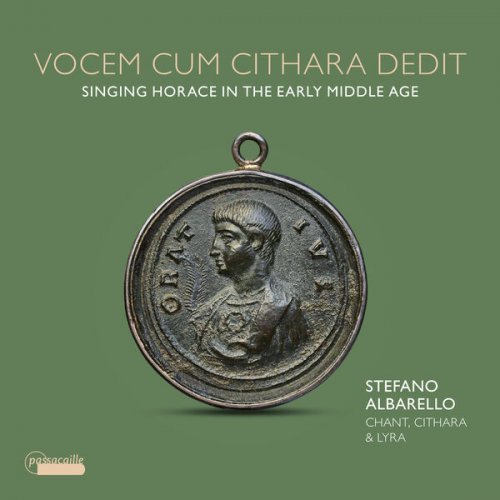
Artist: Stefano Albarello
Title: Vocem cum cithara dedit
Year Of Release: 2026
Label: Passacaille
Genre: Classical
Quality: FLAC (tracks) / FLAC 24 Bit (96 KHz / tracks)
Total Time: 51:27 min
Total Size: 180 / 841 MB
WebSite: Album Preview
Title: Vocem cum cithara dedit
Year Of Release: 2026
Label: Passacaille
Genre: Classical
Quality: FLAC (tracks) / FLAC 24 Bit (96 KHz / tracks)
Total Time: 51:27 min
Total Size: 180 / 841 MB
WebSite: Album Preview
Tracklist:
01. Quis multa gracilis te puer in rosa
02. O fons Bandusiae splendidior vitro
03. Donec gratus eram tibi
04. Maecenas atavis edite regibus
05. Pastor cum traheret per freta navibus
06. Quis desiderio sit pudor aut modus
07. Nullus argento color est avaris
08. Albi ne doleas plus nimio memor
09. Vitas inuleo me similis Chloe
10. Sic te diva potens Cypri
11. Vides ut alta stet nive candidum
12. Integer vitae scelerisque purus
13. Miserarum est neque amori dare ludum neque dulci
14. Est mihi nonum superantis annum
15. Occidi neque virgo est usquam
This recording presents an exceptional corpus of fourteen carmina by Horace, whose melodies—mostly preserved in 10th–12th century manuscripts—bear witness to an ancient musical tradition reinterpreted by medieval monastic culture. Far from being an isolated curiosity, the presence of notated Horatian odes reflects the enduring importance of classical poets in Carolingian and Benedictine education, where the study of Latin metrics held a central place. The melodies, primarily notated in Aquitanian script, allow for a plausible reconstruction of rhythmic chants shaped by ancient quantitative prosody. Their character, often fluid and irregular to the modern ear, reveals an aesthetic that predates the poetic and musical transformations of the 13th century. Some odes draw on pre-existing melodies from the hymn repertoire—such as Est mihi nonum (IV.11) and Integer vitae (I.22), linked to the famous melody of Ut queant laxis—while others retain entirely new musical lines. The result of meticulous transcription and performance work, this program sheds light on a little-known heritage: that of Latin chant shaped both by the metrical rules of Antiquity and by the pedagogical and musical practices of the Middle Ages. The inclusion of an excerpt from Terence’s Eunuchus—whose melody is transmitted in Guidonian notation—further enriches this rare glimpse into medieval sung culture. This recording thus offers a unique immersion into a repertoire at the crossroads of ancient poetry, monastic tradition, and the early developments of Western musical notation.
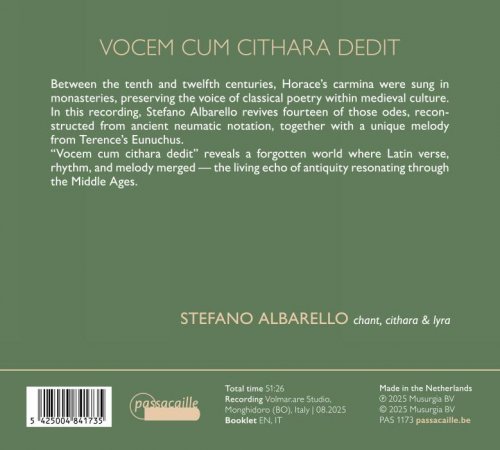
Between the tenth and twelfth centuries, Horace’s carmina were sung in monasteries, preserving the voice of classical poetry within medieval culture. In this recording, Stefano Albarello revives fourteen of those odes, reconstructed from ancient neumatic notation, together with a unique melody from Terence’s Eunuchus. “Vocem cum cithara dedit” reveals a forgotten world where Latin verse, rhythm, and melody merged — the living echo of antiquity resonating through the Middle Ages.
Between the tenth and twelfth centuries, Horace’s carmina were sung in monasteries, preserving the voice of classical poetry within medieval culture. In this recording, Stefano Albarello revives fourteen of those odes, reconstructed from ancient neumatic notation, together with a unique melody from Terence’s Eunuchus. “Vocem cum cithara dedit” reveals a forgotten world where Latin verse, rhythm, and melody merged — the living echo of antiquity resonating through the Middle Ages.
![Ernie Johnson From Detroit - Vigilante (2026) [Hi-Res]](https://img.israbox.com/img/2026-07/23/vs15cqy5cqmsdorn1nfgt45h5.jpg "Ernie Johnson From Detroit - Vigilante (2026) [Hi-Res]")

![Nicholas Payton & Butcher Brown - A Supreme Blue (2026) [Hi-Res]](https://www.dibpic.com/uploads/posts/2026-07/1784654667_a2341215803_10.jpg "Nicholas Payton & Butcher Brown - A Supreme Blue (2026) [Hi-Res]")
![Corey King - Change the Wind (2026) [Hi-Res]](https://img.israbox.com/img/2026-07/23/kz2fs9fm8rcjgnltqmewj0px1.jpg "Corey King - Change the Wind (2026) [Hi-Res]")
![Tony Grey - Elevation (2013) [Hi-Res]](https://www.dibpic.com/uploads/posts/2026-07/1784965070_cover.jpg "Tony Grey - Elevation (2013) [Hi-Res]")