Pascal Rogé, Mie Kobayashi, Yoko Hasegawa - Ravel & Chausson: Piano Trios (2005)
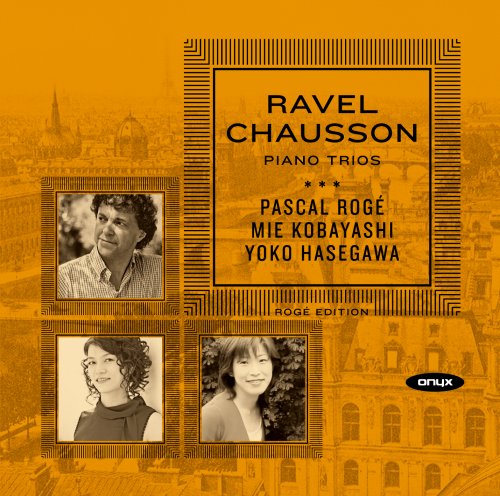
Artist: Pascal Rogé, Mie Kobayashi, Yoko Hasegawa
Title: Ravel & Chausson: Piano Trios
Year Of Release: 2005
Label: Onyx Classics Ltd.
Genre: Classical
Quality: flac lossless (tracks) +Booklet
Total Time: 00:58:01
Total Size: 252 mb
WebSite: Album Preview
TracklistTitle: Ravel & Chausson: Piano Trios
Year Of Release: 2005
Label: Onyx Classics Ltd.
Genre: Classical
Quality: flac lossless (tracks) +Booklet
Total Time: 00:58:01
Total Size: 252 mb
WebSite: Album Preview
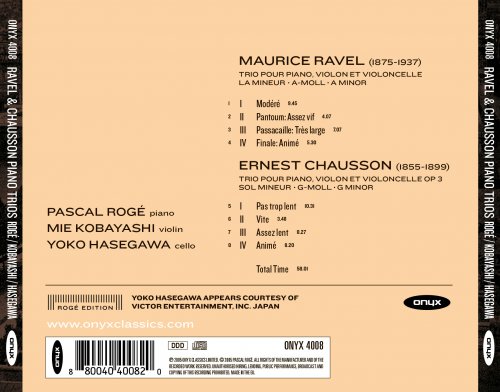
01. Trio: I Modéré
02. Trio: II Pantoum: Assez Vif
03. Trio: III Passacaille: Très Large
04. Trio: IV Finale: Animé
05. Trio: I Pas Trop Lent
06. Trio: II Vite
07. Trio: III Assez Lent
08. Trio: IV Animé
As war loomed in the summer of 1914 Ravel enjoyed his usual holiday with friends at his Basque retreat of Saint-Jean-de-Luz. Following the intense creativity that had recently produced such masterpieces as Daphnis et Chlo and Valses nobles et sentimentales, the Piano Trio in A minor was written at high speed, consistent with Ravel's (as it turned out correct) expectation of imminent calling to active war service. It was first played at a Socit Musicale Indpendante concert at the Salle Gaveau, Paris, in January the following year, with the composer Alfredo Casella at the piano, together with Gabriel Willaume (violin) and Louis Feuillard (cello). Seen in the context of Ravel's relatively few chamber works the Trio is particularly substantial both in length and scale, perhaps a reflection of the giant canvas of Daphnis et Chlo, with which it also shares some thematic resemblances. It seem to be a synthesis of many inspirations: Ravel was said to have modelled it on a trio by Saint-Sans, and its dedication to his counterpoint teacher Andr Gedalge is reflected in the Passacaglia third movement and in fugal elements in the slower central section of the opening Modr. The opening movement's development is mainly on the first theme, and the recapitulation is hinted at rather than made explicit. Next comes the Scherzo which Ravel headed Pantoum, deriving from the pantun, a type of Eastern poetry where the second and fourth lines of a verse are repeated to form the first and third lines of the next. It was adopted by Baudelaire and Verlaine, as well as Victor Hugo for his Orientales, and Ravel loosely parallels the form in musical terms. The grave and spare melody of the Passacaille starts in the lowest register of all three instruments - first piano alone, then joined by the cello and finally violin. Gradually the pace and intensity increase in a strongly rising sequence...
![Edwin de Paula - Alfabeto (2026) [Hi-Res]](https://img.israbox.com/img/2026-07/30/s6b3wefjsyjftkz2t5sw0xjw9.jpg "Edwin de Paula - Alfabeto (2026) [Hi-Res]")