Ives Ensemble, Naomi Sato - Rijnvos: Aphrodíte & Seléne (2026) [Hi-Res]
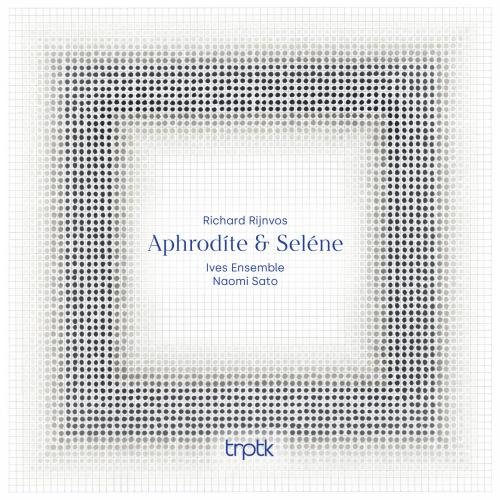
Artist: Ives Ensemble, Naomi Sato
Title: Rijnvos: Aphrodíte & Seléne
Year Of Release: 2026
Label: TRPTK
Genre: Classical
Quality: flac lossless (tracks) / flac 24bits - 192.0kHz +Booklet
Total Time: 00:52:07
Total Size: 251 mb / 1.77 gb
WebSite: Album Preview
TracklistTitle: Rijnvos: Aphrodíte & Seléne
Year Of Release: 2026
Label: TRPTK
Genre: Classical
Quality: flac lossless (tracks) / flac 24bits - 192.0kHz +Booklet
Total Time: 00:52:07
Total Size: 251 mb / 1.77 gb
WebSite: Album Preview
01. Rijnvos: Aphrodíte
02. Rijnvos: Seléne
In 2021, under the umbrella title Kosmoscópio, Richard Rijnvos started a series of compositions dedicated to the nine components of the “Musica Universalis”. Commonly referred to as the “Harmony of the Spheres”, this ancient Greek philosophical abstraction contemplates the various proportions in the movements of celestial bodies.
Aphrodíte represents the planet Venus and is scored for Japanese mouthorgan (shō) and string sextet. The work consists of fifteen consecutive sections, the first being an otherworldly approach (kefáli), and the last one being an evaporating departure (ourá). In between we follow thirteen orbits (trochiá): a cosmic observation of the ‘pentagram of Venus’, the apparent path of the planet as observed from Earth.
The successive conjunctions of Venus repeat with an orbital resonance of 13:8, meaning Earth orbits eight times for every thirteen orbits of Venus. The pentagram is sometimes referred to as the petals of Venus due to the path’s visual similarity to a flower.
In an ideal performance the members of the sextet are positioned in a circular space, facing inwards, with the shō in its centre, and the audience all around them in an amphitheatre setting. At the end of the coda, each member of the string sextet walks offstage, one after the other, whilst performing an ostinato, leaving the shō behind, all by itself.
Seléne consists of five main sections, each four minutes in duration, depicting a predominantly monochrome sky, with in its centre the consecutive lunar phases (as seen from Earth): starting at the obscured New Moon, step by step transforming, from a multi-textured Half Moon to a bright polyphonic Full Moon, then back again to the original starting point. The shorter sections in between, each sixty seconds long, represent the intermediate phases.
In an ideal performance the members of the quartet are positioned in a circular space, facing inwards, with the audience all around them in an amphitheatre setting. The cello is the first to split off and rotate outwards, personifying the first glimpse of moonlight (Waxing Crescent). The viola joins when we reach First Quarter, then the second violin (Waxing Gibbous), and midway the first violin (Full Moon). This process is then reversed until a New Moon is, yet again, nowhere to be seen.
![VA - The Singers- The Songs (2026) [3CD]](https://www.dibpic.com/uploads/posts/2026-07/1785050956_000.jpg "VA - The Singers- The Songs (2026) [3CD]")
![Joe Pass - Behind Better Days (1971/2024) [Vinyl]](https://www.dibpic.com/uploads/posts/2026-07/1785076354_r-30823554-1722773064-4918.jpg "Joe Pass - Behind Better Days (1971/2024) [Vinyl]")