Christina Harmon - Eight Historic Pipe Organs of the Copper Country, Keweenaw Peninsula, Michigan (2023)
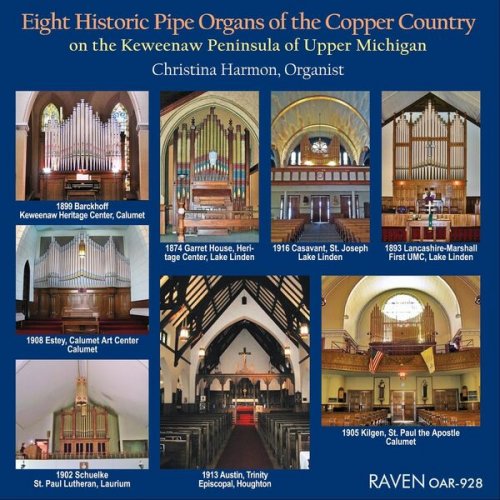
Artist: Christina Harmon
Title: Eight Historic Pipe Organs of the Copper Country, Keweenaw Peninsula, Michigan
Year Of Release: 2023
Label: Raven
Genre: Classical
Quality: FLAC (tracks)
Total Time: 1:17:11
Total Size: 272 MB
WebSite: Album Preview
Tracklist:Title: Eight Historic Pipe Organs of the Copper Country, Keweenaw Peninsula, Michigan
Year Of Release: 2023
Label: Raven
Genre: Classical
Quality: FLAC (tracks)
Total Time: 1:17:11
Total Size: 272 MB
WebSite: Album Preview
1. Christina Harmon – Concerto in G Major, BWV 592: III. Allegro (03:30)
2. Christina Harmon – Finlandia, Op. 26 (03:56)
3. Christina Harmon – Voluntary in A Major: Andante - Allegro (04:40)
4. Christina Harmon – Festival Preslude on "Old Hundredth" (02:22)
5. Christina Harmon – Rhosymedre (03:41)
6. Christina Harmon – Regina Coeli (04:04)
7. Christina Harmon – Ave Maria (03:31)
8. Christina Harmon – Copper Country Sketches for Organ: Passacaglia (Iron Mountain) (06:27)
9. Christina Harmon – Copper Country Sketches for Organ: Toccata (Lake Superior) (08:31)
10. Christina Harmon – Theme & Variations on "The Morning Trumpet" (09:18)
11. Christina Harmon – Andante in G Major (01:28)
12. Christina Harmon – Koppangen Traditional Swedish Melody (04:27)
13. Christina Harmon – Theme with Variations (05:02)
14. Christina Harmon – Prelude in G Major, Op. 37, No. 2 (03:17)
15. Christina Harmon – Fugue in G Major, Op. 37, No. 2 (04:24)
16. Christina Harmon – 24 Pieces for organ or harmonium: No. 18: Fantaisie sur un thème norvégien (03:35)
17. Christina Harmon – Highland Cathedral (04:51)
The Bach Concerto in G, BWV 592, is one of two transcriptions for solo organ that J. S. Bach (1685-1750) created in 1713-14 from works composed for other instruments and orchestra by Duke Johann Ernst of Saxe-Weimar. Bach transcribed five such concertos in the period while he was working in Weimar, the other three originally having been composed by Antonio Vivaldi.
Jean Sibelius (1865-1957) composed his symphonic paean to his native Finland in 1899 as part of a larger work. Nationalistic impetus for its creation arose as Imperial Russia sought greater influence over the then-autonomous Grand Duchy of Finland. Within about two years, Sibelius revised the “Finland Awakes” section of the larger work a free-standing work to which he gave the name Finlandia. A tune within the work is used for six Christian hymns, an alma mater, and the national anthem of a now-defunct African state, as well as the Finlandia Hymn to which two famous sets of words exist.
Samuel Long (fl. 1745-70) was a London organist of whom little is known, other than his widow published a few compositions by him ca. 1770.
Clarence Eddy (1851-1937) published Festival Prelude on Old 100th in 1909, when his fame as an American concert organist had become international. A native New Englander, he worked in Chicago for many years and eventually resided in Paris, commanding large audiences for annual recitals there and elsewhere in Europe, and serving on the juries of the Paris Conservatoire. Marathon recital tours with hundreds of programs throughout the U. S., even into the 1920s, made Eddy’s name a household word during the organ’s prominence as a mainline means of musical communication.
Ralph Vaughan Williams (1872-1958) was a major British musical figure and celebrated composer in many forms, particularly symphonic and choral, and was editor of the English Hymnal (1906), contributing many tunes which have become beloved. His Rhosymedre was published in 1920 with two other preludes on Welsh hymn tunes. He was the great great grandson of the English potter Josiah Wedgwood (1730-1795).
Everett Titcomb (1884-1968) was organist for 50 years at the Church of St. John the Evangelist in Boston beginning in 1910, where he pursued a fascination with Renaissance polyphony and composed prolifically for organ and choir. Regina Coeli was published in 1940. His family of Unitarians allowed him at age 9 to join the boy choir of St. James’ Episcopal church in his native Amesbury, where he had become the parish organist by age 14.
Ave Maria refers to the Latin words which begin the prayer, “Hail, Mary, full of grace, the Lord is with thee.” The prayer has been set to music using many tunes over the centuries, the well known ones today being tunes by 19th-century composers Charles Gounod (who adpated Bach’s Prelude in C, BWV 846) and Franz Schubert. The tune arranged by Christina Harmon was composed in purposeful anonymity.
Powell Weaver (1890-1951), a native of Clearfiled, Pennsylvania, summered in the Keweenaw and composed the three Copper Country Sketches for publication in 1948. Two of them are recorded, here. He was organist of First Baptist Church, Kansas City. His teachers include Italian composers Pietro Yon and Ottorino Respighi.
The Morning Trumpet is a tune composed by Benjamin F. White (1800-1879) for the poem written in 1793 by John Leland. White, a native of Union County, South Carolina, and musically active in the Baptist church, relocated to Harris County, Georgia, in 1842. He collected and composed hymns which were published in 1844 in the tunebook, The Sacred Harp, in which The Morning Trumpet first appeared. The tunebook was greatly successful and enjoyed many editions. White taught music, established and edited a newspaper beginning in 1858, was elected clerk of the Inferior Court of Harris County in 1858, and was active as a Major in the militia.
Karl Heinrich Zollner (1792-1836) was born in Selesia and settled in Hamburg as a widely-travelled organist, musicologist, composer, and critic. He published several sets of organ works in addition to piano pieces and operas. Koppången is a Swedish folk song and is also the name of places in Sweden and Norway. Popular English lyrics to this tune begin, “There is silence around me in this peaceful winter night. From the church down in the valley I can see the candlelight,” and it sometimes is performed in churches.
Robert T. Anderson (1934-2009) was born in Chicago and became a famous organist and teacher who taught many organists as professor of organ at Southern Methodist University, Dallas, Texas. Triptych, of which the Theme with Variations is a part, was composed in 1958 in Frankfurt, Germany, and dedicated “To my esteemed teacher, Robert Baker.” In the period 1957-59, Anderson was studying with Helmut Walcha in Frankfurt. As a graduate teaching assistant to Dr. Anderson and his student, Christina Harmon received a copy of the manuscript from him. The first recording of the work appears on this CD.
Felix Mendelssohn (1805-1847) composed three preludes and fugues 1833-39 and published them in England as op. 37. The works are composed to fully utilize the organ’s pedal keyboard which had only been introduced ca. 1800 in England, so the works challenged the nation’s organists and organ builders to become proficient in more fully adopting the pedal keyboard. Mendelssohn was greatly popular in England, where he gave concerts during eight visits 1829-1847. His popularity led to the commission from an English publisher for Mendelssohn’s famous Six Organ Sonatas, op. 65, composed 1839-45.
Jean Langlais (1907-1991) composed some 300 pieces for organ, both for sacred and for secular use, as well as many works for other instruments. Famed as an organist despite his blindness, Langlais became organist at the important Church of St. Clotilde in Paris for life. The rarely heard Fantaisie on a Norwegian Theme was published in 1939 as no. 18 in a set of 24 pieces for organ or harmonium.
Highland Cathedral is a popular bagpipe tune written by German musicians Ulrich Roever and Michael Korb and first published in 1982. Korb began bagpipe lessons in 1975 in Berlin with a Scottish piper whom he followed to Edinburgh to continue study. By 1979, Korb had adapted the bagpipe to disco music and made a successful record. He joined forces with producer and arranger Uli Roever to compose and develop Highland Cathedral.
Jean Sibelius (1865-1957) composed his symphonic paean to his native Finland in 1899 as part of a larger work. Nationalistic impetus for its creation arose as Imperial Russia sought greater influence over the then-autonomous Grand Duchy of Finland. Within about two years, Sibelius revised the “Finland Awakes” section of the larger work a free-standing work to which he gave the name Finlandia. A tune within the work is used for six Christian hymns, an alma mater, and the national anthem of a now-defunct African state, as well as the Finlandia Hymn to which two famous sets of words exist.
Samuel Long (fl. 1745-70) was a London organist of whom little is known, other than his widow published a few compositions by him ca. 1770.
Clarence Eddy (1851-1937) published Festival Prelude on Old 100th in 1909, when his fame as an American concert organist had become international. A native New Englander, he worked in Chicago for many years and eventually resided in Paris, commanding large audiences for annual recitals there and elsewhere in Europe, and serving on the juries of the Paris Conservatoire. Marathon recital tours with hundreds of programs throughout the U. S., even into the 1920s, made Eddy’s name a household word during the organ’s prominence as a mainline means of musical communication.
Ralph Vaughan Williams (1872-1958) was a major British musical figure and celebrated composer in many forms, particularly symphonic and choral, and was editor of the English Hymnal (1906), contributing many tunes which have become beloved. His Rhosymedre was published in 1920 with two other preludes on Welsh hymn tunes. He was the great great grandson of the English potter Josiah Wedgwood (1730-1795).
Everett Titcomb (1884-1968) was organist for 50 years at the Church of St. John the Evangelist in Boston beginning in 1910, where he pursued a fascination with Renaissance polyphony and composed prolifically for organ and choir. Regina Coeli was published in 1940. His family of Unitarians allowed him at age 9 to join the boy choir of St. James’ Episcopal church in his native Amesbury, where he had become the parish organist by age 14.
Ave Maria refers to the Latin words which begin the prayer, “Hail, Mary, full of grace, the Lord is with thee.” The prayer has been set to music using many tunes over the centuries, the well known ones today being tunes by 19th-century composers Charles Gounod (who adpated Bach’s Prelude in C, BWV 846) and Franz Schubert. The tune arranged by Christina Harmon was composed in purposeful anonymity.
Powell Weaver (1890-1951), a native of Clearfiled, Pennsylvania, summered in the Keweenaw and composed the three Copper Country Sketches for publication in 1948. Two of them are recorded, here. He was organist of First Baptist Church, Kansas City. His teachers include Italian composers Pietro Yon and Ottorino Respighi.
The Morning Trumpet is a tune composed by Benjamin F. White (1800-1879) for the poem written in 1793 by John Leland. White, a native of Union County, South Carolina, and musically active in the Baptist church, relocated to Harris County, Georgia, in 1842. He collected and composed hymns which were published in 1844 in the tunebook, The Sacred Harp, in which The Morning Trumpet first appeared. The tunebook was greatly successful and enjoyed many editions. White taught music, established and edited a newspaper beginning in 1858, was elected clerk of the Inferior Court of Harris County in 1858, and was active as a Major in the militia.
Karl Heinrich Zollner (1792-1836) was born in Selesia and settled in Hamburg as a widely-travelled organist, musicologist, composer, and critic. He published several sets of organ works in addition to piano pieces and operas. Koppången is a Swedish folk song and is also the name of places in Sweden and Norway. Popular English lyrics to this tune begin, “There is silence around me in this peaceful winter night. From the church down in the valley I can see the candlelight,” and it sometimes is performed in churches.
Robert T. Anderson (1934-2009) was born in Chicago and became a famous organist and teacher who taught many organists as professor of organ at Southern Methodist University, Dallas, Texas. Triptych, of which the Theme with Variations is a part, was composed in 1958 in Frankfurt, Germany, and dedicated “To my esteemed teacher, Robert Baker.” In the period 1957-59, Anderson was studying with Helmut Walcha in Frankfurt. As a graduate teaching assistant to Dr. Anderson and his student, Christina Harmon received a copy of the manuscript from him. The first recording of the work appears on this CD.
Felix Mendelssohn (1805-1847) composed three preludes and fugues 1833-39 and published them in England as op. 37. The works are composed to fully utilize the organ’s pedal keyboard which had only been introduced ca. 1800 in England, so the works challenged the nation’s organists and organ builders to become proficient in more fully adopting the pedal keyboard. Mendelssohn was greatly popular in England, where he gave concerts during eight visits 1829-1847. His popularity led to the commission from an English publisher for Mendelssohn’s famous Six Organ Sonatas, op. 65, composed 1839-45.
Jean Langlais (1907-1991) composed some 300 pieces for organ, both for sacred and for secular use, as well as many works for other instruments. Famed as an organist despite his blindness, Langlais became organist at the important Church of St. Clotilde in Paris for life. The rarely heard Fantaisie on a Norwegian Theme was published in 1939 as no. 18 in a set of 24 pieces for organ or harmonium.
Highland Cathedral is a popular bagpipe tune written by German musicians Ulrich Roever and Michael Korb and first published in 1982. Korb began bagpipe lessons in 1975 in Berlin with a Scottish piper whom he followed to Edinburgh to continue study. By 1979, Korb had adapted the bagpipe to disco music and made a successful record. He joined forces with producer and arranger Uli Roever to compose and develop Highland Cathedral.
![Quincy Jones - I Heard That!! (1976) [Hi-Res]](https://www.dibpic.com/uploads/posts/2026-07/1785239712_cover.png "Quincy Jones - I Heard That!! (1976) [Hi-Res]")
![Stan Getz - Big Band Bossa Nova (1962/2026) [Hi-Res]](https://www.dibpic.com/uploads/posts/2026-07/1785431844_cover.jpg "Stan Getz - Big Band Bossa Nova (1962/2026) [Hi-Res]")