Haedong Lee & YIDAN KIM - Ecology of Death and Annihilation: A Ceremony for Things that Wither (2026)
Artist: Haedong Lee, YIDAN KIM
Title: Ecology of Death and Annihilation: A Ceremony for Things that Wither
Year Of Release: 2026
Label: 99CHANTS
Genre: Electronic
Quality: 16bit-44,1kHz FLAC / 24bit-44,1kHz FLAC
Total Time: 49:18
Total Size: 255 mb / 404 mb
WebSite: Album Preview
TracklistTitle: Ecology of Death and Annihilation: A Ceremony for Things that Wither
Year Of Release: 2026
Label: 99CHANTS
Genre: Electronic
Quality: 16bit-44,1kHz FLAC / 24bit-44,1kHz FLAC
Total Time: 49:18
Total Size: 255 mb / 404 mb
WebSite: Album Preview
1. Part I (04:46)
2. Part II (10:50)
3. Part III (14:24)
4. Part IV (12:50)
5. Part V (06:28)
Haedong Lee & Yidan Kim - Ecology of Death and Annihilation: A Ceremony for Things that Wither — 죽음과 소멸의 생태계 : 사라지는 것들을 위한 세레모니 (99CHANTS)
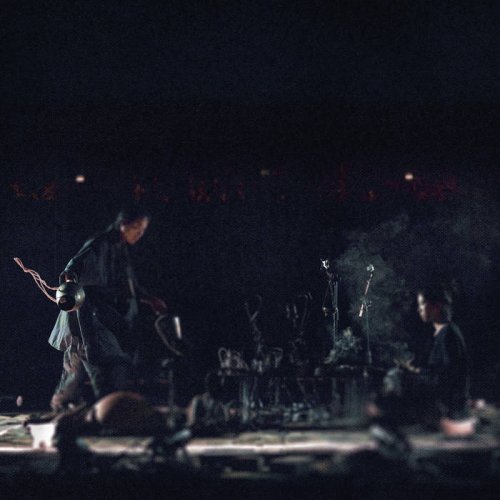
Rooted in diverse ritual cultures from across the world, Haedong Lee and Yidan Kim's latest work is presented as a contemporary ceremony, a multi-disciplinary performance that pulls together various elements from the duo’s rigorous study of various ceremonial practices across East Asia and the wider Asian continent, and shamanic cultures found in West Africa and throughout Europe. Ringing various bells Lee has collected or created, playing wooden and metal percussive instruments used in rituals that span different cultures, chanting and overlaying hallucinatory synthesized and processed sounds, the two artists create a uniquely contemporary interpretation of ritual soundscapes, braiding remnants of folk songs with oblique ceremonial forms. They complement their meticulously engineered sonic ecosystem with physical actions and olfactory expressions that are harder to perceive on record, such as the gestures involved in the offering of incense and the materials that have historically been used in rituals and ceremonies. Scouring history, Kim creates a layered smell-scape from plant resins, leaves and bark like frankincense, agarwood and sage that diffuses as the performance unfolds. And even on record, 'Ecology of Death and Annihilation: A Ceremony for Things that Wither' is more than just sound; Lee and Kim supply the tools required for listeners to interact with the album more physically. As well as a recording of their performance, there's an additional sample pack featuring high-quality recordings of Lee's handmade bells and special cord incense developed by Kim that will allow anyone to perform their own personalized rituals.
Born in South Korea and currently based in London, Lee and Kim are both seasoned interdisciplinary artists, with Lee concentrating his interest on sound and Kim primarily working with smell. And for almost a decade, their work has overlapped repeatedly as they have developed a way to harmonize their respective skills, exploring the history of ritual, ceremonial and multi-sensory experiences by merging installation and performance. Kim's interests took them to the Korean Traditional Incense Cultural Association, where they received a formal training in incense ceremony, allowing them to refine their approach to olfactory imagery. Lee meanwhile spent time imagining sound sculptures with metal, wood and the by-products of the Anthropocene, objects that allow him to reflect on ecological and civilizational crises while practicing restraint and control. 'Ecology of Death and Annihilation: A Ceremony for Things that Wither' first emerged in 2021, when it was debuted at Seoul's Oil Tank Culture Park, and it stretches Lee and Kim's art through the past and present and far into the future. Hypothesizing art itself is itself an ancient ritual, the performance establishes itself as a contemporary hybrid, where sounds, movements and smells mimic each others' temporal motions, appearing and disappearing to provoke consciousness itself.
Sonically, the recording plays as a continuous piece that's split into five distinct movements. At first, Lee's evocative bell sounds are swept up by echo trails and haunted reverberations, building up into dense, droning clouds that the duo augment with acoustic instrumentation and effects. Then percussive elements form what might be environmental sounds - rainfall, insects and storm winds - before processed metallic chimes alter time once more, calling into the distance alongside lamellophone twangs and noisy electronic interference. And the boundary between the real and the artificial is routinely permeated as synths mimic animal calls and chants are absorbed into meditative hums. A discernible rhythm only appears in the piece's final moments, a pulsing, rumbling reminder of life before the ceremonial thumps disappear once more and the whirring drones wilt and evaporate.
![Tyler Sabbag - Novella (2026) [Hi-Res]](https://img.israbox.com/img/2026-07/14/56rz34zifatovi3ae5ru29o27.jpg "Tyler Sabbag - Novella (2026) [Hi-Res]")



![Vittorio De Scalzi, Gianni Mazza - Occasioni (2026) [Hi-Res]](https://www.dibpic.com/uploads/posts/2026-07/1784207017_1280x1280.jpg "Vittorio De Scalzi, Gianni Mazza - Occasioni (2026) [Hi-Res]")