Time for Three, Joyce DiDonato - Kevin Puts: Emily - No Prisoner Be (2026) [Hi-Res]
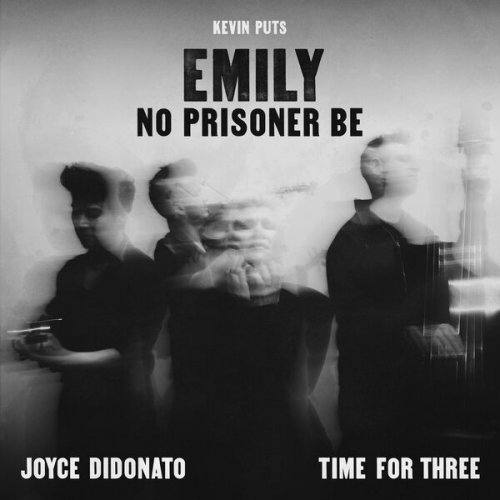
Artist: Time for Three, Joyce DiDonato
Title: Kevin Puts: Emily - No Prisoner Be
Year Of Release: 2026
Label: Platoon
Genre: Classical
Quality: flac lossless (tracks) / flac 24bits - 96.0kHz +Booklet
Total Time: 01:05:18
Total Size: 299 mb / 1.08 gb
WebSite: Album Preview
TracklistTitle: Kevin Puts: Emily - No Prisoner Be
Year Of Release: 2026
Label: Platoon
Genre: Classical
Quality: flac lossless (tracks) / flac 24bits - 96.0kHz +Booklet
Total Time: 01:05:18
Total Size: 299 mb / 1.08 gb
WebSite: Album Preview
01. Emily — No Prisoner Be: No. 1, They shut me up
02. Emily — No Prisoner Be: No. 2, I was the slightest in the House —
03. Emily — No Prisoner Be: No. 3, The Soul selects her own Society
04. Emily — No Prisoner Be: No. 4, Again — his voice is at the door
05. Emily — No Prisoner Be: No. 5, Interlude No. 1
06. Emily — No Prisoner Be: No. 6, I dwell in Possibility
07. Emily — No Prisoner Be: No. 7, Because I could not stop for Death
08. Emily — No Prisoner Be: No. 8, A Bee I personally knew (Scherzo No. 1)
09. Emily — No Prisoner Be: No. 9, I Felt a Funeral
10. Emily — No Prisoner Be: No. 10, I reason, Earth is short
11. Emily — No Prisoner Be: No. 11, A little Snow
12. Emily — No Prisoner Be: No. 12, I tie my Hat - I crease my Shawl
13. Emily — No Prisoner Be: No. 13, Hope is the thing
14. Emily — No Prisoner Be: No. 14, Interlude No. 2
15. Emily — No Prisoner Be: No. 15, The Props assist the House
16. Emily — No Prisoner Be: No. 16, There is a solitude of space
17. Emily — No Prisoner Be: No. 17, Could I ride but indefinite (Bee Scherzo No. 2)
18. Emily — No Prisoner Be: No. 18, So set its Sun in Thee
19. Emily — No Prisoner Be: No. 19, Her Face
20. Emily — No Prisoner Be: No. 20, Tell Her
21. Emily — No Prisoner Be: No. 21, His Feet are shod with Gauze (Bee Scherzo No. 3)
22. Emily — No Prisoner Be: No. 22, Wild Nights!
23. Emily — No Prisoner Be: No. 23, There is another sky
24. Emily — No Prisoner Be: No. 24, ‘Tis true - They shut me in the Cold
25. Emily — No Prisoner Be: No. 25, If I can stop one Heart from breaking (on Praetorius Lo, How a Rose E'er Blooming)
26. Emily — No Prisoner Be: No. 26, No Prisoner Be
When composer Kevin Puts told mezzo-soprano Joyce DiDonato of his wish to set poems by Emily Dickinson to music, it set in motion a series of events that resulted in one of the most thrilling song cycles to emerge in recent years. “I was singing the role of Virginia Woolf in Kevin’s opera The Hours,” DiDonato tells Apple Music Classical, “and he came to me during the first run and said, ‘Joyce, I’d love to write more for you.’” Puts had also recently composed and recorded the Grammy award-winning album Contact with string trio Time for Three. Here, he envisaged, was the perfect combination of musicians to bring the visionary and timeless poetry of the 19th-century Dickinson to life. “I feel like you guys would be electric together,” Puts assured DiDonato.
And so it proved. Inspired both by Time for Three’s unusual combination of two violins and double bass, by DiDonato’s dramatic and technical versatility, and by all four musicians’ unbounded enthusiasm for the project’s potential, Puts set about crafting music of extraordinary originality. The resulting songs defy categorization, traversing opera, musical theater, and rock in their quest to bring the sheer emotive power of Dickinson’s poems erupting to the surface. “It feels like Emily Dickinson’s words have always been waiting for Kevin’s music,” says DiDonato.
In the opening song, “They shut me up,” a visceral, insistent juddering in the upper strings palpably evokes Dickinson’s anger and injustice at the restricted world that she inhabited. “Dickinson was stuck in this world of prose,” says DiDonato, “which was society, Calvinism, the end of the Civil War, and strict ideas of what a woman should and shouldn’t be. And she was trying to function, so she just literally shut the world out and went deeper and deeper into this world that she could conjure.”
A similar sense of urgency colors “The Soul selects her own Society,” where smooth melodic lines and jagged rhythms coalesce, while in “I Felt a Funeral,” Dickinson’s powerful portrait of mental collapse, Puts uses a driving double bass rhythm to mimic a funeral drum while underlying swooping vocals and strange, disconcerting harmonies mirror the poem’s central premise. In a typical flash of inspiration, Puts uses the formal dramatic intensity of the Baroque to underline the architectural metaphor in “The Props assist the House,” and for “Her Face” Time for Three violinist Charles Yang gifts his extraordinarily beautiful tenor voice to a duet with DiDonato. “It really was a life-changing moment,” says Yang. “Kevin allowed this moment for me to express a different side of what I do with an artist that is at the top of her field, and it was one of those moments that meant the world to me.”
DiDonato and Time for Three bring each song alive with passionate commitment and impressive skill. “We yearn for that reciprocal energy of putting out and then receiving back and playing with that moment,” says Time for Three violinist Nick Kendall of all four musicians’ close-knit dynamic. “Kevin writes like that, he writes for the emotion. I’ve known Joyce’s music making for such a long time—it’s just another instrument that is all about the heart.” Bassist Ranaan Meyer agrees. “I never feel like I’m playing the bass in this group. Never. Not for one second. It’s like that feeling some people talk about when you’re surfing or skiing: you find this breath, or time stands still. It’s spontaneous, it’s improvisatory, it’s bending, it’s flexing, it’s fluid.”
This seemingly perfect confluence of talents is a result of long periods of rehearsal and reflection, unusual in the classical music world where artists often move from one project to another in relatively quick succession. “I had never worked this way on a new piece,” says DiDonato of the year she and Time for Three spent workshopping Emily – No Prisoner Be. “I think the first time we met at Juilliard, Kevin had 13 or 14 of the pieces finished. We worked through them, and all of us were contributing. It was the most exhilarating musical time in my life to be in this room with no egos.”
Kendall agrees: “So often in our world, the professional musicians, they’re just like, ‘We don’t need to hear too much of the story. Just give us the notes and we’ll execute. We’re trained. We’ll do it well, we’ll do our job well.’” But even before each recording session, adds Meyer, they did things differently. “Joyce would come into the room and she would settle everyone down,” he says, “bring everyone in, and read the poem, just to center all of us.”
The result is a set of works whose impact has gone far deeper than any of its musicians were expecting. “I felt like I didn’t really fully understand the nature of the effect that this piece would have,” says Kendall, “in the sense of when we performed it live, the tears, the puddles of tears from the audience. People ran to us with the emotions and the extremes that they felt from the performance. And we have that on the album.”
![Reza Askari & ROAR Quintet - xAYb v8v dYAx (2026) [Hi-Res]](https://www.dibpic.com/uploads/posts/2026-07/1784643712_folder.jpg "Reza Askari & ROAR Quintet - xAYb v8v dYAx (2026) [Hi-Res]")
![Jean-Baptiste Rousseaux - Kaveriot Korridor (2026) [Hi-Res]](https://www.dibpic.com/uploads/posts/2026-07/1784717051_g51adctrfhr29_600.jpg "Jean-Baptiste Rousseaux - Kaveriot Korridor (2026) [Hi-Res]")