Nicolaus Esterhazy Sinfonia, Michael Halász - Beethoven: Fidelio (1999)
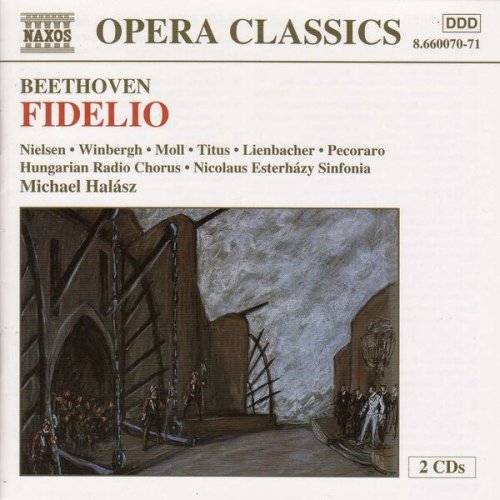
Artist: Michael Halász, Nicolaus Esterhazy Sinfonia
Title: Beethoven: Fidelio
Year Of Release: 1999
Label: Naxos
Genre: Classical, Opera
Quality: FLAC (tracks)
Total Time: 01:54:52
Total Size: 559 Mb
WebSite: Album Preview
Tracklist:Title: Beethoven: Fidelio
Year Of Release: 1999
Label: Naxos
Genre: Classical, Opera
Quality: FLAC (tracks)
Total Time: 01:54:52
Total Size: 559 Mb
WebSite: Album Preview
DISC 1
Fidelio, Op. 72 (Excerpts) (Ludwig van Beethoven)
01. Overture (00:06:23)
Fidelio, Op. 72, Act I (Ludwig van Beethoven)
02. Duet. Jetzt, Schatzchen, jetzt sind wir allein (Jaquino, Marzelline) (00:04:46)
03. Dialogue: Armer Jaquino (Marzelline) (00:00:10)
04. No. 2 Aria. O war' ich schon mit dir vereint (00:03:49)
05. Dialogue: Marzelline? Marzelline? (Rocco, Marzelline, Jaquino, Leonore) (00:00:45)
06. No. 3 Quartet: Mir ist so wunderbar (00:04:43)
07. Dialogue: Hore Fidelio! (Rocco, Marzelline) (00:00:30)
08. No. 4 Aria. Hat man nicht auch Gold beineben (00:02:46)
09. Dialogue: Ihr habt recht, Vater Rocco (Leonore, Rocco, Marzelline) (00:01:29)
10. Terzetto. Gut Sohnchen, gut (Rocco, Leonore, Marzelline) (00:06:30)
11. No. 6 March (00:02:14)
12. Dialogue: Drei Schildwachen auf den Wall (Pizarro, Rocco) (00:00:45)
Fidelio, Op. 72 (Excerpts) (Ludwig van Beethoven)
13. Ha! Welch ein Augenblick! (00:03:10)
Fidelio, Op. 72, Act I (Ludwig van Beethoven)
14. Dialogue: Hauptmann! Besteigen Sie mit einem Trompeter (Pizarro, Rocco) (00:00:25)
15. Duet. Jetzt, Alter, jetzt hat es Eile! (Pizarro, Rocco) (00:04:35)
Fidelio, Op. 72 (Ludwig van Beethoven)
16. Abscheulicher! Wo eilst du hin? (00:07:29)
Fidelio, Op. 72, Act I (Ludwig van Beethoven)
17. Dialogue: Marzelline! Marzelline!! (Jaquino, Marzelline, Rocco, Leonore) (00:00:52)
18. No. 10 Finale. O welche Lust (00:07:09)
19. Nun sprecht, wie ging's? (Leonore, Rocco, Marzelline, Jaquino, Pizarro) (00:07:37)
20. Leb'wohl, du warmes Sonnenlicht (Prisoners, Marzelline, Leonore, Jaquino, Pizarro, Rocco) (00:03:26)
DISC 2
Fidelio, Op. 72, Act II (Ludwig van Beethoven)
01. No. 11 Introduction and Aria. Gott! Welch' Dunkel hier! (00:10:45)
Fidelio, Op. 72 (Ludwig van Beethoven)
02. Wie kalt ist es (00:05:21)
Fidelio, Op. 72, Act II (Ludwig van Beethoven)
03. Dialogue: Er erwacht! (Leonore, Rocco, Florestan) (00:00:59)
04. Terzetto. Euch werde Lohn in bessern Welten (Florestan, Rocco, Leonore) (00:05:53)
05. Dialogue: Alles ist bereit (Rocco, Florestan, Leonore) (00:00:27)
06. No. 14 Quartet: Er sterbe! (00:05:07)
Fidelio, Op. 72 (Excerpts) (Ludwig van Beethoven)
07. O namenlose Freude! (00:02:47)
08. Heil! Heil sei dem Tag! (00:02:07)
Fidelio, Op. 72, Act II (Ludwig van Beethoven)
09. Des besten Konigs Wink und Wille (Don Fernando, People and Prisoners, Rocco, Pizarro, Leonore, Marzelline, Florestan) (00:07:53)
10. Wer ein holdes Weib errungen (People and Prisoners, Florestan, Leonore, Marzelline, Jaquino, Rocco, Don Fernando) (00:04:00)
Total length: 01:54:52
Label: Naxos
Performers:
Inga Nielsen (Leonore)
Gosta Winbergh (Florestan)
Kurt Moll (Rocco)
Alan Titus (Pizarro)
Herwig Pecoraro (Jaquino)
Edith Lienbacher (Marzelline)
Wolfgang Glashof (Fernando)
Péter Pálinkás (First Prisoner)
Józef Moldvay (Second Prisoner)
Nicolaus Esterhazy Sinfonia
Hungarian Radio Chorus
Michael Halász
Naxos has an uncanny knack for choosing the right artists for its operatic ventures. On this occasion, four of the singers are among the better known in the field, each judiciously cast.
Halász projects every facet of the score, inspiring his forces to live every moment of the plot in words and music. This isn't an interpretation in the romantic, quasi-philosophical mode of Furwängler or Klemperer, rather one that alerts the mind and ear to the human agony of it all.
Nielsen's Leonore is no projection of subservient femininity but a tormented wife seeking to save her husband, her plight expressed in every key phrase. She doesn't provide the heroic sounds of a Nilsson (Maazel) or all the warmth of Rysanek (Fricsay), but her slimmer, more compact tone exactly fits this performance. Winberg is a Florestan equal to his Leonore in vocal and interpretative assets. Not even Heppner (Davis) or Seiffert (Harnoncourt), among modern interpreters, sings the role better. His voice poised between the lyrical and the heroic, his tone warm, his technique firm, Florestan's scene can seldom have been so satisfyingly sung and enacted. As Marzelline, Edith Lienbacher is something of a discovery, catching the eagerness, also the sense of nerves a-jangle predicated by the part.
The dialogue, rather drastically foreshortened, is well spoken by all and intelligently directed.
The orchestral and choral singing need fear no comparisons, and the recording has plenty of presence, no tricks. This is a performance that fulfils almost all the demands made on its principals and at the price should be eagerly sought after: its most notable predecessors are matched, if not surpassed.
Halász projects every facet of the score, inspiring his forces to live every moment of the plot in words and music. This isn't an interpretation in the romantic, quasi-philosophical mode of Furwängler or Klemperer, rather one that alerts the mind and ear to the human agony of it all.
Nielsen's Leonore is no projection of subservient femininity but a tormented wife seeking to save her husband, her plight expressed in every key phrase. She doesn't provide the heroic sounds of a Nilsson (Maazel) or all the warmth of Rysanek (Fricsay), but her slimmer, more compact tone exactly fits this performance. Winberg is a Florestan equal to his Leonore in vocal and interpretative assets. Not even Heppner (Davis) or Seiffert (Harnoncourt), among modern interpreters, sings the role better. His voice poised between the lyrical and the heroic, his tone warm, his technique firm, Florestan's scene can seldom have been so satisfyingly sung and enacted. As Marzelline, Edith Lienbacher is something of a discovery, catching the eagerness, also the sense of nerves a-jangle predicated by the part.
The dialogue, rather drastically foreshortened, is well spoken by all and intelligently directed.
The orchestral and choral singing need fear no comparisons, and the recording has plenty of presence, no tricks. This is a performance that fulfils almost all the demands made on its principals and at the price should be eagerly sought after: its most notable predecessors are matched, if not surpassed.
DOWNLOAD FROM ISRA.CLOUD
Nicolaus Esterhazy Sinfonia, Michael Halász - Beethoven Fidelio (1999).rar - 559.7 MB
Nicolaus Esterhazy Sinfonia, Michael Halász - Beethoven Fidelio (1999).rar - 559.7 MB

![Mitsuru Araya - Natura' Rhythm (2004) [2007 SACD]](https://www.dibpic.com/uploads/posts/2026-07/1784442640_folder.jpg "Mitsuru Araya - Natura' Rhythm (2004) [2007 SACD]")
![David Mash - The Lost Book of David Mash (2026 Remaster) (2026) [Hi-Res]](https://www.dibpic.com/uploads/posts/2026-07/1784721592_the-lost-book-of-david-mash.jpg "David Mash - The Lost Book of David Mash (2026 Remaster) (2026) [Hi-Res]")
![Van Morrison, Georgie Fame, Mose Allison, Ben Sidran - Tell Me Something: The Songs of Mose Allison (Remastered) (2026) [Hi-Res]](https://www.dibpic.com/uploads/posts/2026-07/1784706816_folder.jpg "Van Morrison, Georgie Fame, Mose Allison, Ben Sidran - Tell Me Something: The Songs of Mose Allison (Remastered) (2026) [Hi-Res]")
![Carl Winther, Rune Fog-Nielsen, Anders Mogensen - Centenary Coltrane (Ballads for Meditation) (2026) [Hi-Res]](https://www.dibpic.com/uploads/posts/2026-07/1784531865_hx0hkyot0y3db_600.jpg "Carl Winther, Rune Fog-Nielsen, Anders Mogensen - Centenary Coltrane (Ballads for Meditation) (2026) [Hi-Res]")