The Chicago Chamber Musicians - American Classics - John Harbison: Chamber Music (2006)
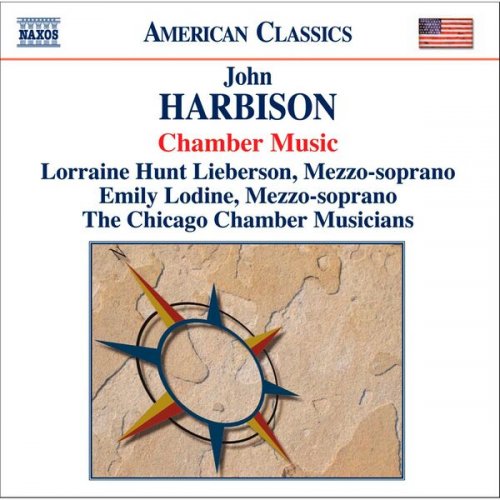
Artist: The Chicago Chamber Musicians
Title: American Classics - John Harbison: Chamber Music
Year Of Release: 2006
Label: Naxos
Genre: Classical
Quality: FLAC (tracks)
Total Time: 01:06:10
Total Size: 273 Ьи
WebSite: Album Preview
Tracklist:Title: American Classics - John Harbison: Chamber Music
Year Of Release: 2006
Label: Naxos
Genre: Classical
Quality: FLAC (tracks)
Total Time: 01:06:10
Total Size: 273 Ьи
WebSite: Album Preview
North and South (John Harbison)
01. Book I: No. 1, Ballad for Billie (I) / Lorraine Hunt Lieberson (00:03:55)
02. Book I: No. 2, Late Air / Lorraine Hunt Lieberson (00:01:57)
03. Book I: No. 3, Breakfast Song / Lorraine Hunt Lieberson (00:04:48)
04. Book II: No. 1, Ballad for Billie (II) / Lorraine Hunt Lieberson (00:03:28)
05. Book II: No. 2, Song / Lorraine Hunt Lieberson (00:02:49)
06. Book II: No. 3, Dear, my compass / Lorraine Hunt Lieberson (00:02:17)
6 American Painters (John Harbison)
07. No. 1, Bingham / Mathieu Dufour (00:02:23)
08. No. 2, Eakins / Mathieu Dufour (00:01:57)
09. No. 3, Heade / Mathieu Dufour (00:01:31)
10. No. 4, Homer / Mathieu Dufour (00:02:44)
11. No. 5, Hoffman / Mathieu Dufour (00:02:29)
12. No. 6, Diebenkorn / Mathieu Dufour (00:02:06)
Christmas Vespers (John Harbison)
13. I. Prelude / Bill Kurtis (00:03:45)
14. Ii. — / Bill Kurtis (00:01:26)
15. Iii. — / Bill Kurtis (00:01:20)
16. Iv. — / Bill Kurtis (00:01:53)
17. V. — / Bill Kurtis (00:01:23)
18. Vi. — / Bill Kurtis (00:01:46)
19. Vii. — / Bill Kurtis (00:01:28)
20. VIII. Postlude / Bill Kurtis (00:02:35)
Book of Hours and Seasons (John Harbison)
21. No. 1, Dem aufgehenden Vollmond (to the Rising Full Moon) / Emily Lodine (00:03:28)
22. No. 2, Immer und uberall (Always and Everywhere) / Emily Lodine (00:02:28)
23. No. 3, Interlude. Jahreszeiten kommen wieder (Interlude. The Seasons Come Again) / Emily Lodine (00:04:48)
24. No. 4, Mich angstigt das Verfangliche (the Artful makes me anxious) / Emily Lodine (00:01:52)
25. No. 5, Um Mitternacht (At midnight) / Emily Lodine (00:05:34)
Total length: 01:06:10
Label: Naxos
Performers:
Lorraine Hunt Lieberson (mezzo-soprano)
Mathieu Dufour (flute)
Joseph Genualdi (violin)
Rami Solomonow (viola)
Brant Taylor (cello)
Barbara Butler (trumpet)
Charles Geyer (trumpet)
Craig Knox (tuba)
Bill Kurtis (narrator)
Michael Mulcahy (trombone)
Gail Williams (horn)
The song cycle accompanied by a small instrumental ensemble is one of John Harbison's favored genres, and this CD, featuring vigorous performances by the Chicago Chamber Musicians, includes two of his cycles. Mezzo-soprano Lorraine Hunt Lieberson performs North and South: Six Poems of Elizabeth Bishop, composed in 1999. Harbison's blues-inflected settings of the two Ballads for Billie [Holliday] stand out for Bishop's vividly human portrait of her narrator and for Harbison's virtuosity in playfully flirting with popular clichés without ever slipping into them. Hunt Lieberson's performance is artless in the best sense -- these songs come off as entirely honest and deeply felt expressions of the narrator's character, rather than as artistic "interpretations" -- and she manages to bring the same convincing sense of personality to the more abstract songs in the set. Her voice, warm, velvety, and enveloping, seems to emanate from a pool of great inner strength. Unfortunately, the recorded balance in this cycle favors the instrumental ensemble, and Hunt Lieberson's radiant performance occasionally comes close to being swallowed by the instruments.
The other set of songs, Book of Hours and Seasons: Goethe Settings for voice, flute, violoncello, and piano, is sung by mezzo-soprano Emily Lodine, whose rich and powerful voice, particularly striking in its lower register, is ideal for these strongly dramatic pieces. Both this set and North and South are eloquent and significant contributions to American song literature of the late twentieth century, and in a perfect world, would be widely known and frequently performed.
Two less substantial works, Six American Painters for instrumental quartet and The Three Wise Men for brass quintet and narrator, fill out the recording. The quartet, a set of attractive quasi-tonal abstract miniatures, would have benefited from a less evocative title; the fact that Winslow Homer inhabits a sound world so idiomatically similar to that of Richard Diebenkorn is disconcerting and distracting. The Three Wise Men would be highly effective in the liturgical setting for which it was conceived, but as a concert piece on CD, the alternation of narration with instrumental interludes comes across as stilted and simplistic.
The other set of songs, Book of Hours and Seasons: Goethe Settings for voice, flute, violoncello, and piano, is sung by mezzo-soprano Emily Lodine, whose rich and powerful voice, particularly striking in its lower register, is ideal for these strongly dramatic pieces. Both this set and North and South are eloquent and significant contributions to American song literature of the late twentieth century, and in a perfect world, would be widely known and frequently performed.
Two less substantial works, Six American Painters for instrumental quartet and The Three Wise Men for brass quintet and narrator, fill out the recording. The quartet, a set of attractive quasi-tonal abstract miniatures, would have benefited from a less evocative title; the fact that Winslow Homer inhabits a sound world so idiomatically similar to that of Richard Diebenkorn is disconcerting and distracting. The Three Wise Men would be highly effective in the liturgical setting for which it was conceived, but as a concert piece on CD, the alternation of narration with instrumental interludes comes across as stilted and simplistic.

![David Mash - Decades (2026 Remaster) (2026) [Hi-Res]](https://www.dibpic.com/uploads/posts/2026-07/1784720868_cover.jpg "David Mash - Decades (2026 Remaster) (2026) [Hi-Res]")