Francesco Diodovich - Nodari: Tales of the Chord, Chamber Music with Guitar (2026)
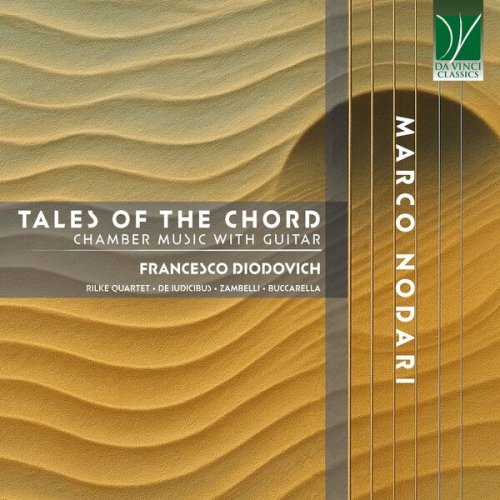
Artist: Francesco Diodovich
Title: Nodari: Tales of the Chord, Chamber Music with Guitar
Year Of Release: 2026
Label: Da Vinci Classics
Genre: Classical Guitar
Quality: flac lossless (tracks)
Total Time: 00:55:25
Total Size: 165 mb
WebSite: Album Preview
TracklistTitle: Nodari: Tales of the Chord, Chamber Music with Guitar
Year Of Release: 2026
Label: Da Vinci Classics
Genre: Classical Guitar
Quality: flac lossless (tracks)
Total Time: 00:55:25
Total Size: 165 mb
WebSite: Album Preview
01. Tre Novelle: No. 1, Antagonismi. Allegro
02. Tre Novelle: No. 2, Mondo interiore. Andante
03. Tre Novelle: No. 3, Danze e ombre della sera. Allegro
04. Mythos: No. 1, Aracne, la tessitrice. Con moto
05. Mythos: No. 2, Teseo e il Minotauro. Presto
06. Guitarresca: No. 1, Preludio. Vivo
07. Guitarresca: No. 2, Melodia. Larghetto
08. Guitarresca: No. 3, Danza. Mosso
09. Dune, Two landscapes: No. 1, Espressivo, ma scorrevole
10. Dune, Two landscapes: No. 2, Vivo
11. Levante - Tranquillo - Più mosso - Espressivo - Più mosso - Espressivo - Tranquillo
The overall title of the composition and the subtitles of the three pieces that forms it, reflect a personal intention to create music, that is not only a well thought out and engaging play of rhythms and sounds, but it’s also capable of telling a “story”, evoking atmospheres and emotional states. In the three pieces, certain characters appear (the musical themes), whose stories can be followed (thematic development): it’s clearly evident, therefore, my narrative intention. To this end, it must not be forgotten the famous quote by Victor Hugo: “Music expresses that which cannot be put into words and that which cannot remain silent”.
The first novella, Antagonisms, is built on the dialectic between two thematic ideas: the first one, more rhythmical and open; the second one, more restless, veiled, and melodic. The structure of the piece essentially follows the classical sonata form, though meant modernly. In fact, in the central section of the piece, the ideas are developed and transformed.
The second novella, Inner World, is an introspective composition; it narrates and explores emotional states veiled with melancholy. It is organized in three parts: the first one (A) is more peaceful and touching, and it opens with a cello pizzicato that presents the main theme; the second one (B) is more restless, with quick guitar note passages supported by sustained chords in the strings; the third part is a revised resumption of A, followed by a brief coda.
Dances and Shadows of the Evening, on the whole, is a more lively and sparkling piece, and might evoke memories of a summer party. Its structure is reminds the rondo’s one: A-B-A’-C-A”-B’-A”’/C”-Coda (the A section thus repeatedly comes back circularly). Section C, placed in the middle of the composition, differs from the rest of the piece and it’s defined by an intense lyricism: an expressive melody relied on the guitar, supported by sophisticated strings harmonies (the shadows of the evening); metaphorically, it represents a moment of reflection and detachment before once again being swept away by more intense and engaging rhythms.
![Santana - Amigos (1976) [2026 SACD]](https://www.dibpic.com/uploads/posts/2026-07/1784829394_folder.jpg "Santana - Amigos (1976) [2026 SACD]")

![Silvano Monasterios - Solo In Paris (2026) [Hi-Res]](https://www.dibpic.com/uploads/posts/2026-07/1784826338_hl0ywqug7xvvv_600.jpg "Silvano Monasterios - Solo In Paris (2026) [Hi-Res]")
![Bob Baldwin - BSpoke (2026) [Hi-Res]](https://www.dibpic.com/uploads/posts/2026-07/1784876277_scfje3hosz0nk_600.jpg "Bob Baldwin - BSpoke (2026) [Hi-Res]")
![Ernie Johnson From Detroit - Vigilante (2026) [Hi-Res]](https://img.israbox.com/img/2026-07/23/vs15cqy5cqmsdorn1nfgt45h5.jpg "Ernie Johnson From Detroit - Vigilante (2026) [Hi-Res]")