Leipziger Streichquartett - Haydn: String Quartets, Vol. 21 (2026) [Hi-Res]
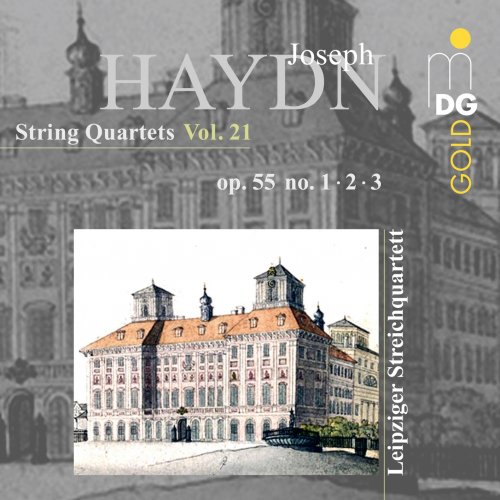
Artist: Leipziger Streichquartett
Title: Haydn: String Quartets, Vol. 21
Year Of Release: 2026
Label: Musikproduktion Dabringhaus und Grimm
Genre: Classical
Quality: FLAC (tracks) / 24bit-96kHz FLAC (tracks+booklet)
Total Time: 69:03
Total Size: 307 MB / 1.20 GB
WebSite: Album Preview
Tracklist:Title: Haydn: String Quartets, Vol. 21
Year Of Release: 2026
Label: Musikproduktion Dabringhaus und Grimm
Genre: Classical
Quality: FLAC (tracks) / 24bit-96kHz FLAC (tracks+booklet)
Total Time: 69:03
Total Size: 307 MB / 1.20 GB
WebSite: Album Preview
1. Haydn: String Quartet in A Major, Op. 55 No. 1, Hob. III: 60: I. Allegro (8:59)
2. Haydn: String Quartet in A Major, Op. 55 No. 1, Hob. III: 60: II. Adagio cantabile (4:20)
3. Haydn: String Quartet in A Major, Op. 55 No. 1, Hob. III: 60: III. Menuet (3:11)
4. Haydn: String Quartet in A Major, Op. 55 No. 1, Hob. III: 60: IV. Finale. Vivace (2:46)
5. Haydn: String Quartet in F Minor, Op. 55 No. 2, Hob. III: 61: I. Andante o più tosto allegretto (9:52)
6. Haydn: String Quartet in F Minor, Op. 55 No. 2, Hob. III: 61: II. Allegro (8:08)
7. Haydn: String Quartet in F Minor, Op. 55 No. 2, Hob. III: 61: III. Menuet. Allegro (4:46)
8. Haydn: String Quartet in F Minor, Op. 55 No. 2, Hob. III: 61: IV. Finale. Presto (5:18)
9. Haydn: String Quartet in B-Flat Major, Op. 55 No. 3, Hob. III: 62: I. Vivace assai (7:15)
10. Haydn: String Quartet in B-Flat Major, Op. 55 No. 3, Hob. III: 62: II. Adagio ma non troppo (5:45)
11. Haydn: String Quartet in B-Flat Major, Op. 55 No. 3, Hob. III: 62: III. Menuet (4:10)
12. Haydn: String Quartet in B-Flat Major, Op. 55 No. 3, Hob. III: 62: IV. Finale. Presto (4:40)
With the three quartets of Op. 55, the Leipzig String Quartet brings Haydn's mature genius vividly to life. These works capture the composer at the peak of the Classical era, blending elegance, wit, and profound musical insight. In the Quartet’s hands, every nuance and flourish shines, offering listeners an unforgettable journey through Haydn's timeless artistry.
No. 1 radiates brilliance from its opening energetic theme, with flowing figures, virtuosic triplets, and a characteristically unexpected modulation that sets the tone for the work. Haydn’s inventiveness shines throughout, from the noble and finely scored Adagio cantabile to the Minuet, Trio, and lively Finale, which feature imaginative instrumental interplay, subtle formal extensions, and a confident return to the tonic.
According to legend, Haydn traded "his best quartet" in exchange for English razors, giving No. 2 its nickname. Remarkably it opens with a slow, expressive variation movement in F minor. The alternation between minor and major creates a tonal limbo that creates a sense of tonal instability. This tension is sharpened in the spiky Allegro and contemplative Minuet, before an exuberant, jig-like finale decisively affirms a triumphant F major.
No. 3 opens with striking simplicity, as a unison motif of descending seconds gives way to sighing figures and a more animated second subject, all of which Haydn masterfully develops through concise modulation, counterpoint, and fugato. His inventiveness continues with a questioning-and-answering Adagio permeated by variation, a Minuet whose final gesture seeds the Trio, and a virtuosic Presto finale that drives the quartet to a brisk and decisive conclusion."
No. 1 radiates brilliance from its opening energetic theme, with flowing figures, virtuosic triplets, and a characteristically unexpected modulation that sets the tone for the work. Haydn’s inventiveness shines throughout, from the noble and finely scored Adagio cantabile to the Minuet, Trio, and lively Finale, which feature imaginative instrumental interplay, subtle formal extensions, and a confident return to the tonic.
According to legend, Haydn traded "his best quartet" in exchange for English razors, giving No. 2 its nickname. Remarkably it opens with a slow, expressive variation movement in F minor. The alternation between minor and major creates a tonal limbo that creates a sense of tonal instability. This tension is sharpened in the spiky Allegro and contemplative Minuet, before an exuberant, jig-like finale decisively affirms a triumphant F major.
No. 3 opens with striking simplicity, as a unison motif of descending seconds gives way to sighing figures and a more animated second subject, all of which Haydn masterfully develops through concise modulation, counterpoint, and fugato. His inventiveness continues with a questioning-and-answering Adagio permeated by variation, a Minuet whose final gesture seeds the Trio, and a virtuosic Presto finale that drives the quartet to a brisk and decisive conclusion."