Ensemble Les Nations, Speculum Musicae - Porta: Madrigali, Motetti et Missa (2012)
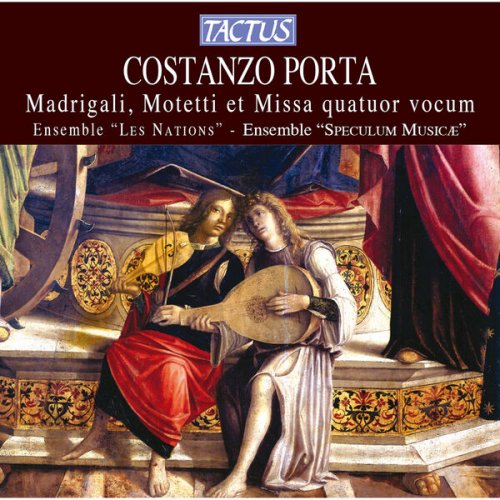
Artist: Ensemble Les Nations, Speculum Musicae
Title: Porta: Madrigali, Motetti et Missa
Year Of Release: 2012
Label: Tactus
Genre: Classical
Quality: flac lossless (tracks) +Booklet
Total Time: 00:56:02
Total Size: 268 mb
WebSite: Album Preview
TracklistTitle: Porta: Madrigali, Motetti et Missa
Year Of Release: 2012
Label: Tactus
Genre: Classical
Quality: flac lossless (tracks) +Booklet
Total Time: 00:56:02
Total Size: 268 mb
WebSite: Album Preview
01. Armato un gran pastore
02. Ero così dicea
03. Fammi sentir - Aguaglia la speranza
04. Non mi duol il morire
05. Missa quattuor vocum: Kyrie
06. Missa quattuor vocum: Gloria
07. Missa quattuor vocum: Credo
08. Missa quattuor vocum: Sanctus
09. Missa quattuor vocum: Angus Dei
10. Pater peccavi
11. Praeparate corda vestra
12. Ornaverunt faciem templi
13. Laudate pueri
14. Magnificat
The motets for double choir presented on this CD display all the characteristics of a grandiose and sonorous style. Their most striking feature is their homophony: imitative sections are used sporadically, leaving plenty of room for the rhythms of the text and the full sonority.
Two of the motets, the Magnificat and Laudate Dominum (both vesper psalms), are constructed over a Gregorian chant. The Magnificat alternates polyphonic sections with simple chant but, contrary to usual practice, ends with the Gregorian versicle and not with polyphony.
The cantus firmus appears irregularly and is often only pronounced by the tenor before it is immediately elaborated by all the voices. Although structurally it is almost never treated as a true tenor (in the polyphonic sense of the word), the vocal melody can nevertheless be regarded as the basis for the entire thematic development.
A detail of considerable modernity is the way in which the theme is altered so that it becomes completely tonal rather than modal. The same kind of treatment can be found in the 'Laudate', where the cantus firmus is passed back and forth between the two tenor voices like a fragment and a thematic idea.
The Missa quatuor vocum is preserved in a Bolognese codex, which contains various compositions attributed to Costanzo Porta. The attribution is not certain, but the hypothesis is supported by the curator of Porta's Opera Omnia, Siro Cisilino.
The mass is definitely based on a pre-existing piece and probably follows the design of a missa parodia.
Although it has not been possible to identify the model used, the Ionic tono, a rather unusual choice in sacred music, suggests that the original piece was secular.
![Santana - Amigos (1976) [2026 SACD]](https://www.dibpic.com/uploads/posts/2026-07/1784829394_folder.jpg "Santana - Amigos (1976) [2026 SACD]")
![David Mash - Colors, Textures, Moods (2026) [Hi-Res]](https://www.dibpic.com/uploads/posts/2026-07/1784723161_jgm70mpp0afoz_600.jpg "David Mash - Colors, Textures, Moods (2026) [Hi-Res]")
![Aaron Edgcomb - Sisters Songbook (2026) [Hi-Res]](https://img.israbox.com/img/2026-07/24/a0b60tvr2ke1vyl46xrf4r52q.jpg "Aaron Edgcomb - Sisters Songbook (2026) [Hi-Res]")
![Corey King - Change the Wind (2026) [Hi-Res]](https://img.israbox.com/img/2026-07/23/kz2fs9fm8rcjgnltqmewj0px1.jpg "Corey King - Change the Wind (2026) [Hi-Res]")
![David Mash - The Lost Book of David Mash (2026 Remaster) (2026) [Hi-Res]](https://www.dibpic.com/uploads/posts/2026-07/1784721592_the-lost-book-of-david-mash.jpg "David Mash - The Lost Book of David Mash (2026 Remaster) (2026) [Hi-Res]")