Serge Koussevitzky - Barber, Honegger & Sibelius (1948/49) [2019]
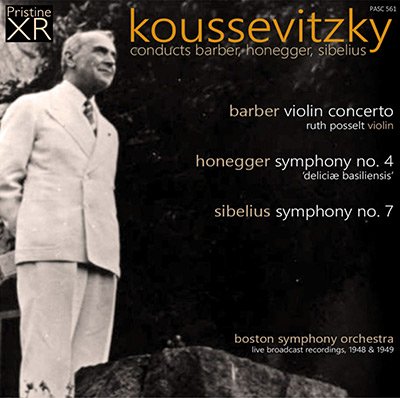
Artist: Serge Koussevitzky
Title: Barber, Honegger & Sibelius
Year Of Release: 1948/49 [2019]
Label: Pristine [PASC561]
Genre: Classical
Quality: FLAC (*tracks) 24 Bit/44,1 kHz
Total Time: 01:11:37
Total Size: 727 mb (+3%rec.)
WebSite: Album Preview
Serge Koussevitzky was a prominent champion of twentieth century music during his long tenure as the conductor of the Boston Symphony Orchestra. The music of his Russian contemporaries (Shostakovich, Prokofiev (PASC558), and Rachmaninov) naturally featured heavily, as did several composers of his adopted America (Aaron Copland (PASC458) Roy Harris, Edward Hill (PASC484), Walter Piston (PASC463) and others), but Koussevitzky’s love of modern music spread even wider than that. This release brings together works by American, Swiss and Finnish composers.Title: Barber, Honegger & Sibelius
Year Of Release: 1948/49 [2019]
Label: Pristine [PASC561]
Genre: Classical
Quality: FLAC (*tracks) 24 Bit/44,1 kHz
Total Time: 01:11:37
Total Size: 727 mb (+3%rec.)
WebSite: Album Preview
Samuel Barber’s Violin Concerto was completed in 1939 and was premiered in 1941 by the Philadelphia Orchestra conducted by Eugene Ormandy. Barber revised the concerto in late 1948 to correct what he considered to be ‘an unsatisfactory climax in the adagio and some muddy orchestration in the finale.’ This recording preserves the first performance of the revised version. Massachusetts native Ruth Posselt is the soloist. She had first performed the piece with the BSO in 1942 and featured quite regularly with the orchestra, premiering Edward Hill’s Violin Concerto in 1939 for instance. Posselt was married to the BSO’s assistant conductor Richard Burgin, but her talent as a soloist is quite clear. A review of a 1935 recital praised her ‘virtuoso style’ and her ‘fine technique’. Her commercial recordings are few, mainly confined to chamber pieces, and therefore this is an important addition to her discography. A few days after this performance, the orchestra, conductor and soloist repeated the concert in New York. Reviewing the concert for the New York Times critic Olin Downs, reported that ‘Miss Posselt played the concerto very capably and in a way which must have gratified its author.’
Arthur Honegger was born in Le Harve in 1892 but had Swiss nationality through his parents. He spent most of his career in France, and remained in occupied Paris during the war. Honegger’s Symphony No. 4 was premiered in Switzerland in 1947, before receiving its American premiere in December 1948 with Charles Munch conducting the New York Philharmonic. It is partly a celebration of the joys of the peaceful Swiss countryside, incorporating some traditional Swiss folk tunes for example, but it is also a product of its times, recognising towards the end the trauma that Europe was just emerging from. While sensibly declining to offer a full critique of the symphony after just one hearing, Olin Downes (reviewing the American premiere) believed there was an obvious contrast between Honegger’s war time ‘dark and tragical’ works and ‘this new symphony [that] emerges into the light’ offering ‘music of spiritual health.’
Jean Sibelius’s Symphony No.7 was written in 1924 and quickly became a concert favourite. Of the three pieces in this release it is the only one that has really established itself in the mainstream repertoire. It was the last piece Sibelius wrote that he endowed with the title of a symphony and it broke with symphonic convention in a number of ways. It was written in a single movement, for example, and resolved to C Major, a key generally avoided by composers at the time. Ralph Vaughan Williams described it as ‘the supreme number seven’ and its power and empathy continue to resonate. Koussevitzky conducted this piece regularly during his long tenure at the BSO but there are only two extant recordings, this one and a 1946 broadcast. There is also a live 1933 recording made by HMV in London when Koussevitzky guest conducted the BBC Symphony Orchestra.
The BSO concerts were not broadcast during the 1948-9 season and all these recordings were ‘bootlegs’ made by the owner of a Boston recording studio who set up a microphone in a ventilating grill on the right of the stage, with a link to his disc-cutting machines. As direct line recordings, albeit with less than optimum microphone placing, they do not suffer from the limitations of an aircheck and offer surprisingly clear and detailed reproduction.
Tracks:
BARBER Violin Concerto
HONEGGER Symphony No. 4 'Deliciæ Basiliensis"
SIBELIUS Symphony No. 7
Personnel:
Ruth Posselt, violin
Boston Symphony Orchestra
conducted by Serge Koussevitzky
![Serge Koussevitzky - Barber, Honegger & Sibelius (1948/49) [2019]](https://www.dibpic.com/uploads/posts/2026-03/1773590940_bb.jpg)