Radio Svizzera Choir, Lugano, Sonatori De La Gioiosa Marca, Diego Fasolis - Banchieri: Il Zabaione Musicale (1997)
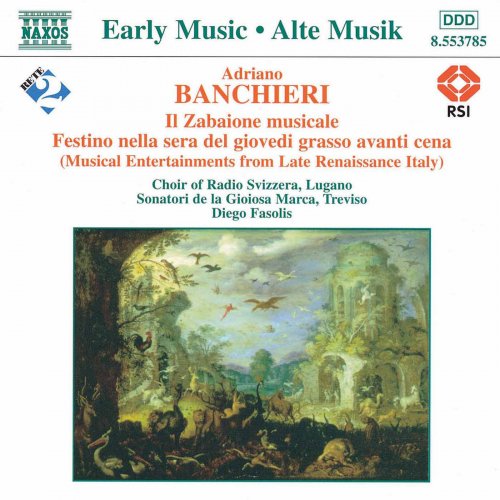
Artist: Radio Svizzera Choir, Lugano, Sonatori De La Gioiosa Marca, Diego Fasolis
Title: Banchieri: Il Zabaione Musicale
Year Of Release: 1997
Label: Naxos
Genre: Classical
Quality: FLAC (tracks)
Total Time: 01:01:54
Total Size: 313
WebSite: Album Preview
Tracklist:Title: Banchieri: Il Zabaione Musicale
Year Of Release: 1997
Label: Naxos
Genre: Classical
Quality: FLAC (tracks)
Total Time: 01:01:54
Total Size: 313
WebSite: Album Preview
Il Zabaione Musicale -
01. I. Introduzione - [01:31]
02. II. Prologo. L'Humor spensierato - [00:45]
03. III. Intermedio di felici pastori, a due cori - [01:36]
04. IV. Progne e Filomena - [01:36]
05. V. Danza di pastorelle, in aria del spagnoletto, con le riprese nella cornamusa - [01:05]
06. Atto I: VI. Madrigale: Soavissimo ardore - [01:42]
07. Atto II: VII. Intermedio di pignattari - [01:14]
08. Atto II: VIII. Un pastorello con un augellino uccisogli da un gatto - [01:34]
09. Atto II: IX. Tirsi a Clori - [01:45]
10. Atto II: X. Dialogo: Aminta, Dafne e giudizio d'Amore - [01:00]
11. Atto II: XI. Gioco della passerina - [01:44]
12. Atto II: XII. Madrigale: Baci, sospir e voci - [02:26]
13. Atto III: XIII. Ergasto appasionato - [02:13]
14. Atto III: XIV. Preparamento pastorale - [01:07]
15. Atto III: XV. Gara amorosa di pastori - [02:36]
16. Atto III: XVI. Danza di ninfe e pastori - [01:55]
17. Atto III: XVII. Licenza: L'Humore spensierato - [00:59]
Festino Nella Sera Del Giovedì Grasso Avanti Cena, Op. 18 -
18. I. Il diletto moderno per introduzione - [01:09]
19. II. Giustiniana di vicchietti chiozzotti - [01:36]
20. III. Mascherata di villanelle - [02:31]
21. IV. Seguita la detta mascherata - [01:45]
22. V. Madrigale a un dolce usiglio - [02:41]
23. VI. Mascherata d'amanti - [00:41]
24. VII. Gli amanti morescano - [01:08]
25. VIII. Gli amanti cantano un madrigale - [02:08]
26. IX. Gli amanti cantano una canzonetta - [01:48]
27. X. La zia Bernardina racconta una novella - [01:59]
28. XI. Capricciata a tre voci - [01:21]
29. XII. Contrappunto bestiale alla mente - [01:33]
30. XIII. I cervellini cantano un madrigale - [02:07]
31. XIV. Intermedio di venditori di fusi - [01:12]
32. XV. Li fusari cantano un madrigale - [02:07]
33. XVI. Gioco del conte - [02:00]
34. XVIIa. Li festinanti (solo di scacciapensieri: Marco Beasley) - [00:55]
35. XVIIb - [01:05]
36. XVIII. Vinata di brindesi e ragioni - [03:00]
37. XIX. Sproposito di goffi (pero di gusto) - [01:30]
38. XX. Il diletto moderno licenza e di nuovo invita - [01:13]
The monastery organist Adrian Bankieri certainly possessed theatrical talent and a deep understanding of the weaknesses and shortcomings of human behavior.
His madrigal comedies, more like descriptions of table gatherings than short stories, are full of charmingly funny characters, as well
as party buffoons, recognizable almost four hundred years after they were vividly depicted in musical sketches. The details may have changed over time.
time, but the basic components of human entertainment remain unchanged. Who could listen to teasing, jokes, flirting, courtship, slightly ambiguous
stories, or somewhat grotesque ones (like in Gioco della passerina, where a sparrow is devoured by body parts) without remembering the last office party, a student
night out, or a Super Bowl party? Bankieri is not just collections of fascinating madrigals, but a collection of wittily and sympathetically presented
personalities in vocal form. In the end, however, it is the monk Bankieri who steps forward and reminds us that life, no matter how exciting it may
be at the moment, should not be devoted to the search for pleasure. The acts end seriously, not with thrilling climaxes, but with poignant reflections
delivered through chromatically colored lines and harmonically saturated passages.
The spirit of Bankieri is perfectly conveyed by Diego Fasolis and the choir of the Swiss Radio Lugano. Their interpretation allows the music to live while providing a dense
and a loosely connected narrative. Madrigals remain stylistically representative of that era (1604-1608), while sounding as fresh as today
's secular speakers. The mood, one might even say the affect (albeit anachronistic for the late Renaissance) of individual fragments is conveyed clearly and always
appropriately. The rhythms in fast madrigals are vibrant and dancing; in more serious ones, strong emotionality prevails. Comic sound effects, whether it's
contrapuntal bestiality or artfully depicted bagpipes, lutes and harps are perfectly reproduced, causing smiles and immediate pressing
of the repeat button.
In all respects, Bankieri's magic is magnificent. The performance is impeccable both in musical skill and in spirit. The recording itself is flawless
, giving the madrigals the space to sound the way they should sound — rich, full-blooded music created from playing individual lines. Listening
makes it easy to get transported to a celebration, ready to join it.
His madrigal comedies, more like descriptions of table gatherings than short stories, are full of charmingly funny characters, as well
as party buffoons, recognizable almost four hundred years after they were vividly depicted in musical sketches. The details may have changed over time.
time, but the basic components of human entertainment remain unchanged. Who could listen to teasing, jokes, flirting, courtship, slightly ambiguous
stories, or somewhat grotesque ones (like in Gioco della passerina, where a sparrow is devoured by body parts) without remembering the last office party, a student
night out, or a Super Bowl party? Bankieri is not just collections of fascinating madrigals, but a collection of wittily and sympathetically presented
personalities in vocal form. In the end, however, it is the monk Bankieri who steps forward and reminds us that life, no matter how exciting it may
be at the moment, should not be devoted to the search for pleasure. The acts end seriously, not with thrilling climaxes, but with poignant reflections
delivered through chromatically colored lines and harmonically saturated passages.
The spirit of Bankieri is perfectly conveyed by Diego Fasolis and the choir of the Swiss Radio Lugano. Their interpretation allows the music to live while providing a dense
and a loosely connected narrative. Madrigals remain stylistically representative of that era (1604-1608), while sounding as fresh as today
's secular speakers. The mood, one might even say the affect (albeit anachronistic for the late Renaissance) of individual fragments is conveyed clearly and always
appropriately. The rhythms in fast madrigals are vibrant and dancing; in more serious ones, strong emotionality prevails. Comic sound effects, whether it's
contrapuntal bestiality or artfully depicted bagpipes, lutes and harps are perfectly reproduced, causing smiles and immediate pressing
of the repeat button.
In all respects, Bankieri's magic is magnificent. The performance is impeccable both in musical skill and in spirit. The recording itself is flawless
, giving the madrigals the space to sound the way they should sound — rich, full-blooded music created from playing individual lines. Listening
makes it easy to get transported to a celebration, ready to join it.