Joseph Rouleau - Hommage (2011)
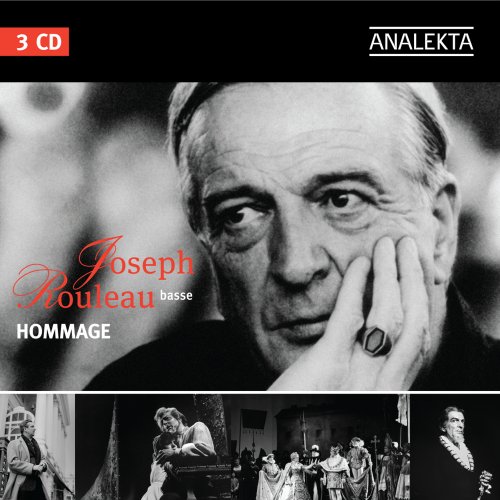
Artist: Joseph Rouleau
Title: Hommage
Year Of Release: 2011
Label: Analekta
Genre: Classical
Quality: FLAC (tracks)
Total Time: 3:05:46
Total Size: 687 MB
WebSite: Album Preview
Tracklist:Title: Hommage
Year Of Release: 2011
Label: Analekta
Genre: Classical
Quality: FLAC (tracks)
Total Time: 3:05:46
Total Size: 687 MB
WebSite: Album Preview
Disc 1
1. Joseph Rouleau – Don Carlos / "Carlo, il sommo Imperatore" (Un Frate, Act II) (06:32)
2. Joan Sutherland – Lucia di Lammermoor / "Ah! cedi, cedi, o più sciagure" (Raimondo, Act II) (07:02)
3. Joan Sutherland – Lucia di Lammermoor / "Dalle stanze, ove Lucia; Oh! Qual funesto avvenimento!" (Lucia, Raimondo, Acte II) (07:05)
4. Joseph Rouleau – Il Trovatore / "Abbietta zingara, fosca vegliarda!; "Brevi e tristi giorni visse" (Ferrando et al, Part 1 : Il duello) (05:55)
5. Joseph Rouleau – Il Trovatore / "E deggio, e posso crederlo?" (Ferrando et al, Part II: La gitana) (04:58)
6. Joseph Rouleau – Mefistofele / Concert Announcement (00:49)
7. Joseph Rouleau – Mefistofele / Prologue (09:43)
8. Joseph Rouleau – Mefistofele / "Son lo spirito" (Mefistofele, Faust, Act I, Scene II) (10:27)
9. Joseph Rouleau – Mefistofele / "Ecco il mondo" (Mefistofele, Faust, Act II, Scene II) (17:21)
Disc 2
1. Joseph Rouleau – Bois aimés (03:14)
2. Joseph Rouleau – Tristesse (02:51)
3. Joseph Rouleau – Lamento du pêcheur (03:46)
4. Joseph Rouleau – Don Quichotte à Dulcinée / I. Chanson romantique (02:03)
5. Joseph Rouleau – Don Quichotte à Dulcinée / II. Chanson épique (02:50)
6. Joseph Rouleau – Don Quichotte à Dulcinée / III. Chanson à boire (01:37)
7. Joseph Rouleau – Phydilé (05:36)
8. Joseph Rouleau – La vague et la cloche (05:24)
9. Joseph Rouleau – Chanson triste (03:19)
10. Joseph Rouleau – Les batteliers de la volga (03:42)
11. Joseph Rouleau – La puce (03:22)
12. Joseph Rouleau – Chanson de la mort de Don Quichotte / "Ne pleure pas Sancho" (03:00)
13. Joseph Rouleau – Vier ernste Gesänge / Four Serious Songs, Op.121 / I. Denn es gehet dem Menschen... (For that which befalleth the sons of men..., (04:54)
14. Joseph Rouleau – Vier ernste Gesänge / Four Serious Songs, Op.121 / II. Ich wandte mich...(J'ai considéré ensuite..., Ecclésiaste 4, 1-3) (04:20)
15. Joseph Rouleau – Vier ernste Gesänge / Four Serious Songs, Op.121 / III. O Tod, wie bitter bist du... (O death, how bitter..., Ecclesiasticus Sirac (04:20)
16. Joseph Rouleau – Vier ernste Gesänge / Four Serious Songs, Op.121 / IV. Wenn ich mit Menschen und Engelszungen redete... (Though I speak with the t (05:04)
Disc 3
1. Joseph Rouleau – L'Ultima Canzone (05:01)
2. Joseph Rouleau – La Sérénata (03:25)
3. Joseph Rouleau – Danse macabre (02:45)
4. Joseph Rouleau – Je t'aime (02:26)
5. Joseph Rouleau – Le Cor (05:03)
6. Joseph Rouleau – Saisons canadiennes / L'automne (Fall) (03:28)
7. Joseph Rouleau – Saisons canadiennes / L'hiver (Winter) (05:01)
8. Joseph Rouleau – Songs & Dances of Death / Lullaby (04:35)
9. Joseph Rouleau – Songs & Dances of Death / Serenade (03:56)
10. Joseph Rouleau – Songs & Dances of Death / Trepak (04:38)
11. Joseph Rouleau – Songs & Dances of Death / The Field-Marshal (05:22)
12. Joseph Rouleau – Samson / "How Willing My Paternal Love" (Manoah, Act III) (04:17)
13. Joseph Rouleau – L'elisir d'amore / "Udite, Udite, o rustici" (Dulcamara) (06:39)
Acclaimed on the world's greatest opera stages, he sang alongside the likes of Joan Sutherland, Victoria de Los Angeles, Maria Callas, Luciano Pavarotti, Cesare Siepi, Placido Domingo, and his compatriots Jon Vickers and Richard Verreau. He was equally at ease with Rossini, Verdi, Bellini, Mussorgsky, and Félix Leclerc. Conscious of the need to promote modern repertoire, he took part in the premiere of Harry Somers' opera Louis Riel, and he commissioned Jacques Hétu's Le Prix and Clément Pépin's Messe sur le monde. He conveyed his passion to a new generation of singers for nearly 20 years at the Université de Québec à Montréal, while taking on the presidency of Jeunesses Musicales du Canada, a position he has held since 1989 and that paved the way for his co-founding, along with André Bourbeau, of the Montréal International Music Competition. Whatever he does, and wherever he goes, whether singing or sharing the memories of an enviable career, Joseph Rouleau is filled with a contagious fervour. Drawing from this Matane native's impressive discography, Analekta presents here not a description of his legacy but rather a portrayal of his vigour and vitality.
In 1949, when Joseph Rouleau won the Prix Archambault at the age of 20, he did not realize that his life was about to undergo its first major change. Certainly he had been told he "had a voice" before, but he didn't feel ready to dedicate his whole life to it. Whether alone or with others, he sang for the simple pleasure of music. In addition to receiving $100 in prize money, young Rouleau was invited to perform with the Société des concerts symphoniques de Montréal (which would become the Orchestre symphonique de Montréal in 1953) under the direction of Wilfrid Pelletier. Enchanted by Rouleau's voice, the conductor took him under his wing and immediately had him admitted to the Conservatoire de musique de Montréal, even though it did not yet have a singing class.
Rouleau soon joined a number of Radio-Canada choirs, and it came as no surprise that he was quickly given solo parts, and then taken on tour by Jeunesses Musicales du Canada, the fees for which would help fund his studies in Italy. Even so, he had accumulated a significant debt by the time he returned, so in 1955 he entered the singing contest of the New Orleans Experimental Theatre of America, sponsored by the New Orleans Opera Company. As the only bass selected by the jury, he was offered a series of performances, including the roles of Colline in La bohème, the king in Aida, and the Chevalier des Grieux in Manon.
In December 1956, his second brush with destiny occurred: he was asked to audition for David Webster, legendary director of the Covent Garden Theatre in London. On the fated day, Rouleau came down with a bout of laryngitis. His agent suggested he consult Dr. Reckford, the official laryngologist for the Metropolitan Opera, who prescribed complete silence. Webster rescheduled the audition for three days later after his return from Chicago. The doctor, after hearing him sing a few vocalises, told him to limit himself to three arias. So Rouleau sang an excerpt from Verdi's Simon Boccanegra, Sarastro's aria "In diesen Heil'gen Hallen" from Mozart's The Magic Flute, and Philip II's aria from Verdi's Don Carlos. Captivated, Webster asked him: "My boy, would you like to join Covent Garden?"
Half a century later, seated behind his desk at Jeunesses Musicales du Canada, Rouleau is still visibly moved as he describes this moment. He was offered a six-month contract that included five performances of La bohème and five of The Magic Flute, with an option to renew for the 57-58 season. But far from 10 shows, he gave 37 performances of five operas during that first of what would prove to be 30 seasons treading the Covent Garden boards. In all, he gave over a thousand performances of 49 different operas there. "My father said that in life we have three chances to accomplish something extraordinary," he recalls. "I was able to take advantage of them, and the wind was in my favour, but I never forgot I was from the Gaspé, even as I travelled the world singing." Even today, before each concert or opera, he admits to saying a little prayer to his father: "Papa, help me... Help me be my best." And he tells himself, "My Lord, I'm a long way from Matane!"
Throughout his dazzling career, Rouleau left an indelible mark on certain key roles. He avows an unbridled passion for the role of Don Quixote, a character he sympathizes with and whose adventures rested on his bedside table many a year; he incarnated the role of Mephistopheles–in Gounod's Faust, Berlioz's La damnation de Faust or Boito's Mefistofele–over 500 times. But without a doubt, the role that made his claim to fame is that of Boris Godunov. "In my opinion, Boris is the perfect role for an opera singer, whether you look at it from a dramatic, vocal or acting point of view. He goes through every possible emotion–and takes the audience with him. I feel honoured and fortunate to have been able to interpret such a remarkable work."
Joseph Rouleau feels that a bass voice reaches maturity at about the age of 35, and it was clear that he would not take on the role before then. "You have to have the patience to develop slowly and only take on the great characters like Boris, Mephistopheles, Philip II, or Don Quixote after you have full control over your voice, technique and even your psyche," he explains in the biography À tour de roles. "You also must have enough stage experience to feel completely comfortable. [...] So I resisted when Georg Solti urged me toward the repertoire of Wagner at the age of 30. I no doubt missed out on a number of opportunities, but I was convinced that if I took on Wagner, I wouldn't be able to sing for half a century, as was the case. An artist must be completely honest with himself and determine what he is able to achieve and, above all, reject that which won't serve him well." A man of conviction, he sang excerpts from Boris Godunov, in Russian, under the direction of Wilfrid Pelletier at the age of 35. He first sang the entire role in September 1966, in Kazan in the former USSR, again in Russian, during a triumphant tour in which critics compared him to Feodor Chaliapin.
When asked how he enjoyed such a long career, Rouleau reflects for a moment before offering, in his deep bass voice: "You need an instrument, a lot of study and preparation, excellent technique, nerves of steel, a highly developed memory, constant work on language and acting skills, and an awareness that there are a hundred other singers waiting in the wings to take your place. How did I overcome all the obstacles? Even today it's a mystery to me. A single answer? Vocal, musical and acting talent, all in the same person." Certainly, it's a winning combination, one that proved itself over and over again. "I always loved singing, and I hope I gave pleasure to many people. Audiences make the effort to buy tickets and come to the theatre. If our interpretations are successful, they forget about their long, hard day and return home with a smile. In the end, audiences are our friends and reward us with their applause; we are so fortunate to work in this profession."
In 1949, when Joseph Rouleau won the Prix Archambault at the age of 20, he did not realize that his life was about to undergo its first major change. Certainly he had been told he "had a voice" before, but he didn't feel ready to dedicate his whole life to it. Whether alone or with others, he sang for the simple pleasure of music. In addition to receiving $100 in prize money, young Rouleau was invited to perform with the Société des concerts symphoniques de Montréal (which would become the Orchestre symphonique de Montréal in 1953) under the direction of Wilfrid Pelletier. Enchanted by Rouleau's voice, the conductor took him under his wing and immediately had him admitted to the Conservatoire de musique de Montréal, even though it did not yet have a singing class.
Rouleau soon joined a number of Radio-Canada choirs, and it came as no surprise that he was quickly given solo parts, and then taken on tour by Jeunesses Musicales du Canada, the fees for which would help fund his studies in Italy. Even so, he had accumulated a significant debt by the time he returned, so in 1955 he entered the singing contest of the New Orleans Experimental Theatre of America, sponsored by the New Orleans Opera Company. As the only bass selected by the jury, he was offered a series of performances, including the roles of Colline in La bohème, the king in Aida, and the Chevalier des Grieux in Manon.
In December 1956, his second brush with destiny occurred: he was asked to audition for David Webster, legendary director of the Covent Garden Theatre in London. On the fated day, Rouleau came down with a bout of laryngitis. His agent suggested he consult Dr. Reckford, the official laryngologist for the Metropolitan Opera, who prescribed complete silence. Webster rescheduled the audition for three days later after his return from Chicago. The doctor, after hearing him sing a few vocalises, told him to limit himself to three arias. So Rouleau sang an excerpt from Verdi's Simon Boccanegra, Sarastro's aria "In diesen Heil'gen Hallen" from Mozart's The Magic Flute, and Philip II's aria from Verdi's Don Carlos. Captivated, Webster asked him: "My boy, would you like to join Covent Garden?"
Half a century later, seated behind his desk at Jeunesses Musicales du Canada, Rouleau is still visibly moved as he describes this moment. He was offered a six-month contract that included five performances of La bohème and five of The Magic Flute, with an option to renew for the 57-58 season. But far from 10 shows, he gave 37 performances of five operas during that first of what would prove to be 30 seasons treading the Covent Garden boards. In all, he gave over a thousand performances of 49 different operas there. "My father said that in life we have three chances to accomplish something extraordinary," he recalls. "I was able to take advantage of them, and the wind was in my favour, but I never forgot I was from the Gaspé, even as I travelled the world singing." Even today, before each concert or opera, he admits to saying a little prayer to his father: "Papa, help me... Help me be my best." And he tells himself, "My Lord, I'm a long way from Matane!"
Throughout his dazzling career, Rouleau left an indelible mark on certain key roles. He avows an unbridled passion for the role of Don Quixote, a character he sympathizes with and whose adventures rested on his bedside table many a year; he incarnated the role of Mephistopheles–in Gounod's Faust, Berlioz's La damnation de Faust or Boito's Mefistofele–over 500 times. But without a doubt, the role that made his claim to fame is that of Boris Godunov. "In my opinion, Boris is the perfect role for an opera singer, whether you look at it from a dramatic, vocal or acting point of view. He goes through every possible emotion–and takes the audience with him. I feel honoured and fortunate to have been able to interpret such a remarkable work."
Joseph Rouleau feels that a bass voice reaches maturity at about the age of 35, and it was clear that he would not take on the role before then. "You have to have the patience to develop slowly and only take on the great characters like Boris, Mephistopheles, Philip II, or Don Quixote after you have full control over your voice, technique and even your psyche," he explains in the biography À tour de roles. "You also must have enough stage experience to feel completely comfortable. [...] So I resisted when Georg Solti urged me toward the repertoire of Wagner at the age of 30. I no doubt missed out on a number of opportunities, but I was convinced that if I took on Wagner, I wouldn't be able to sing for half a century, as was the case. An artist must be completely honest with himself and determine what he is able to achieve and, above all, reject that which won't serve him well." A man of conviction, he sang excerpts from Boris Godunov, in Russian, under the direction of Wilfrid Pelletier at the age of 35. He first sang the entire role in September 1966, in Kazan in the former USSR, again in Russian, during a triumphant tour in which critics compared him to Feodor Chaliapin.
When asked how he enjoyed such a long career, Rouleau reflects for a moment before offering, in his deep bass voice: "You need an instrument, a lot of study and preparation, excellent technique, nerves of steel, a highly developed memory, constant work on language and acting skills, and an awareness that there are a hundred other singers waiting in the wings to take your place. How did I overcome all the obstacles? Even today it's a mystery to me. A single answer? Vocal, musical and acting talent, all in the same person." Certainly, it's a winning combination, one that proved itself over and over again. "I always loved singing, and I hope I gave pleasure to many people. Audiences make the effort to buy tickets and come to the theatre. If our interpretations are successful, they forget about their long, hard day and return home with a smile. In the end, audiences are our friends and reward us with their applause; we are so fortunate to work in this profession."
![Alex Puddu - Francia Meccanica (2026) [Hi-Res]](https://www.dibpic.com/uploads/posts/2026-08/1787747698_gu9noh3dd4obl_600.jpg "Alex Puddu - Francia Meccanica (2026) [Hi-Res]")
![Fania All Stars - Fania All Stars Live In Japan 1976 (Remastered 2026) (2026) [Hi-Res]](https://img.israbox.com/img/2026-08/30/fx6f4l5motbsy457ouy6qnxft.jpg "Fania All Stars - Fania All Stars Live In Japan 1976 (Remastered 2026) (2026) [Hi-Res]")
![Klöve - Klöve (2026) [Hi-Res]](https://www.dibpic.com/uploads/posts/2026-08/1787743956_592x592bb.jpg "Klöve - Klöve (2026) [Hi-Res]")
![Jared Schonig - Big Band: Live at Dizzy's (Live) (2026) [Hi-Res]](https://img.israbox.com/img/2026-08/28/v4zdhqwm35azwr9dp57rfb7y1.jpg "Jared Schonig - Big Band: Live at Dizzy's (Live) (2026) [Hi-Res]")
![Alicia Witt - Between Heaven and Earth (2026) [Hi-Res]](https://img.israbox.com/img/2026-08/29/vdfub0as4sebuz9ep06t3j7q4.jpg "Alicia Witt - Between Heaven and Earth (2026) [Hi-Res]")