Gabriele Pieranunzi, Alessandro Carbonare, Enrico Pieranunzi, San Carlo Theatre Orchestra, Jeffrey Tate - Kurt Weill: Violin Concerto (2013)
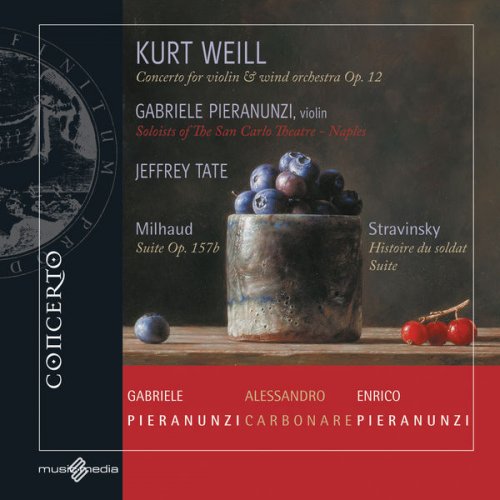
Artist: Gabriele Pieranunzi, Alessandro Carbonare, Enrico Pieranunzi, San Carlo Theatre Orchestra, Jeffrey Tate
Title: Kurt Weill: Violin Concerto
Year Of Release: 2013
Label: Concerto Classics
Genre: Classical
Quality: flac lossless (tracks)
Total Time: 00:52:37
Total Size: 258 mb
WebSite: Album Preview
TracklistTitle: Kurt Weill: Violin Concerto
Year Of Release: 2013
Label: Concerto Classics
Genre: Classical
Quality: flac lossless (tracks)
Total Time: 00:52:37
Total Size: 258 mb
WebSite: Album Preview
01. Violin Concerto, Op. 12: I. Andante con moto
02. Violin Concerto, Op. 12: II. Notturno. Allegro un poco tenuto
03. Violin Concerto, Op. 12: III. Cadenza. Moderato
04. Violin Concerto, Op. 12: IV. Serenata. Allegretto
05. Violin Concerto, Op. 12: V. Allegro molto. Un poco agitato
06. Histoire du soldat, Trois danses: Tango - Valse - Ragtime
07. Three Pieces for Clarinet solo: No. 3, Quarter note = 160
08. Histoire du soldat: Danse du diable
09. Suite for Violin, Clarinet and Piano, Op. 157b: I. Ouverture
10. Suite for Violin, Clarinet and Piano, Op. 157b: II. Divertissement
11. Suite for Violin, Clarinet and Piano, Op. 157b: III. Jeu
12. Suite for Violin, Clarinet and Piano, Op. 157b: IV. Introduction et Final
The marquee work here, Kurt Weill's Concerto for violin and wind orchestra, Op. 12, was composed in 1924 and has been recorded a number of times. The work originated shortly after the end of Weill's period of study, which included lessons from both Engelbert Humperdinck and Ferruccio Busoni, and it has a little of everything in it. Those looking for premonitions of The Threepenny Opera and Weill's later popular career will find jazz impulses, beneath the surface and ready to break out, but it's not the most prominent feature; dissonance rules in the five short movements that mix Stravinsky's neo-classical stasis with Schoenberg's rigor of material. It's not an easy work to love, but it comes off very well here. Partly that's due to the taut playing of violinist Gabriele Pieranunzi and the Soloists of the San Carlo Theatre, Naples. These might not be musicians you would naturally pick for this repertory, but Pieranunzi and his brother Enrico are fluent in jazz as well as classical music, and the rest of the program, with its stronger jazz component, brings out the stylistic issues of the whole period, the varying responses of European composers as they tried to deal with the startling new music coming from America. Pairing the Weill with music from Stravinsky's jazziest period and with the more playful take of Milhaud results in a thread that connects the whole. The players don't add jazz improvisation, but they do insert a short composition by Enrico Pieranunzi into the sequence of pieces by Stravinsky. There doesn't seem to be any very good reason for this, but in general this recording puts across the stylistically plural musical world of the 1920s better than most.
![Four80East - Barn Sessions Volume One (2025) [CD-Rip]](https://www.dibpic.com/uploads/posts/2026-08/1787663681_h20up3jlj678a_600.jpg "Four80East - Barn Sessions Volume One (2025) [CD-Rip]")
![Henry Threadgill - Cut You Where You Was (2026) [Hi-Res]](https://www.dibpic.com/uploads/posts/2026-08/1787757260_a2094249576_10.jpg "Henry Threadgill - Cut You Where You Was (2026) [Hi-Res]")
![Jared Schonig - Big Band: Live at Dizzy's (Live) (2026) [Hi-Res]](https://img.israbox.com/img/2026-08/28/v4zdhqwm35azwr9dp57rfb7y1.jpg "Jared Schonig - Big Band: Live at Dizzy's (Live) (2026) [Hi-Res]")
![Alicia Witt - Between Heaven and Earth (2026) [Hi-Res]](https://img.israbox.com/img/2026-08/29/vdfub0as4sebuz9ep06t3j7q4.jpg "Alicia Witt - Between Heaven and Earth (2026) [Hi-Res]")
![Kelly Green - Eat Your Greens (2026) [Hi-Res]](https://img.israbox.com/img/2026-08/27/2chtyjfvrpd2bmocqig5xvjnx.jpg "Kelly Green - Eat Your Greens (2026) [Hi-Res]")