Alma Petchersky - Piano Music of Carlos Guastavino (2005)
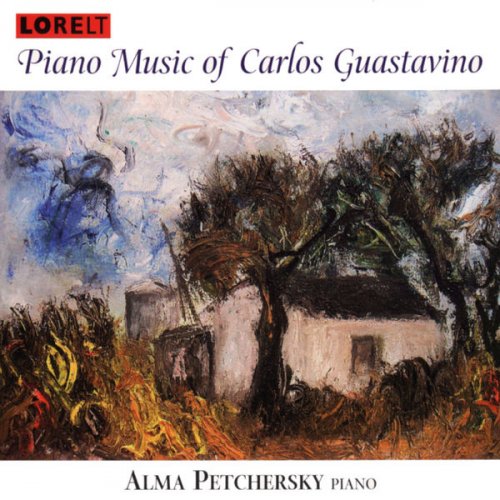
Artist: Alma Petchersky
Title: Piano Music of Carlos Guastavino
Year Of Release: 2005
Label: Lorelt
Genre: Classical
Quality: FLAC (tracks)
Total Time: 1:17:40
Total Size: 225 MB
WebSite: Album Preview
Tracklist:Title: Piano Music of Carlos Guastavino
Year Of Release: 2005
Label: Lorelt
Genre: Classical
Quality: FLAC (tracks)
Total Time: 1:17:40
Total Size: 225 MB
WebSite: Album Preview
1. Estilo (a la manera popular) (05:51)
2. Diez Cantilenas Argentinas Santa Fe para llorar (03:36)
3. Diez Cantilenas Argentinas Adolescencias (04:36)
4. Diez Cantilenas Argentinas Jacaranda (05:18)
5. Diez Cantilenas Argentinas El ceibo (03:49)
6. Diez Cantilenas Argentinas Abelarda Olmos (06:27)
7. Diez Cantilenas Argentinas Juanita (03:51)
8. Diez Cantilenas Argentinas Herbert (07:35)
9. Diez Cantilenas Argentinas Santa Fe Antiguo (03:26)
10. Diez Cantilenas Argentinas Trébol (03:14)
11. Diez Cantilenas Argentinas La casa (05:14)
12. Tierra Linda (04:42)
13. Sonata Allegretto intimo (05:07)
14. Sonata Scherzo - Molto vivace (03:33)
15. Sonata Recitativo - Lento (04:11)
16. Sonata Fuga y Final - Allegro (07:01)
The name of composer Carlos Guastavino (1912-2000) has often come up in connection with the new surge of interest in the music of Argentina. Known primarily for songs and piano music, Guastavino rejected modern compositional trends. The booklet notes for this album of Guastavino's piano compositions name-check Scriabin, Chopin, Brahms, and Argentine composer Ernesto Drangosch, but these hints and references miss the point that Guastavino had a unique style that allowed him to resist modernist trends. It is both folkloric and highly expressive, with a predominantly melodic orientation and a free treatment of rhythm. Guastavino's music is solidly tonal, but its individual, untrammeled quality prevents it from sounding derivative of any particular earlier style. The centerpiece of the album is a set of what Guastavino calls Ten Cantilenas Argentinas, medium-length pieces that mostly evoke places or flowers. Perhaps the most interesting work on the album is the concluding Piano Sonata in C sharp minor, which was intended as an homage to Beethoven's Piano Sonata in B flat, Op. 106 (not Op. 110 as is mistakenly stated in the notes). The four movements are balanced roughly as in the Beethoven work, with a commanding first movement (not quite with the imposing quality of Beethoven's), a dry, rhythmically nervous Scherzo, a recitative-like, introductory-sounding third movement, and a concluding fugue. But all are infused with Guastavino's characteristic lyricism and with bits of Argentine folk rhythm. It is charming to hear this singing creole fugue, and after it's over, Piazzolla's rigorous tango fugues don't seem so far away. Pianist Alma Petchersky picks up on and emphasizes a dreamy quality in Guastavino's music. At times one wishes for clearer articulation of the individual notes; sample Mirian Conti's recording of Guastavino's El ceibo, heard on her Looking South album, and compare it to Petchersky's version here; it may be that Guastavino can take a bit more zing without losing the essential lyricism of the music. But Petchersky has provided a big service with this contribution to the rediscovery of an underrated composer of the twentieth century.
![Adam Rose, Mountain Jazz Quartet - Holler Serenade (2026) [Hi-Res]](https://www.dibpic.com/uploads/posts/2026-08/1787640003_g047p1rsxuc8r_600.jpg "Adam Rose, Mountain Jazz Quartet - Holler Serenade (2026) [Hi-Res]")
![Ale Núñez - Blue Room (2026) [Hi-Res]](https://img.israbox.com/img/2026-08/27/x7n7owmuquv203irmpuzayub4.jpg "Ale Núñez - Blue Room (2026) [Hi-Res]")
![Tomasz Stanko, Stanisław Soyka - Soyka / Stańko (2026) [Hi-Res]](https://www.dibpic.com/uploads/posts/2026-08/1787476533_jivemvbhhmhwg_600.jpg "Tomasz Stanko, Stanisław Soyka - Soyka / Stańko (2026) [Hi-Res]")

![The John Payne Band - Bedtime Stories (1976) [Hi-Res]](https://www.dibpic.com/uploads/posts/2026-08/1787861782_cover.jpg "The John Payne Band - Bedtime Stories (1976) [Hi-Res]")
![Duesund - Under overflaten (2026) [Hi-Res]](https://img.israbox.com/img/2026-08/23/k02uc3gso89jmrqasrcueuwpa.jpg "Duesund - Under overflaten (2026) [Hi-Res]")