Artist:
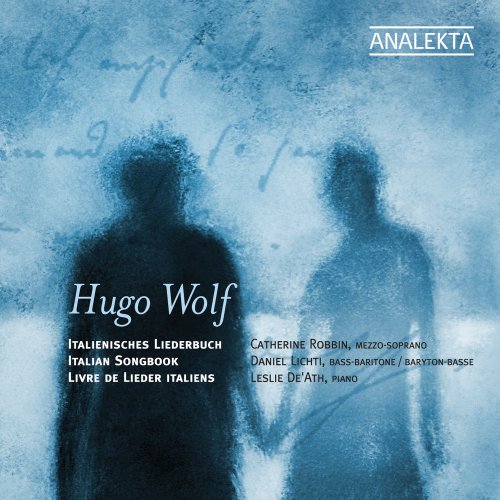
Catherine Robbin, Daniel Lichti, Leslie De’Ath
Title:
Wolf: Italienisches Liederbuch
Year Of Release:
2010
Label:
Analekta
Genre:
Classical
Quality:
FLAC (tracks)
Total Time: 1:14:37
Total Size: 324 MB
WebSite:
Album Preview
Tracklist:1. Auch kleine Dinge können uns entzücken (Even little things can delight us) (02:14)
2. Nicht länger kann ich singen (No longer can I sing) (01:05)
3. Schweig einmal still (Be silent) (00:59)
4. O wüßtest du, wie viel ich deinetwegen (Oh, if you knew how much I've suffered for your sake) (01:29)
5. Wer rief dich denn (Who has called you?) (01:03)
6. Hoffärtig seid Ihr, schönes Kind (You are haughty, lovely maid) (00:46)
7. Was soll der Zorn, mein Schatz (Why all this wrath, my dear) (01:38)
8. Wie soll ich fröhlich sein (How can I be gay) (01:26)
9. Verschling' der Abgrund meines Liebsten Hütte (Oh, may my lover's cottage be engulfed in an abyss) (01:25)
10. Gesegnet sei, durch den die Welt entstund (Blessed be He who made the world) (01:17)
11. Ich esse nun mein Brot nicht trocken mehr (I do not eat my bread unmoistened anymore) (01:40)
12. Nun laß uns Frieden schließen (Now let us make peace) (01:46)
13. Wenn du, mein Liebster, steigst zum Himmel auf (If you, my love, ascend to Heaven) (01:29)
14. Wir haben lange Zeit geschwiegen (We both kept silence for a long time) (01:57)
15. "Was für ein Lied soll dir gesungen werden (What kind of song could I sing to you)" (02:02)
16. Mein Liebster singt am Haus (My lover is singing before my house) (01:21)
17. Selig ihr Blinden (Happy are you, blind ones) (01:52)
18. Wohl kenn' ich Euren Stand (How well I know your rank) (02:10)
19. Benedeit, die sel'ge Mutter (Blessed the happy mother) (04:34)
20. Mann sagt mir, deine Mutter wollt'es nicht (I am told your mother does not agree) (01:02)
21. Sterb' ich, so hüllt in Blumen meine Glieder (And when I die, make me a shroud of flowers) (01:55)
22. Mir ward gesagt (I have been told) (01:39)
23. Und willst du deinen Liebsten sterben sehen (And would you see your sweetheart die) (02:02)
24. Schon streckt' ich aus im Bett (I have already stretched) (01:43)
25. Heut' Nacht erhob ich mich um Mitternacht (Last night I rose at midnight) (01:47)
26. Heb' auf dien blondes Haupt (Lift your fair head) (01:43)
27. O wär' dein Haus durchsichtig wie ein Glas (I wish your house were transparent as glass) (01:31)
28. Und steht ihr früh am Morgen auf (When early at dawn you rise) (02:40)
29. Gesegnet sei das Grün (Blessed be the green) (01:22)
30. Daß doch gemalt all deine Reize wären (Oh, had all your loveliness been painted) (01:37)
31. Wenn du mich mit den Augen streifst (When you glance at me with your laughing eyes) (01:34)
32. Ihr jungen Leute (Listen, boys) (01:15)
33. Der Mond hat eine schwere Klag' erhoben (The moon has made a bitter complaint) (02:02)
34. Du denkst mit einem Fädchen mich zu fangen (You think you can catch me with a single thread) (01:02)
35. Geselle, woll'n wir uns in Kutten hüllen (Friend, shall we don the monkish garb) (02:16)
36. Mein Liebster is so klein (My true love is so small) (01:30)
37. Ein Ständchen euch zu bringen (I came hither to serenade you) (01:11)
38. Nein, junger Herr (No, Master) (00:49)
39. Ihr seid die Allerschönste (You are the most beautiful) (01:34)
40. Wie lange schon war immer mein Verlangen (How long has it been my desire) (02:14)
41. Wie viele Zeit verlor ich dich zu lieben! (How much time I lost in loving you!) (01:40)
42. Mein Liebster hat zu Tische mich geladen (My lover has invited me to dinner) (00:55)
43. Ich ließ mir sagen und mir ward erzählt (I was told, and it was related) (01:37)
44. Du sagst mir, daß ich keine Fürstin sei (You tell me I am no princess) (01:05)
45. Laß sie nur gehen, die so die Stolze spielt (Just let her go, who acts so proud) (01:23)
46. Ich hab' in Penna einen Liebsten wohnen (I have a love who lives in Penna) (00:55)
The miniature vignettes of the Italian Songbook constitute Wolf's last major contribution to the lied, before his early death. After the high-minded philosophical sobriety of Goethe and the weighty devoutness of the Geistliche Lieder in the Spanish Songbook, Wolf must have found the lusty, direct gioia di vivere of the Italian poems a great breath of fresh air. He had a particular affection for them, to judge from his assertion in an 1891 letter that "my Italian songs are the most original and artistically the most perfect of all my things."
As with the Spanish Songbook, Wolf does not seem to have intended these songs to be performed together as a cycle in concert. But the poems conveniently fall into three groups, roughly equal in number: those from a male standpoint, those from a female standpoint, and those that can be considered either way. The poems all preoccupy themselves with a wide gamut of male / female relationships and emotions, from flippancy to despair, complaint to provocation, intimacy and passion to adulation and reverence. Thus, the collection invites performance as a unit, with two singers alternating songs in a loose dramatic chronicle. A latitude for creative dramatization is inherent in the set, with some songs able to function as responses or provocative rebuttals to others. We have seen fit to follow the lead of Irmgard Seefried, Dietrich Fischer-Dieskau, and their accompanist Erik Werba, who employed the same ordering of songs in their 1958 Salzburg Festival performance.
Forty of the poems are rispetti in their original Italian - Tuscan folk poems of eight 11-syllable lines, with an ABABABC or similar rhyme scheme. The remaining six are Venetian vilote or folksongs. Paul Heyse was careful to preserve the poetic structure of the originals in his German translations, and in the process allowed for some limited license in meaning and connotation. The often disarming Mediterranean directness of the sentiments and imagery in the anonymous original Italian poems was no doubt part of the charm that attracted Heyse, made his publication successful in Germany, and so attracted Wolf.
The stylistic homogeneity of the entire set belies the fact that they were composed in two bursts of compositional activity, separated by over four years. The first spate of song writing, late in 1891, yielded 22 songs over a 90-day stretch. The remaining 24 were written in March / April 1896. The order of their composition corresponds to neither the published order in the score nor the sequence chosen for this recording.
The words "kleinen Dinge, die uns entzücken" in the opening song ('little things that delight us' - i.e., by extension, the songs that follow), introduce an opening group that consists primarily of songs of argument and strife, culminating in Verschling der Abgrund. The second and third songs form a pair in that they share the same key and principal musical motif, and function as statement and response. The uncertain, longing wretch in Nicht länger kann ich singen meets a heartless, cruel response in Schweig' einmal still (with its derisive donkey brays), and the tone is set. Almost a third of the songs we encounter are sung by women, who (in Susan Youens's words) "revile, dismiss, mock, or reproach their inconsiderate, faithless, and unsatisfactory lovers." The man frequently idolizes the woman with an almost sacred adulation (Gesegnet sei, durch den die Welt entstund / Was für ein Lied / Benedeit / Sterb' ich / Und steht Ihr früh / Wenn du mich mit den Augen / Ihr seid die Allerschönste), but such a stance is rarely reciprocated by the woman. Wenn du, mein Liebster and Wir haben beide lange Zeit are the exceptions, although these songs could as easily have been sung by the man. At times the fervency of the male seems hyperbolic in its poetic conceits, as in Der Mond and Dass doch gemalt, but Wolf wisely treats these poems with complete earnestness.
After the first group, the ensuing songs are concerned with reconciliation, to Wenn du, mein Liebster. The several songs that follow are primarily lyrical in nature, extolling devotion, longing for death, and vows of fidelity. We encounter songs of passion (Man sagt mir), anguish (Benedeit) and sensuousness (Und willst du deinen Liebsten), and soon songs of humour (Geselle, woll'n wir / Mein Liebster ist so klein / Wie lange schon / Ich liess mir sagen), lightheartedness (Ihr jungen Leute / Ein Ständchen euch zu bringen) and frivolity (Du denkst mit einem Fädchen / Nein, junger Herr / Ich hab' in Penna) are added to the mix. The justly famous Ich hab' in Penna that always concludes the Songbook brings us full-circle to the tone of the opening. It is as if the pitiless girl of Schweig' einmal still returned to reveal her full nature in the final song.
The greatness of the Songbook lies in Wolf's uncanny ability to find precise and telling musical counterparts to the ideas and images in the poems. Rarely does his instinct flag. The songs are vivid character sketches, some almost theatrical in their pictorial immediacy. This is all done with great wit and brevity, with few songs lasting for more than two minutes, and some less than one minute. Benedeit, die sel'ge Mutter stands out in this regard, being almost twice the length of even the longest of the other songs. Its ternary structure, with the entire opening section returning at the end, is common in Lieder literature generally, but unique in this cycle. This formal incongruity in the set would perhaps be problematic, were it not for the redeeming beauty of the music. It is the only poem that is neither rispetto nor vilote - unique in having more than one stanza. Unusually, Wolf brings back the opening two stanzas after the two contrasting ones. In sandwiching the passionate, anguished middle section between a hymn-like outpouring of love and devotion, Wolf seems to be saying that the latter state of being is greater than the former and encompasses it.
Although the merit of these songs goes far beyond mere pictorialism, vivid referential motifs abound, appropriately laconic for such aphoristic miniatures. Rapid figuration, grace notes, and wide leaps are frequent in the mocking, flippant songs for the women, like Schweig' einmal still and Nein, junger Herr. The surges of the Arno River (and by extension, the disgust at the girl's infidelity) are heard in Lass sie nur gehn - one of the few male songs that seem to match the disdain that surfaces so easily in the female songs. The disjunct dotted rhythms of Geselle, woll'n wir instantly capture the men's mincing duplicity. In the constant lush arpeggiations of Und willst du deinen Liebsten, one feels both the sensuousness of the man's stroking the woman's hair and his supernal fervency of devotion. The twochord tidbits that open Mein Liebster ist so klein, with their tiny intervals, portray the minuscule lover and set in relief the huge leaps in the piano part when they occur. At the end, when the woman must bend low to kiss him, the piano postlude lets us know that the poor heightchallenged male, craning to reach her lips, is probably doing most of the work. The song that exploits candid pictorialism at its most direct has to be Wie lange schon, with its wicked portrayal of the meek violinist lover, whose romantic earnestness is more than matched by his ineptitude as a performer. His pedantic attempts at a love song in the postlude (marked ‘with great difficulty and hesitancy') take up far too much time, and leave the girl speechless.
On occasion Wolf approaches a Wagnerian grandiosity of utterance, stretching the Lied to its breaking point. In Verschling' der Abgrund, we are not far from the musical vocabulary of the Ride of the Valkyries. Wolf's wholehearted appropriation of Wagnerian chromaticism serves his purpose well in the more tortured poetic utterances, as in Hoffärtig seid Ihr and the middle section of Benedeit.
Wolf responds to the Mediterranean serenade tradition with six fine contributions. In O wär dein Haus, the pervading repeated-note motif, with its octave leap, perfectly captures both the crystalline transparency of the glass, and the subdued passion of the lover. Note the single break in the pattern at vorüberstehle (‘to tip-toe by'). In Heb' auf dein blondes Haupt, the iambic rhythm of both poetry and music portray the lover's heartbeat and create the atmosphere of a lullaby, especially in the piano postlude. In Schon streckt' ich, the cavalier lad's impulsiveness is mirrored in the contrast between the two halves of the song. The most patent serenade, however, is reserved for Ein Ständchen Euch zu bringen, in which the swaggering Don Juan is more caught up in his own virtuosity and charisma than in any sincere romantic outpouring. The spirited postlude, with its decrescendo, tells us that it's time to move on to the next balcony. In the exquisite Mein Liebster singt am Haus, we are privy to the girl's response to hearing her lover's song, heard in the piano. The vividness of this song lies in the simultaneous intertwining of the sinuous serenade with the helpless frustration of the girl, cloistered in her bedroom. Her passionate desperation overflows in Man sagt mir, with its tortured chromaticisms resolving finally into a victorious major-key postlude.
The sheet music libraries of most singers typically include numerous examples of excellent folksong arrangements, from Beethoven to Brahms to Britten. The aesthetic intent of the Italian Songbook, both in its poetic original and in Wolf's musical manifestation, is diametrically opposed to the tradition of providing musical accompaniment to folk melodies. The poignancy (and indeed the whole raison d'être) of these miniatures is to encapsulate with great charm and endearment, more than a little envy, and the utmost sophistication, a vibrant, slightly exotic culture, very much alive with the pulse of human passion, through the spyglass of a more encompassing artistic field of vision.
As with all art song - but especially with the Italian Songbook - an appreciation of the subtleties and essence of this music hinges upon a commensurate comprehension and appreciation of the poetry.

![matahari sons - Sol en Berlin (2026) [Hi-Res]](https://img.israbox.com/img/2026-08/27/liphdh62asdoa57stjteqmcdz.jpg "matahari sons - Sol en Berlin (2026) [Hi-Res]")