Martinu String Quartet, Sequoia String Quartet, Boston Composers String Quartet - William Thomas McKinley String Quartets, Vol. 1 (2026) [Hi-Res]
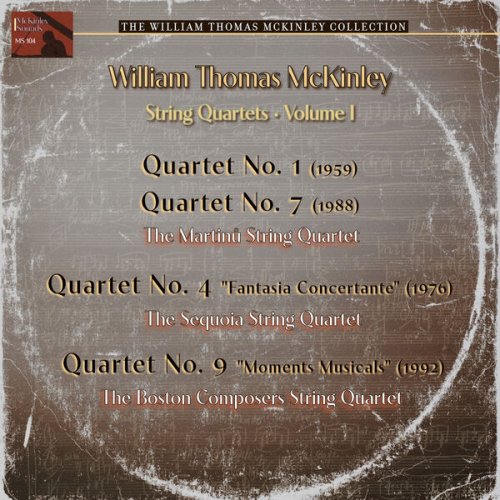
Artist: Martinu String Quartet, Sequoia String Quartet, Boston Composers String Quartet
Title: William Thomas McKinley String Quartets, Vol. 1
Year Of Release: 2026
Label: McKinley Sounds
Genre: Classical
Quality: flac lossless (tracks) / flac 24bits - 96.0kHz
Total Time: 01:12:05
Total Size: 331 mb / 1.15 gb
WebSite: Album Preview
TracklistTitle: William Thomas McKinley String Quartets, Vol. 1
Year Of Release: 2026
Label: McKinley Sounds
Genre: Classical
Quality: flac lossless (tracks) / flac 24bits - 96.0kHz
Total Time: 01:12:05
Total Size: 331 mb / 1.15 gb
WebSite: Album Preview
01. String Quartet No. 1: I. Allegro vivace (1959)
02. String Quartet No. 1: II. Andante con moto (1959)
03. String Quartet No. 7: I. Andante e misterioso (1988)
04. String Quartet No. 7: II. Presto e ritmico (1988)
05. String Quartet No. 7: III. Lento e tragico (1988)
06. String Quartet No. 7: IV. Tempo di Valse (1988)
07. String Quartet No. 7: V. Moderato e luminoso (1988)
08. String Quartet No. 7: VI. Prestissimo con fuoco e agitato (1988)
09. String Quartet No. 7: VII. Allegro brillante (1988)
10. String Quartet No. 7: VIII. Adagietto e misterioso (1988)
11. String Quartet No. 4: Fantasia Concertante (1976)
12. String Quartet No. 9 - Moments Musicales: I. Grandisoso (1992)
13. String Quartet No. 9 - Moments Musicales: II. Presto (1992)
14. String Quartet No. 9 - Moments Musicales: III. Largo (1992)
15. String Quartet No. 9 - Moments Musicales: IV. Tempo di Valse (1992)
16. String Quartet No. 9 - Moments Musicales: V. Adagio dramatico (1992)
17. String Quartet No. 9 - Moments Musicales: VI. Scherzando e sardonico (1992)
18. String Quartet No. 9 - Moments Musicales: VII. Prestissimo e volante (1992)
19. String Quartet No. 9 - Moments Musicales: VIII. Lamento e triste (1992)
20. String Quartet No. 9 - Moments Musicales: IX. Tempestoso (1992)
21. String Quartet No. 9 - Moments Musicales: X. Tempo di Marcia (1992)
String Quartet No. 1 (1959) falls under the McKinley’s First Early Period. Performed ably here by the Martinů Quartet, it is dedicated to Nikolai Lopatnikoff, McKinley’s early mentor and composition teacher at then-Carnegie Tech (now Carnegie Mellon). Lopatnikoff was a student of Prokofiev and one of McKinley’s early influences. The composer was 20 years old at the time of the composition of String Quartet No. 1, and yet the piece is fully formed and already mature. The piece is divided into two movements which are highly contrasting on the surface, but which deploy subtle connectives that tie the two together. The common linkages between the two movements include an interest in angular melodic lines, chromatically inflected intervals, imitative counterpoint, and tripartite textures (often one emergent line, one accompanying line, and a third aspect in dialogue with each). The harmonies are steeped in a healthy amount of dissonance in both movements, though one is never too far afield from tonal centers and other pitch structures that ground the piece. The rhythms are strongly motoric in both movements, despite the disparate tempi that characterize each.
That both movements employ imitative counterpoint presages a lifelong interest in maintaining a dialogue with older forms of music throughout the composer’s career. This raises the question: what is neoclassical about this piece? One certainly couldn’t confuse it with Mozart (or even a Stravinskian sort of Pergolesi). As mentioned, imitative counterpoint abounds; furthermore, textures clearly bifurcate (and sometimes trifurcate) into hierarchical strata so one perceives “main melody plus accompanimental figures” throughout. Still, these are dispersed with an egalitarian sensibility among the four members of the quartet. Ostinati frequently underpin particularly motoric and driven textures. Sharp dynamic contrasts (especially in the first movement) recall the Sturm und Drang of classicism.
All told, these elements add up to a remarkably mature early work. McKinley could have stopped here and developed this aesthetic for the rest of his life, and there probably would have been little complaint. The composer, of course, had other ideas.
![Carlos Casazza - Sueño y telepatía (2026) [Hi-Res]](https://www.dibpic.com/uploads/posts/2026-07/1784174255_fiuqb6zj33tjh_600.jpg "Carlos Casazza - Sueño y telepatía (2026) [Hi-Res]")