Ávéd János, Tilo Weber & David Six - The Transcendent Triptych (2026) Hi-Res
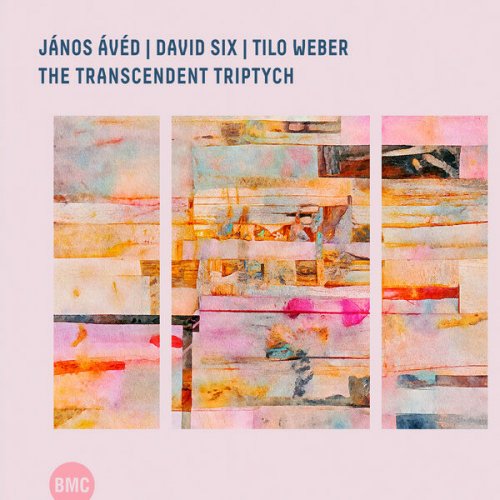
Artist: Ávéd János, Tilo Weber, David Six
Title: The Transcendent Triptych
Year Of Release: 2026
Label: BMC Records
Genre: Jazz
Quality: FLAC (tracks) / FLAC 24 Bit (88,2 KHz / tracks)
Total Time: 54:43 min
Total Size: 242 / 841 MB
WebSite: Album Preview
Tracklist:Title: The Transcendent Triptych
Year Of Release: 2026
Label: BMC Records
Genre: Jazz
Quality: FLAC (tracks) / FLAC 24 Bit (88,2 KHz / tracks)
Total Time: 54:43 min
Total Size: 242 / 841 MB
WebSite: Album Preview
01. Minta
02. David's Dream
03. Pastel
04. Da fällt es ab von ihm
05. Pastorale
06. Gólya
07. Lound
08. Kleiner Trost
09. Visszhang
10. μεταμόρφωση
What exactly does transcendence mean? In times of increasing uncertainty, the word has become almost a buzzword for the indescribable. Something that cannot be grasped, that is not worth the time or effort to explain.
A handy filler to skip over apparently superfluous derivations and chains of thought. And an alibi to escape the constraints of everyday life. The word transcendence is almost as inexplicable as the state it describes. It is the opposite of immanence, i.e. that which relates to reality. But how are we to penetrate something mentally or grasp it with words, when it lies beyond our perception and reflection? Are there actually categories for the uncategorizable?
Is transcendence perhaps a hybrid of something abstract, suspected, and sensed? Or is it much simpler? Perhaps transcendence means nothing other than transcending the individual into a generalization. Thus, transcendence would primarily be the opposite of itself, in that we relieve the concrete of its present reality in order to make it explainable, nameable and thus communicable. Because of this paradox, people back in the Middle Ages beat each other’s heads, not in the transcendental, but in the literal sense. Ultimately, transcendence and immanence are bound together, like Yin and Yang. Not only is the one not conceivable without the other, the one is the other, and in full consequence also vice versa. The supernatural (or let’s call it the inter-natural) can only be explained through nature. And everything that we cannot explain in the context of what is measurable and recordable through natural perception is therefore super- or inter-natural, i.e. transcendent. These categories of thought are naturally subject to change. The Higgs-Boson particle was transcendent until it was detected. It wasn’t called the God particle for nothing.
And that brings us to the core of the matter. We humans are not the only creatures who can make music. Whales, wolves, songbirds and cicadas are just four genera of the animal world that make music and, with their concerts, they also influence the music of humans. Animals have been shown to have a sense of harmony, with certain species even being able to distinguish octaves. Most birds and mammals have much finer hearing than we do, and are therefore considerably better at distinguishing and classifying deviations from tones and sounds. But we humans are the only beings who perceive music as music and, even more crucially, plan. Music is the only art form that, while based on the objectivity of physical sound generation, gives us the opportunity to escape from our human physis into a state of transcendence.
Austrian pianist David Six, Hungarian saxophonist János Ávéd, and German drummer and vibraphonist Tilo Weber show us how. All three musicians push the boundaries of their own selves, and transform themselves into a state that transcends mensurable coordinates such as time and space. This transcending allows for mutual interpenetration, which cancels the impulse and replaces it with the principle of all-inclusive insight, for which there are neither words nor names. Sound remains the final outlet for the manifestation of this depth of insight. We hear not a trio, but a unity in the plurality that engages us as listeners from the very first moment. This discloses the certainty that the music is already there beforehand. What presents itself as the beginning or the end in the arbitrary framework of a recording is in reality an excerpt of a perpetual continuum, a circle that continuously opens and closes, expands and contracts, so that gravity and weightlessness form a unity.
The triptych made of David Six, János Ávéd, and Tilo Weber becomes the medium. It is both the transmitter and the receiver. Each wing of this openly framed Trinity is at the same time the completed painting; every tone, every pulse, every sound, every reverberation, every pause depicts the complete album. “The Transcendent Triptych” describes the impressive process of an osmosis that is transformed the moment it is heard, and can never be the same when you listen to the album again. Because it also transcends the path from the sound source via the vibrating ether to the eardrum and from there to the musical memory. Every time we hear it, we become a little more part of the disclosure here underway, until we converge against the point where perception and remembrance cancel each other out, as do gravity and centrifugal force, sound and silence, transcendence and immanence.
David Six, János Ávéd, and Tilo Weber give their audience the unique gift of transforming themselves into music through listening.
A handy filler to skip over apparently superfluous derivations and chains of thought. And an alibi to escape the constraints of everyday life. The word transcendence is almost as inexplicable as the state it describes. It is the opposite of immanence, i.e. that which relates to reality. But how are we to penetrate something mentally or grasp it with words, when it lies beyond our perception and reflection? Are there actually categories for the uncategorizable?
Is transcendence perhaps a hybrid of something abstract, suspected, and sensed? Or is it much simpler? Perhaps transcendence means nothing other than transcending the individual into a generalization. Thus, transcendence would primarily be the opposite of itself, in that we relieve the concrete of its present reality in order to make it explainable, nameable and thus communicable. Because of this paradox, people back in the Middle Ages beat each other’s heads, not in the transcendental, but in the literal sense. Ultimately, transcendence and immanence are bound together, like Yin and Yang. Not only is the one not conceivable without the other, the one is the other, and in full consequence also vice versa. The supernatural (or let’s call it the inter-natural) can only be explained through nature. And everything that we cannot explain in the context of what is measurable and recordable through natural perception is therefore super- or inter-natural, i.e. transcendent. These categories of thought are naturally subject to change. The Higgs-Boson particle was transcendent until it was detected. It wasn’t called the God particle for nothing.
And that brings us to the core of the matter. We humans are not the only creatures who can make music. Whales, wolves, songbirds and cicadas are just four genera of the animal world that make music and, with their concerts, they also influence the music of humans. Animals have been shown to have a sense of harmony, with certain species even being able to distinguish octaves. Most birds and mammals have much finer hearing than we do, and are therefore considerably better at distinguishing and classifying deviations from tones and sounds. But we humans are the only beings who perceive music as music and, even more crucially, plan. Music is the only art form that, while based on the objectivity of physical sound generation, gives us the opportunity to escape from our human physis into a state of transcendence.
Austrian pianist David Six, Hungarian saxophonist János Ávéd, and German drummer and vibraphonist Tilo Weber show us how. All three musicians push the boundaries of their own selves, and transform themselves into a state that transcends mensurable coordinates such as time and space. This transcending allows for mutual interpenetration, which cancels the impulse and replaces it with the principle of all-inclusive insight, for which there are neither words nor names. Sound remains the final outlet for the manifestation of this depth of insight. We hear not a trio, but a unity in the plurality that engages us as listeners from the very first moment. This discloses the certainty that the music is already there beforehand. What presents itself as the beginning or the end in the arbitrary framework of a recording is in reality an excerpt of a perpetual continuum, a circle that continuously opens and closes, expands and contracts, so that gravity and weightlessness form a unity.
The triptych made of David Six, János Ávéd, and Tilo Weber becomes the medium. It is both the transmitter and the receiver. Each wing of this openly framed Trinity is at the same time the completed painting; every tone, every pulse, every sound, every reverberation, every pause depicts the complete album. “The Transcendent Triptych” describes the impressive process of an osmosis that is transformed the moment it is heard, and can never be the same when you listen to the album again. Because it also transcends the path from the sound source via the vibrating ether to the eardrum and from there to the musical memory. Every time we hear it, we become a little more part of the disclosure here underway, until we converge against the point where perception and remembrance cancel each other out, as do gravity and centrifugal force, sound and silence, transcendence and immanence.
David Six, János Ávéd, and Tilo Weber give their audience the unique gift of transforming themselves into music through listening.

![Solveig Slettahjell - Det er vi (2026) [Hi-Res]](https://img.israbox.com/img/2026-10/09/xmqre7a7s0ijly51stls4qrnk.jpg "Solveig Slettahjell - Det er vi (2026) [Hi-Res]")



![Daisy DeVell - UNDERWORLD (2026) [Hi-Res]](https://www.dibpic.com/uploads/posts/2026-10/1791891459_folder.jpg "Daisy DeVell - UNDERWORLD (2026) [Hi-Res]")