Fritz Reiner - Rarities, Volume 3 (1938-49) [2015]
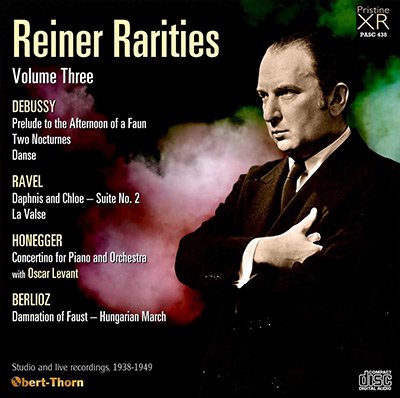
Artist: Fritz Reiner
Title: Rarities, Volume 3
Year Of Release: 1938-49 [2015]
Label: Pristine [PASC438]
Genre: Classical
Quality: FLAC (*tracks)
Total Time: 01:12:19
Total Size: 306 mb (+3%rec.)
WebSite: Album Preview
Reiner Rarities, Volume 3: Debussy, Ravel, Honegger and BerliozTitle: Rarities, Volume 3
Year Of Release: 1938-49 [2015]
Label: Pristine [PASC438]
Genre: Classical
Quality: FLAC (*tracks)
Total Time: 01:12:19
Total Size: 306 mb (+3%rec.)
WebSite: Album Preview
"This is a CD that will haunt your imagination long after you’ve heard it"- Fanfare
Like the two earlier releases in this series (PASC 235 and 294), this volume of Reiner Rarities features works which are rare in more than one sense First, these are Fritz Reiner’s only commercial recordings of the works presented. In addition, none of them have ever received an “official” CD reissue from their originating labels. The current release features all of Reiner’s French repertoire recordings which fall under these criteria.
The Debussy Faune and Nocturnes come from Reiner’s earliest issued recording session, although they were originally published without crediting the conductor or the orchestra. They were part of the “World’s Greatest Music” series recorded by RCA Victor for the New York Post, which featured similarly anonymous recordings by Ormandy and the Philadelphia and Rodzinski and the NBC Symphony.
This session featured 78 players from Barbirolli’s New York Philharmonic, and also included works by Wagner. What is particularly striking here, as in many of the recordings featured in this program, is Reiner’s pacing, allowing the music to unfold with seeming inevitability even as he moves it along, choosing tempi that seem ideal. (The uncredited flute soloist in Faune is most likely John Amans, the Philharmonic’s principal at the time.)
The broadcast of the Daphnis Suite, although not a commercial recording, was part of the series of V-Discs released by the U.S. government for the entertainment of servicemen during World War II, and falls under Reiner’s issued discography. Again, one is struck by the pacing, the judgment in the length of pauses, and the choices for when (and how much) to use string portamenti to underline emotional points.
The Pittsburgh recordings document Reiner’s decade as music director of that city’s orchestra. In La Valse, Reiner does not play his hand too early, letting loose only in the final pages (in contrast to Munch, who, for all his admitted excitement, plays it at fever pitch from the start). The Ravel orchestration of Debussy’s Danse gets an appropriately energetic performance, while the rousing Berlioz march ends with an unusual, rarely-heard diminuendo.
In 1927, Reiner conducted the U.S. première of Honegger’s 1924 single-movement Concertino, a work which seems to have been somewhat influenced by Prokofiev’s Third Concerto. The soloist, Oscar Levant, is perhaps best known today for his acting work in such films as An American in Paris, The Band Wagon and Humoresque; but in his time, he was a highly popular piano soloist specializing in twentieth century repertoire (particularly the works of his friend, George Gershwin), as well as an author, composer and raconteur.
The sources for the recordings were American Columbia LPs for La Valse and the Honegger, and shellac 78 rpm discs for the remaining items, except for the Daphnis Suite, which was taken from a tape of original off-the-air acetates, which sounded better than the V-Disc dubbings.
Tracks:
DEBUSSY Prelude to the Afternoon of a Faun - Two Nocturnes - Danse
RAVEL Daphnis and Chloe – Suite No. 2 - La Valse
HONEGGER Concertino for Piano and Orchestra
BERLIOZ Damnation of Faust – Hungarian March
Personnel:
Fritz Reiner, conductor
Oscar Levant, piano
Philharmonic-Symphony Orchestra of New York
Pittsburgh Symphony Orchestra
CBS Symphony Orchestra
Columbia Symphony Orchestra
![Fritz Reiner - Rarities, Volume 3 (1938-49) [2015]](https://www.dibpic.com/uploads/posts/2026-04/1777217418_bb.jpg)
![Scott Hamilton, Rob van Bavel, Vincent Koning, Frans van Geest - The Ghost, The King and I (High Resolution Version / Live) (2026) [Hi-Rers]](https://www.dibpic.com/uploads/posts/2026-08/1786256235_zxa6da2om5s6k_600.jpg "Scott Hamilton, Rob van Bavel, Vincent Koning, Frans van Geest - The Ghost, The King and I (High Resolution Version / Live) (2026) [Hi-Rers]")



![Nat King Cole - A Blossom Fell (1970) [Vinyl Rip]](https://www.dibpic.com/uploads/posts/2026-08/1786467430_5.jpg "Nat King Cole - A Blossom Fell (1970) [Vinyl Rip]")
![Audrey Morris - The Voice of... Audrey Morris (1956) [Hi-Res]](https://www.dibpic.com/uploads/posts/2026-08/1786381539_5.jpg "Audrey Morris - The Voice of... Audrey Morris (1956) [Hi-Res]")