The Linarol Consort, Héloïse Bernard - Epitaph for a Green Lover - Music from the Songbooks of Margaret of Austria (2026) [Hi-Res]
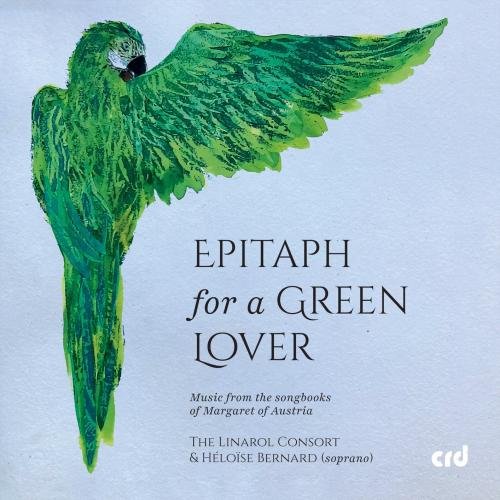
Artist: The Linarol Consort, Héloïse Bernard
Title: Epitaph for a Green Lover - Music from the Songbooks of Margaret of Austria
Year Of Release: 2026
Label: CRD
Genre: Classical
Quality: flac lossless (tracks) / flac 24bits - 96.0kHz +Booklet
Total Time: 01:10:34
Total Size: 361 mb / 1.31 gb
WebSite: Album Preview
TracklistTitle: Epitaph for a Green Lover - Music from the Songbooks of Margaret of Austria
Year Of Release: 2026
Label: CRD
Genre: Classical
Quality: flac lossless (tracks) / flac 24bits - 96.0kHz +Booklet
Total Time: 01:10:34
Total Size: 361 mb / 1.31 gb
WebSite: Album Preview
01. Tous les regretz
02. Belle pour l'amour de vous
03. Si sumpsero
04. Vray Dieu qui me confortera
05. L'Esperance de Bourbon
06. Petite camusette
07. Doleo super te
08. Plus nulz regretz
09. La Danse de Cleves
10. Mijn hert altijt heeft verlanghen
11. Me fauldra il
12. Il me fait mal
13. La Spagna
14. Du tout plongiet
15. Soubz ce tumbel (Epitaphe de l'amant vert)
16. Que vous madame
17. Sy dedero
18. Plaine de dueil
19. Dulces exuviae
20. Cueurs desolez par toute nation
Many performers have been inspired by the personality and life of Margaret of Austria and several recordings have been devoted to music which can in one way or another be connected to her. Most of the repertoire was written by the best composers of her time and much of it is rather sad, reflecting her tragic life. Thus, one disc bears the title “Doleo”, “I am distressed” or “I grieve”, the first word of the motet Doleo super te by Pierre de La Rue, Margaret’s favourite composer. Margaret had every reason to be distressed. She was born in 1480 as the daughter of emperor Maximilian I and Mary of Burgundy. Misery started early, when her mother was killed in a hunting accident when Margaret was just two years of age. She was supposed to marry Charles VIII, but was renounced by him for political reasons and married John of Castile instead, but he died within a year after their marriage. Two months later Margaret suffered a miscarriage. She then married Philibert of Savoy, but he died after only three years. Shortly afterwards her brother, Philip the Handsome, died as well, and as a result she became governor of the Habsburg-Burgundian Netherlands in 1507, a region she ruled for 23 years.
During her reign, the court in Brussels developed into a centre of the arts. Margaret herself was artistically gifted: she danced, sang, played several instruments and wrote poetry. She also collected paintings by some of the most famous painters of her time, like Jan van Eyk and Hieronymus Bosch. Pierre de La Rue who had already served other Habsburgs, like Maximilian and Philip the Good, had a special position at the court. The large number of his compositions present in Margaret’s songbooks bear witness to that. He also set some of Margaret’s poems to music. He was a composer of great repute; his compositions have been found in many regions in Europe. Many of his chansons reflect the sadness which dominated Margaret’s life.
The present disc offers a programme of music that can be connected to the various stages of Margaret’s life. The booklet includes a biography, with references to the various pieces in the programme. It is a bit odd that they are not performed in chronological order. The pieces that embrace the programme give a good idea of the world of Margaret. It opens with Tous les regretz by Antoine Brumel, a specimen of a “compositional tradition of ‘regrets-chansons'”, as the liner-notes put it. The text says: “All the anguish that ever was in the world, comes to me wherever I am. Take my heart in its deep pain and break it so that my lady may see it.” The chanson Cueurs desolez par toute nation is a fitting end: “Afflicted hearts of all nations, take on mourning and lamentation! Seek no longer the harmonious lyre of Orpheus to proclaim your joy, but be plunged into desolation.”
The programme includes two epitaphs: one Margaret wrote for her brother Philippe: “Doleo super te, frater mi Philippe, Rex optime.” As this seems not to have been set to music, we get here a setting of David’s lamentation on the death of Saul and Jonathan by La Rue, which opens with the same words. This episode undoubtedly inspired Magaret in writing her epitaph. The other is also of by La Rue: Soubz ce tumbel. It is a setting of the last verse of a poem by the court poet Jean Lemaire about Margaret’s beloved green parrot, which gave the disc its title. Margaret had inherited the bird from her mother. “She became very attached to the bird, which apparently had a large vocabulary. During a visit to her father in Germany the parrot, still in Flanders, died. In Lemaire’s poem, Les Épîtres de l’amant vert, the green lover laments his mistress’ absence, contemplating suicide. Finally, the pitiless bird calls to his mistress from his tomb.” That is the text La Rue set.
We are in the middle of the Renaissance, when almost everyone was a Christian believer. Where is the religious aspect in all this misery? I have already mentioned Margaret’s epitaph on her brother, written under the inspiration of David’s lament. There is more. Sacred music was an important part of courtly life. La Rue was Margaret’s favourite composer and six of his masses are in the so-called ‘Mechelen Choirbook’, also known as the Choirbook of Margaret of Austria, created in the workshop of Petrus Alamire. It was performed in its entirety during the Festival Early Music Utrecht 2025. The sacred element is not an important part of this programme, as The Linarol Consort focuses on the two songbooks, which are obviously dominated by secular pieces. Even so, there are some sacred works. One of them is Jacob Obrecht’s motet Si sumpsero, which quotes a verse of Psalm 139, and another one is Alexander Agricola’s Sy dedero, which quotes Psalm 132. However, this is only revealed in the liner-notes, as both pieces are performed instrumentally.
It should also be noted that at that time the sacred and the secular were not strictly separated compartments. References to God can be found in secular pieces, such as Vray Dieu qui me confortera by Antoine Bruhier: “Dear God, who shall comfort me when by a false villain I am held locked in this room alone?” The second stanza of Margaret’s Me fauldra il, set by an anonymous composer, opens thus: “I pray to God that he may give me strength, I swear by my faith, that to this I am accustomed (…).” Cueurs désoléz has a second text, taken from the Lamentations of Jeremiah, but as only the French text is sung, one needs the liner-notes to know that. According to the liner-notes, the French text was written by Margaret, but I have not found any evidence of that. Moreover, it is of doubtful authenticity: it has been excluded from the New Josquin Edition for stylistic reasons.
Lastly, although La Rue was from the southern Netherlands, he seems to have written hardly any songs in Dutch. The programme includes the only ‘authentic’ Dutch song, Mijn hert altijt heeft verlanghen. It should be noted that Margaret may have had some passive knowledge of Dutch, but she very likely did not speak it herself.
All the pieces on this disc, except the dances, are vocal. They are performed in two different ways. Some, as has been mentioned, receive an instrumental performance by a consort of viols. That was a very common way to perform them, but – as noted – the result is that the content of a piece is hidden. The second option followed here is that one voice – mostly the upper part – is sung, whereas the other parts are performed by instruments, here again viols. As we are here in the time of the stile antico, all the voices are treated on equal footing. That said, in some pieces the upper voice starts a little after the others, which gives it a kind of solo role. However, basically the singer should not act as soloist. In these performances the balance differs: in some items it is just as it should be, whereas in others I find Héloïse Bernard a bit too dominant, for instance in Plus nulz regretz by Josquin Desprez. It may be that she wanted to sing with expression, but exactly that is not required here. By the way, whereas in many recordings only a part of this chanson is performed, here we get the whole piece, which deserves much praise. Ms Bernard has a very fine voice, which is perfectly suited to this repertoire. I have very much enjoyed her contributions. It is nice that she uses a historical pronunciation. The fact that she has been studying in the Netherlands may explain her good pronunciation of La Rue’s Dutch song. Here and there I noticed a flutter in her voice, which I find regrettable, but did not bother me that much.
The Linarol Consort delivers excellent performances. The ensemble is immaculate. It helps that they play the same kind of instruments: all of them were built by Richard Jones, who copied the only surviving viol of Francesco Linarol from Venice (which explains the ensemble’s name). Although it is a consort of viols, apparently its members also play the recorder, as a few pieces are played on recorders, which affords some additional variety.
To sum up: this is a compelling musical survey of the world of Margaret of Austria. Her life may have been tragic, but it has been the inspiration of some of the finest music of the Renaissance.

![NORSIDE - Coal & Soul (2026) [Hi-Res]](https://img.israbox.com/img/2026-07/14/u9tu5iei63mereti5f7cokfl2.jpg "NORSIDE - Coal & Soul (2026) [Hi-Res]")
![Betty Buckley - Enough (Live at Joe's Pub) (2026) [Hi-Res]](https://img.israbox.com/img/2026-07/16/0tqmn5gfkaoitg35o5y570hyf.jpg "Betty Buckley - Enough (Live at Joe's Pub) (2026) [Hi-Res]")