Miguel Ulla, Fernando Reyes - Galicia Eterna (2026) [Hi-Res]
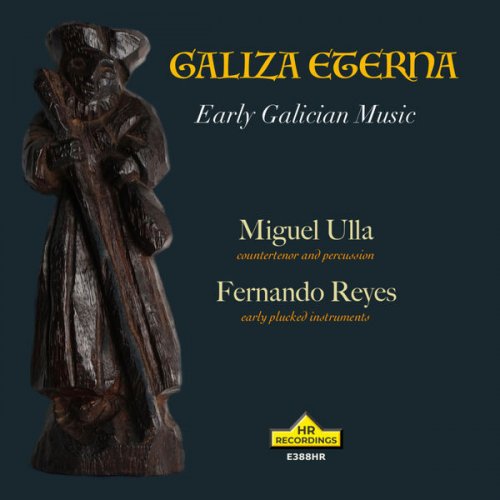
Artist: Miguel Ulla, Fernando Reyes
Title: Galicia Eterna
Year Of Release: 2026
Label: HR Recordings
Genre: Classical
Quality: flac lossless (tracks) / flac 24bits - 192.0kHz +Booklet
Total Time: 00:47:03
Total Size: 193 mb / 1.35 gb
WebSite: Album Preview
TracklistTitle: Galicia Eterna
Year Of Release: 2026
Label: HR Recordings
Genre: Classical
Quality: flac lossless (tracks) / flac 24bits - 192.0kHz +Booklet
Total Time: 00:47:03
Total Size: 193 mb / 1.35 gb
WebSite: Album Preview
01. Cantiga de Santa Maria nº 90 , Sola fusti senlleira
02. Jacobe sancte
03. Cantíga de Santa Maria nº100 , Santa María Strela do Día
04. Ondas do mar de Vigo
05. Dum Pater familias
06. Danza. O Rosal, Tui , Cancionero Castro San Pedro nº 388
07. Folías Gallegas
08. Adios non ti non mo digas
09. Camiña a Virxen pura
10. Aldea de Carramales. Foliada
11. Sancte Jaco a Compostel
12. Canto de Ultreia
13. Vox Clamantis
14. Ductus est
Galiza eterna was born from the desire to give voice to Galicia’s musical heritage from a living historical perspective that is in constant resonance with the present. The journey proposed by this album begins with medieval music, both written in Old Galician by key figures such as Martín Codax and Alfonso X, and pieces from the Codex Calixtinus, an essential testimony to the sound universe linked to Galicia and its “Camino de Santiago”. From this starting point, the journey extends to the Baroque period, tracing a musical arc that spans centuries of creation and memory.
Along this musical path we find the chaconne ‘Sante Jaco’, collected by William Wey, an English pilgrim who heard it in 1456, performed by children dancing in front of the cathedral. Its musical structure, clearly identifiable as a chaconne, challenges traditional musicological approaches to the origin of this dance and points to Galicia and its “Camino de Santiago” as one of its possible places of origin.
The exploration of the Galician folk songbook also reveals that, based on the melodies transmitted by oral tradition, it is possible to construct arrangements based on Baroque dances, returning them to a context that, in all likelihood, connects with a much more distant past. The journey culminates with the music of Diego de las Muelas, composer and chapel master of Santiago Cathedral, thus bringing to a close a journey that, although chronologically spanning from the Middle Ages to the Baroque period, remains alive in Galicia’s musical memory.
This entire repertoire is performed accompanied by reproductions of historical instruments from the periods covered: medieval citterns, theorboes, lutes, Baroque guitars and various percussion instruments, which help to recreate the original sound and reinforce the evocative nature of this journey through time.

![Weather Report - Domino Theory (1984) [Vinyl]](https://www.dibpic.com/uploads/posts/2026-07/1784025425_0888880810519_600.jpg "Weather Report - Domino Theory (1984) [Vinyl]")
![Yotam Ishay - SPROUT (2023) [Hi-Res]](https://www.dibpic.com/uploads/posts/2026-07/1784194867_a2447954829_10.jpg "Yotam Ishay - SPROUT (2023) [Hi-Res]")